

PID Controllers
Description

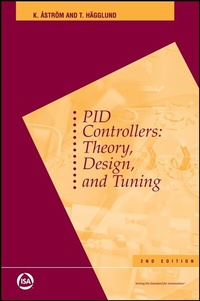
PID Controllers: Theory, Design, and Tuning, 2nd Edition
Greatly expanded over the first edition, this book addresses new developments in digital PID controllers and shares the authors' experiences in designing and applying controllers. It presents modeling methods, implementation details, and problem-solving techniques to improve loop performance and product quality; examines the auto-tuning and adaptation features of several commercial controllers; and provides measures for dealing with specific challenges, such as reset windup, long process dead times, and oscillatory systems. The authors also recommend design methods and tuning rules that consider factors such as load disturbances, measurement noise, model uncertainty, and set point response.
More details
Other editions
Additional editions
Content
1. Introduction 1
2. Process Models 5
2.1 Introduction 5
2.2 Static Models 6
2.3 Dynamic Models 8
2.4 Step Response Methods 11
2.5 Methods of Moments 24
2.6 Frequency Responses 34
2.7 Parameter Estimation 43
2.8 Disturbance Models 46
2.9 Approximate Models and Unmodeled Dynamics 51
2.10 Conclusions 57
2.11 References 58
3. PID Control 59
3.1 Introduction 59
3.2 The Feedback Principle 60
3.3 PID Control 64
3.4 Modifications of the PID Algorithm 70
3.5 Integrator Windup 80
3.6 Digital Implementation 93
3.7 Operational Aspects 103
3.8 Commercial Controllers 108
3.9 When Can PID Control Be Used? 109
3.10 Conclusions 116
3.11 References 117
4. Controller Design 120
4.1 Introduction 120
4.2 Specifications 121
4.3 Ziegler-Nichols' and Related Methods 134
4.4 Loop Shaping 151
4.5 Analytical Tuning Methods 156
4.6 Optimization Methods 164
4.7 Pole Placement 164
4.8 Dominant Pole Design 179
4.9 Design for Disturbance Rejection 193
4.10 Conclusions 196
4.11 References 197
5. New Tuning Methods 200
5.1 Introduction 200
5.2 A Spectrum of Tools 201
5.3 Step-Response Methods 203
5.4 Frequency-Response Methods 212
5.5 Complete Process Knowledge 218
5.6 Assessment of Performance 220
5.7 Examples 225
5.8 Conclusions 227
5.9 References 229
6. Automatic Tuning and Adaptation 230
6.1 Introduction 230
6.2 Process Knowledge 232
6.3 Adaptive Techniques 232
6.4 Model-Based Methods 237
6.5 Rule-Based Methods 241
6.6 Commercial Products 243
6.7 Integrated Tuning and Diagnosis 262
6.8 Conclusions 270
6.9 References 270
7. Control Paradigms 273
7.1 Introduction 273
7.2 Cascade Control 274
7.3 Feedforward Control 281
7.4 Model Following 284
7.5 Nonlinear Elements 287
7.6 Neural Network Control 295
7.7 Fuzzy Control 298
7.8 Interacting Loops 304
7.9 System Structuring 313
7.10 Conclusions 321
7.11 References 321
Bibliography 323
Index 339
