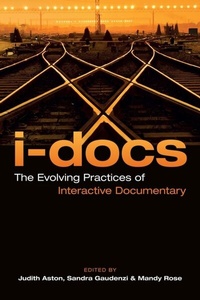
I-Docs
Description
Alles über E-Books | Antworten auf Fragen rund um E-Books, Kopierschutz und Dateiformate finden Sie in unserem Info- & Hilfebereich.
All prices
More details
Other editions
Additional editions

Persons
Content
Acknowledgments Notes on Contributors Foreword, by Brian Winston Introduction, by Judith Aston, Sandra Gaudenzi, Mandy Rose Part 1. Co-Creation Preface, by Mandy Rose 1. I-docs and the documentary tradition: exploring questions of engagement, by Kate Nash 2. Co-creation as talkback: using the collaborative and interactive docu-forms to (re)imagine the 'rape-city', by Anandana Kapur 3. Documentary as co-creative practice: From Challenge for Change to Highrise - Kat Cizek in conversation with Mandy Rose, edited by Anna Wiehl 4. Not media about, but media with: co-creation for activism, by Mandy Rose 5. Living collaborations in Los Sures, Brooklyn: 1984 and today, by Christopher Allen 6. Software as co-creator in interactive documentary, by Craig Hight Part 2. Methods Preface, by Sandra Gaudenzi 7. Evaluating users' experiences: a case study approach to improving i-doc UX Design, by Samuel Gantier and Michel Labour 8. User experience versus author experience: lessons learned from the UX Series, by Sandra Gaudenzi 9. Pushing the craft forward: the POV Hackathon as a collaborative approach to making an interactive documentary, by Jess Linington 10. The Learn Do Share design methodology: Lance Weiler in conversation, by Sandra Gaudenzi 11. Testing and evaluating design prototypes: the case study of Avatar Secrets, by Ramona Pringle 12. Look who's watching: what storytellers can learn from privacy and personalisation, by Ben Moskowitz Part 3. Horizons Preface, by Judith Aston 13. Things to come: the possible futures of documentary ... from a historical perspective, by William Uricchio 14. Towards behavioural realism: experiments in immersive journalism, by Nonny de la Peña 15. Interactive documentary and live performance: from embodied to emplaced interaction, by Judith Aston 16. The travelling i-doc: reflections on the meaning of interactive documentary-based image-making practices in contemporary India, by Paolo Favero 17. Interactive documentary aquí y ahora - here & now: themes and directions in South America, by Arnau Gifreu-Castells 18. Who wants to become banal?: the i-doc from experiment to industry, by Jon Dovey Index

System requirements
File format: ePUB
Copy protection: Adobe-DRM (Digital Rights Management)
System requirements:
- Computer (Windows; MacOS X; Linux): Install the free reader Adobe Digital Editions prior to download (see eBook Help).
- Tablet/smartphone (Android; iOS): Install the free app Adobe Digital Editions or the app PocketBook before downloading (see eBook Help).
- E-reader: Bookeen, Kobo, Pocketbook, Sony, Tolino and many more (not Kindle).
The file format ePub works well for novels and non-fiction books – i.e., „flowing” text without complex layout. On an e-reader or smartphone, line and page breaks automatically adjust to fit the small displays.
This eBook uses Adobe-DRM, a „hard” copy protection. If the necessary requirements are not met, unfortunately you will not be able to open the eBook. You will therefore need to prepare your reading hardware before downloading.
Please note: We strongly recommend that you authorise using your personal Adobe ID after installation of any reading software.
For more information, see our ebook Help page.
File format: PDF
Copy-Protection: Adobe-DRM (Digital Rights Management)
System requirements:
- Computer (Windows; MacOS X; Linux): Install the free reader Adobe Digital Editions prior to download (see eBook Help).
- Tablet/smartphone (Android; iOS): Install the free app Adobe Digital Editions or the app PocketBook before downloading (see eBook Help).
- E-reader: Bookeen, Kobo, Pocketbook, Sony, Tolino and many more (only limited: Kindle).
The file format PDF always displays a book page identically on any hardware. This makes PDF suitable for complex layouts such as those used in textbooks and reference books (images, tables, columns, footnotes). Unfortunately, on the small screens of e-readers or smartphones, PDFs are rather annoying, requiring too much scrolling.
This eBook uses Adobe-DRM, a „hard” copy protection. If the necessary requirements are not met, unfortunately you will not be able to open the eBook. You will therefore need to prepare your reading hardware before downloading.
Please note: We strongly recommend that you authorise using your personal Adobe ID after installation of any reading software.
For more information, see our eBook Help page.
File format: ePUB
Copy protection: Watermark-DRM (Digital Rights Management)
System requirements:
- Computer (Windows; MacOS X; Linux): Use a reading software that can process the file format ePUB: e.g., Adobe Digital Editions or FBReader – both free (see eBook Help).
- Tablet/Smartphone (Android; iOS): Before downloading, install the free app Adobe Digital Editions (see eBook Help).
- E-reader: Bookeen, Kobo, Pocketbook, Sony, Tolino and many more (not Kindle).
The file format ePUB works well for novels and non-fiction books – i.e., „flowing” text without complex layout. On an e-reader or smartphone, line and page breaks automatically adjust to fit the small displays.
This eBook uses Watermark-DRM, a „soft” copy protection. This means that there are no technical restrictions to prevent illegal distribution. However, there is a personalised watermark embedded in the eBook that can be used to identify the purchaser of the eBook in the event of misuse and to provide evidence for legal purposes.
For more information, see our eBook Help page.