

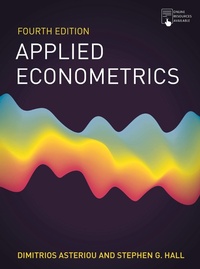
Applied Econometrics
4th Edition
Published on 5. March 2021
536 pages
978-1-350-30614-1 (ISBN)
Description

This trusted textbook returns in its 4th edition with even more exercises to help consolidate understanding - and a companion website featuring additional materials, including a solutions manual for instructors. Offering a unique blend of theory and practical application, it provides ideal preparation for doing applied econometric work as it takes students from a basic level up to an advanced understanding in an intuitive, step-by-step fashion. Clear presentation of economic tests and methods of estimation is paired with practical guidance on using several types of software packages. Using real world data throughout, the authors place emphasis upon the interpretation of results, and the conclusions to be drawn from them in econometric work.
This book will be essential reading for economics undergraduate and master's students taking a course in applied econometrics. Its practical nature makes it ideal for modules requiring a research project.
New to this Edition:
- Additional practical exercises throughout to help consolidate understanding
- A freshly-updated companion website featuring a new solutions manual for instructors
This book will be essential reading for economics undergraduate and master's students taking a course in applied econometrics. Its practical nature makes it ideal for modules requiring a research project.
New to this Edition:
- Additional practical exercises throughout to help consolidate understanding
- A freshly-updated companion website featuring a new solutions manual for instructors
More details
Edition
4th edition
Language
English
Place of publication
London
United Kingdom
Publishing group
Bloomsbury Publishing PLC
Target group
College/higher education
ISBN-13
978-1-350-30614-1 (9781350306141)
Copyright in bibliographic data and cover images is held by Nielsen Book Services Limited or by the publishers or by their respective licensors: all rights reserved.
Schweitzer Classification
Other editions
Additional editions
Dimitrios Asteriou | Stephen G. Hall
Applied Econometrics
Book
03/2021
4th Edition
Bloomsbury Academic
€81.00
Shipment within 15-20 days
Persons
Dimitrios Asteriou is Research Lead in Economics, Finance and Accounting at Oxford Brookes University. He completed his PhD in Economics at City University and he holds both an MSc and a BSc in Economics from the University of Macedonia, Greece. His research interests lie in the area of applied economics, with a focus on economic growth, financial econometrics and the econometrics of panel data. He has published more than 60 research papers in peer-reviewed journals.
Stephen G. Hall is Head of Division and Professor of Economics at Leicester University and Visiting Professor at Pretoria University. He has worked extensively in the areas of econometrics and macro economic modelling. He began his career at the National Institute of Economic and Social Research, London, where he worked on the development of the UK model and a range of methodological and econometric issues. He then moved to the Bank of England as an Economic Advisor for 4 years where he continued working in the area of econometrics and modelling. He then became Director of Research and Professorial Fellow at the Centre for Economic Forecasting at London Business School where he was in charge of the development of the LBS UK model. He then moved to be Professor of Economics at Imperial College, London, and in 2005 he took up his current post. He has published 6 books, and over 250 articles on economic modelling, applied econometrics and forecasting. His editorial and other activities include being, editor of Economic Modelling, an executive Committee member of the United Nations Project Link and on the editorial board of a number of journals. He holds an honorary doctorate from the University of Pretoria, South Africa, and is a fellow of the African Econometric Society and an honorary member of the Romanian Academy of Science.
Stephen G. Hall is Head of Division and Professor of Economics at Leicester University and Visiting Professor at Pretoria University. He has worked extensively in the areas of econometrics and macro economic modelling. He began his career at the National Institute of Economic and Social Research, London, where he worked on the development of the UK model and a range of methodological and econometric issues. He then moved to the Bank of England as an Economic Advisor for 4 years where he continued working in the area of econometrics and modelling. He then became Director of Research and Professorial Fellow at the Centre for Economic Forecasting at London Business School where he was in charge of the development of the LBS UK model. He then moved to be Professor of Economics at Imperial College, London, and in 2005 he took up his current post. He has published 6 books, and over 250 articles on economic modelling, applied econometrics and forecasting. His editorial and other activities include being, editor of Economic Modelling, an executive Committee member of the United Nations Project Link and on the editorial board of a number of journals. He holds an honorary doctorate from the University of Pretoria, South Africa, and is a fellow of the African Econometric Society and an honorary member of the Romanian Academy of Science.
Content
PART I: STATISTICAL BACKGROUND AND BASIC DATA HANDLING
1. Fundamental Concepts
2. The Structure Of Economic Data and Basic Data Handling
PART II: THE CLASSICAL LINEAR REGRESSION MODEL
3. Simple Regression
4. Multiple Regression
PART III: VIOLATING THE ASSUMPTIONS OF THE CLRM
5. Multicollinearity
6. Heteroskedasticity
7. Autocorrelation
8. Misspecification: Wrong Regressors, Measurement Errors And Wrong Functional Forms
PART IV: TOPICS IN ECONOMETRICS
9. Dummy Variables
10. Dynamic Econometric Models
11. Simultaneous Equation Models
12. Limited Dependent Variable Regression Models
PART V: TIME SERIES ECONOMETRICS
13. ARIMA Models And The Box-Jenkins Methodology
14. Modelling The Variance: ARCH-GARCH Models
15. Vector Autoregressive(VAR) Models And Causality Tests
16. Non-Stationarity and Unit Root Tests
17. Cointegration and Error-Correction Models
18. Identification In Standard and Cointegrated Systems
19. Solving Models
20. Time Varying Coefficient Models: A New Way of Estimating Bias Free Parameters
PART VI: PANEL DATA ECONOMETRICS
21. Traditional Panel Data Models
22. Dynamic Heterogeneous Panels
23. Non-Stationary Panels
PART VII: USING ECONOMETRIC SOFTWARE
24. Practicalities in Using Eviews and Stata.
1. Fundamental Concepts
2. The Structure Of Economic Data and Basic Data Handling
PART II: THE CLASSICAL LINEAR REGRESSION MODEL
3. Simple Regression
4. Multiple Regression
PART III: VIOLATING THE ASSUMPTIONS OF THE CLRM
5. Multicollinearity
6. Heteroskedasticity
7. Autocorrelation
8. Misspecification: Wrong Regressors, Measurement Errors And Wrong Functional Forms
PART IV: TOPICS IN ECONOMETRICS
9. Dummy Variables
10. Dynamic Econometric Models
11. Simultaneous Equation Models
12. Limited Dependent Variable Regression Models
PART V: TIME SERIES ECONOMETRICS
13. ARIMA Models And The Box-Jenkins Methodology
14. Modelling The Variance: ARCH-GARCH Models
15. Vector Autoregressive(VAR) Models And Causality Tests
16. Non-Stationarity and Unit Root Tests
17. Cointegration and Error-Correction Models
18. Identification In Standard and Cointegrated Systems
19. Solving Models
20. Time Varying Coefficient Models: A New Way of Estimating Bias Free Parameters
PART VI: PANEL DATA ECONOMETRICS
21. Traditional Panel Data Models
22. Dynamic Heterogeneous Panels
23. Non-Stationary Panels
PART VII: USING ECONOMETRIC SOFTWARE
24. Practicalities in Using Eviews and Stata.
