

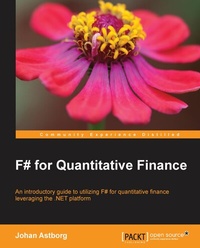
F# for Quantitative Finance
An introductory guide to utilizing F# for quantitative finance leveraging the .NET platform
Published on 13. January 2025
286 pages
978-1-78216-463-0 (ISBN)
Description

An introductory guide to utilizing F# for quantitative finance leveraging the .NET platform
Key Features
Learn functional programming with an easy-to-follow combination of theory and tutorials
Build a complete automated trading system with the help of code snippets
Use F# Interactive to perform exploratory development
Leverage the .NET platform and other existing tools from Microsoft using F#
Book DescriptionF# is a functional programming language that allows you to write simple code for complex problems. Currently, it is most commonly used in the financial sector. Quantitative finance makes heavy use of mathematics to model various parts of finance in the real world. If you are interested in using F# for your day-to-day work or research in quantitative finance, this book is a must-have.This book will cover everything you need to know about using functional programming for quantitative finance. Using a functional programming language will enable you to concentrate more on the problem itself rather than implementation details. Tutorials and snippets are summarized into an automated trading system throughout the book.This book will introduce you to F#, using Visual Studio, and provide examples with functional programming and finance combined. The book also covers topics such as downloading, visualizing and calculating statistics from data. F# is a first class programming language for the financial domain.What you will learn
Use Visual Studio as your main tool for writing F#
Utilize F# to aggregate data and calculate statistics
Plot and visualize data in F#
Learn about volatility, delta hedging, and volatility arbitrage
Understand basic numerical analysis and algorithm implementation
Model orders and market data together with basic pre-trade risk
Structure and write object-oriented code
Develop larger programs using F#
Explore automated trading systems and quantitative trading models
Who this book is forIf you are a practitioner of quantitative finance, economics, or mathematics and wish to learn F#, then this book is for you. You may have a basic conceptual understanding of financial concepts and models, but no previous knowledge is expected.
Key Features
Learn functional programming with an easy-to-follow combination of theory and tutorials
Build a complete automated trading system with the help of code snippets
Use F# Interactive to perform exploratory development
Leverage the .NET platform and other existing tools from Microsoft using F#
Book DescriptionF# is a functional programming language that allows you to write simple code for complex problems. Currently, it is most commonly used in the financial sector. Quantitative finance makes heavy use of mathematics to model various parts of finance in the real world. If you are interested in using F# for your day-to-day work or research in quantitative finance, this book is a must-have.This book will cover everything you need to know about using functional programming for quantitative finance. Using a functional programming language will enable you to concentrate more on the problem itself rather than implementation details. Tutorials and snippets are summarized into an automated trading system throughout the book.This book will introduce you to F#, using Visual Studio, and provide examples with functional programming and finance combined. The book also covers topics such as downloading, visualizing and calculating statistics from data. F# is a first class programming language for the financial domain.What you will learn
Use Visual Studio as your main tool for writing F#
Utilize F# to aggregate data and calculate statistics
Plot and visualize data in F#
Learn about volatility, delta hedging, and volatility arbitrage
Understand basic numerical analysis and algorithm implementation
Model orders and market data together with basic pre-trade risk
Structure and write object-oriented code
Develop larger programs using F#
Explore automated trading systems and quantitative trading models
Who this book is forIf you are a practitioner of quantitative finance, economics, or mathematics and wish to learn F#, then this book is for you. You may have a basic conceptual understanding of financial concepts and models, but no previous knowledge is expected.
All prices
More details
Edition
Digital original
Language
English
Place of publication
Birmingham
United Kingdom
Target group
US School Grade: College Graduate Student
Edition type
Digital original
File size
3,85 MB
ISBN-13
978-1-78216-463-0 (9781782164630)
Copyright in bibliographic data and cover images is held by Nielsen Book Services Limited or by the publishers or by their respective licensors: all rights reserved.
Schweitzer Classification
Other editions
Additional editions
Johan Astborg
F# for Quantitative Finance
Book
12/2013
Packt Publishing
€56.00
Shipment within 3-4 weeks
Person
Astborg Johan :
Johan Astborg is the developer and architect of various kinds of software systems and applications, financial software systems, trading systems, as well as mobile and web applications. He is interested in computer science, mathematics, and quantitative finance, with a special focus on functional programming. Johan is passionate about languages such as F#, Clojure, and Haskell, and operating systems such as Linux, Mac OS X, and Windows for his work. Most of Johan's quantitative background comes from Lund University, where he studied courses in computer science, mathematics, and physics. Currently Johan is studying pure mathematics at Lund University, Sweden, and is aiming for a PhD in the future, combining mathematics and functional programming. Professionally, Johan has worked as a part-time developer for Sony Ericsson and various smaller firms in Sweden. He also works as a part-time consultant focusing on web technologies and cloud solutions. You can easily contact him by sending an e-mail to joastbg@gmail.com or visit his GitHub page at https://github.com/joastbg.
Johan Astborg is the developer and architect of various kinds of software systems and applications, financial software systems, trading systems, as well as mobile and web applications. He is interested in computer science, mathematics, and quantitative finance, with a special focus on functional programming. Johan is passionate about languages such as F#, Clojure, and Haskell, and operating systems such as Linux, Mac OS X, and Windows for his work. Most of Johan's quantitative background comes from Lund University, where he studied courses in computer science, mathematics, and physics. Currently Johan is studying pure mathematics at Lund University, Sweden, and is aiming for a PhD in the future, combining mathematics and functional programming. Professionally, Johan has worked as a part-time developer for Sony Ericsson and various smaller firms in Sweden. He also works as a part-time consultant focusing on web technologies and cloud solutions. You can easily contact him by sending an e-mail to joastbg@gmail.com or visit his GitHub page at https://github.com/joastbg.
Content
Table of Contents

