

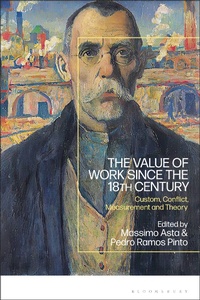
The Value of Work since the 18th Century
Custom, Conflict, Measurement and Theory
1st Edition
Published on 27. July 2023
348 pages
978-1-350-33209-6 (ISBN)
Description

Beginning in the 18th century, a turning point in labour history as work encountered an industrialising modernity, this book explores how different forms of work have been valued up to the present day. Focusing on the cultural, intellectual, social and political implications of wages, the chapters in this collection historicise the labour market, conceiving it as complex system of social relations which evolve through time and differ according to space. They show how the level of wages and other forms of remuneration reflect not only marginal productivity and scarcity but also the nature of work relations and wider political, social and economic circumstances.
With examples ranging across several centuries and different parts of the globe, it shows how wages are influenced by the specific organization and processes of work, conflict and power, social status and hierarchies between workers, custom and identity, family structure and professional ethics, ideology, politics and policy. Combining quantitative and qualitative approaches The Value of Work since the 18th Century also addresses two interlinked questions; how did theoretical interpretations and techniques of wage measurement emerge and evolve, and to what extent does this matter in understanding the social and political history of work?
With examples ranging across several centuries and different parts of the globe, it shows how wages are influenced by the specific organization and processes of work, conflict and power, social status and hierarchies between workers, custom and identity, family structure and professional ethics, ideology, politics and policy. Combining quantitative and qualitative approaches The Value of Work since the 18th Century also addresses two interlinked questions; how did theoretical interpretations and techniques of wage measurement emerge and evolve, and to what extent does this matter in understanding the social and political history of work?
More details
Edition
1. Auflage
Language
English
Place of publication
London
United Kingdom
Publishing group
Bloomsbury Publishing PLC
Target group
Professional and scholarly
Illustrations
10 bw illus
ISBN-13
978-1-350-33209-6 (9781350332096)
Copyright in bibliographic data and cover images is held by Nielsen Book Services Limited or by the publishers or by their respective licensors: all rights reserved.
Schweitzer Classification
Other editions
Additional editions
Massimo Asta | Pedro Ramos Pinto
The Value of Work since the 18th Century
Custom, Conflict, Measurement and Theory
Book
05/2025
Bloomsbury Academic
€44.90
Shipment within 15-20 days
Massimo Asta | Pedro Ramos Pinto
The Value of Work since the 18th Century
Custom, Conflict, Measurement and Theory
Book
09/2023
Bloomsbury Academic
€126.28
Shipment within 15-20 days
Persons
Massimo Asta is research fellow (FCSH/IN2PAST) at the Contemporary History Institute of Nova University of Lisbon, Portugal, affiliated lecturer at the faculty of history of the University of Cambridge, and research associate at Robinson College, Cambridge. His current research explores the interweaving between left-wing political engagement, profession and economic ideas in France, United Kingdom, Italy, and German-speaking countries from the 1870s to the 1930s.
Pedro Ramos Pinto is Associate Professor in International Economic History at the University of Cambridge, UK, where he has taught since 2013. His work focuses on the historical origins and reproduction of inequality, with a particular focus on the history and politics of measurement. He is the co-editor of The History of Universal Basic Income (2021) and is currently working on a book titled, Inequality: A Global History.
Pedro Ramos Pinto is Associate Professor in International Economic History at the University of Cambridge, UK, where he has taught since 2013. His work focuses on the historical origins and reproduction of inequality, with a particular focus on the history and politics of measurement. He is the co-editor of The History of Universal Basic Income (2021) and is currently working on a book titled, Inequality: A Global History.
Content
Introduction: Exploring the Political Economy of Wages - Massimo Asta and Pedro Ramos Pinto, (University of Cambridge, UK)
Part I: Custom and Conflict
1. Conceptualising the Earnings of Wool Spinners in England before Industrialisation, Craig Muldrew, (University of Cambridge, UK)
2. Wage Practices at a Red Bread Factory (Ghent, 1880-1914), Peter Scholliers, (Vrije Universiteit Brussels, Belgium)
3. Papers and Wages: Identity Documents and Work in Habsburg Austria During the Late 19th and Early 20th Century, Sigrid Wadauer, (University of Vienna, Austria)
4. Custom, Wages and Hobsbawm's 'Rule of the Game': New Perspectives on 18th Century Wages, Judy Z. Stephenson, (University College London, UK)
5. Regulating Wage, Realising Rights: Domestic Workers in India, Samita Sen, (University of Cambridge, UK)
6. Enumerating Fairness: Wages and Labour Contractors in Pre-1949 China, Limin Teh, (Leiden University, Netherlands)
7. Everywhere but in the Strike Statistics? Wage Systems and Work Stoppages in Sweden 1863-1927, Tobias Karlsson, (Lund University, Sweden)
Part II: Measurement and Theory
8. From Poverty Lines to Minimum Wages: Commensuration Struggles in Apartheid South Africa, Grace Davie, (Queens College CUNY, USA)
9. Wages Measurement in the Belgian Congo and French sub-Saharan Africa from 1919 to Independence: A Challenge?', Béatrice Touchelay, (Lille University, France)
10. Down with the Caro-Vita! A Social and Intellectual History of the Cost of Living Statistics in Italy, 1910s-1930s, Massimo Asta, (University of Cambridge, UK)
11. Adam Smith on Wages and Labour: Social Norm and Institutions as Necessary Limits to Competition, Antonella Stirati, (Roma Tre University, Italy)
12. Devaluing Labour and Radical Theories of Worker Discrimination in North America in the Late 20th Century, Tiago Mata, (University College London, UK)
13. Rethinking the Concept of the Living Wage: Ontological Presuppositions for Emancipatory Action, Zoe Adams, (University of Cambridge, UK)
Part I: Custom and Conflict
1. Conceptualising the Earnings of Wool Spinners in England before Industrialisation, Craig Muldrew, (University of Cambridge, UK)
2. Wage Practices at a Red Bread Factory (Ghent, 1880-1914), Peter Scholliers, (Vrije Universiteit Brussels, Belgium)
3. Papers and Wages: Identity Documents and Work in Habsburg Austria During the Late 19th and Early 20th Century, Sigrid Wadauer, (University of Vienna, Austria)
4. Custom, Wages and Hobsbawm's 'Rule of the Game': New Perspectives on 18th Century Wages, Judy Z. Stephenson, (University College London, UK)
5. Regulating Wage, Realising Rights: Domestic Workers in India, Samita Sen, (University of Cambridge, UK)
6. Enumerating Fairness: Wages and Labour Contractors in Pre-1949 China, Limin Teh, (Leiden University, Netherlands)
7. Everywhere but in the Strike Statistics? Wage Systems and Work Stoppages in Sweden 1863-1927, Tobias Karlsson, (Lund University, Sweden)
Part II: Measurement and Theory
8. From Poverty Lines to Minimum Wages: Commensuration Struggles in Apartheid South Africa, Grace Davie, (Queens College CUNY, USA)
9. Wages Measurement in the Belgian Congo and French sub-Saharan Africa from 1919 to Independence: A Challenge?', Béatrice Touchelay, (Lille University, France)
10. Down with the Caro-Vita! A Social and Intellectual History of the Cost of Living Statistics in Italy, 1910s-1930s, Massimo Asta, (University of Cambridge, UK)
11. Adam Smith on Wages and Labour: Social Norm and Institutions as Necessary Limits to Competition, Antonella Stirati, (Roma Tre University, Italy)
12. Devaluing Labour and Radical Theories of Worker Discrimination in North America in the Late 20th Century, Tiago Mata, (University College London, UK)
13. Rethinking the Concept of the Living Wage: Ontological Presuppositions for Emancipatory Action, Zoe Adams, (University of Cambridge, UK)
