

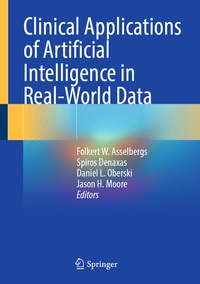
Clinical Applications of Artificial Intelligence in Real-World Data
Published on 4. November 2023
VI, 285 pages
978-3-031-36678-9 (ISBN)
Description

This book is a thorough and comprehensive guide to the use of modern data science within health care. Critical to this is the use of big data and its analytical potential to obtain clinical insight into issues that would otherwise have been missed and is central to the application of artificial intelligence. It therefore has numerous uses from diagnosis to treatment.
Clinical Applications of Artificial Intelligence in Real-World Data is a critical resource for anyone interested in the use and application of data science within medicine, whether that be researchers in medical data science or clinicians looking for insight into the use of these techniques.
Clinical Applications of Artificial Intelligence in Real-World Data is a critical resource for anyone interested in the use and application of data science within medicine, whether that be researchers in medical data science or clinicians looking for insight into the use of these techniques.
More details
Series
Language
English
Place of publication
Cham
Switzerland
Publishing group
Springer International Publishing
Target group
Professional and scholarly
Product notice
Reflowable
Illustrations
VI, 285 p. 80 illus., 58 illus. in color.
File size
11,10 MB
ISBN-13
978-3-031-36678-9 (9783031366789)
DOI
10.1007/978-3-031-36678-9
Schweitzer Classification
Other editions
Additional editions
Folkert W. Asselbergs | Spiros Denaxas | Daniel L. Oberski
Clinical Applications of Artificial Intelligence in Real-World Data
Book
11/2023
Springer
€117.69
Shipment within 15-20 days
Persons
Dr Folkert Asselbergs is a clinical cardiologist at Amsterdam Heart Center, Prof of Precision medicine at the Institute of Health Informatics, University College London, director and founder of the BRC Clinical Research Informatics Unit and the recently initiated Nudging Unit at University College London Hospital, chair of the data infrastructure of the Dutch Cardiovascular Alliance, and associate editor of European Heart Journal for digital health and innovation. His research program focuses on translational data science using existing health data such as electronic health records and clinical registries enriched with novel modalities such as -omics and sensor data for knowledge discovery, drug target validation and precision medicine in cardiovascular disease.
Dr Spiros Denaxas is a Professor in Biomedical Informatics based at the Institute of Health Informatics at University College London and Associate Director leading phenomics at the British Heart Foundation Data Science Centre. His lab's research focuses on creating and evaluating novel computational methods for data modelling, phenotyping, and disease subtype discovery in structured electronic health records.
Dr. Daniel L. Oberski is full professor of Health and Social Data Science with dual appointments at Utrecht University's Department of Methodology & Statistics and the Department of Biostatistics and Data Science at the Julius Center, University Medical Center Utrecht (UMCU). His work focuses on applications of machine learning and data science to applied medical and social research, as well as the development of novel methods, often involving latent variable models. Among other roles, he is task coordinator of the Social Data Science team at the Dutch national infrastructure for the social sciences ODISSEI, and methodological lead at UMCU's Digital Health team.
Dr. Jason Moore is founding Chair of the Department of Computational Medicine at Cedars-Sinai Medical Center where he also serves as founding Director of the Center for Artificial Intelligence Research and Education (CAIRE). He leads an active NIH-funded research program focused on the development and application of cutting-edge AI and machine learning algorithms for the analysis of biomedical data. His recent work has focused on methods for automated machine learning (AutoML) with a goal of democratizing AI in healthcare and biomedical research. He is an elected fellow of the American College of Medical Informatics, the International Academy of Health Sciences Informatics, the American Statistical Association, the International Statistics Institute, and the American Association for the Advancement of Science. He is Editor-in-Chief of the open-access journal BioData Mining.
Dr Spiros Denaxas is a Professor in Biomedical Informatics based at the Institute of Health Informatics at University College London and Associate Director leading phenomics at the British Heart Foundation Data Science Centre. His lab's research focuses on creating and evaluating novel computational methods for data modelling, phenotyping, and disease subtype discovery in structured electronic health records.
Dr. Daniel L. Oberski is full professor of Health and Social Data Science with dual appointments at Utrecht University's Department of Methodology & Statistics and the Department of Biostatistics and Data Science at the Julius Center, University Medical Center Utrecht (UMCU). His work focuses on applications of machine learning and data science to applied medical and social research, as well as the development of novel methods, often involving latent variable models. Among other roles, he is task coordinator of the Social Data Science team at the Dutch national infrastructure for the social sciences ODISSEI, and methodological lead at UMCU's Digital Health team.
Dr. Jason Moore is founding Chair of the Department of Computational Medicine at Cedars-Sinai Medical Center where he also serves as founding Director of the Center for Artificial Intelligence Research and Education (CAIRE). He leads an active NIH-funded research program focused on the development and application of cutting-edge AI and machine learning algorithms for the analysis of biomedical data. His recent work has focused on methods for automated machine learning (AutoML) with a goal of democratizing AI in healthcare and biomedical research. He is an elected fellow of the American College of Medical Informatics, the International Academy of Health Sciences Informatics, the American Statistical Association, the International Statistics Institute, and the American Association for the Advancement of Science. He is Editor-in-Chief of the open-access journal BioData Mining.
Content
Part 1: Data Processing, Storage, Regulations.- Biomedical Big Data: Opportunities and Challenges.- Quality Control, Data Cleaning, Imputation.- Data Security And Privacy Issues.- Data Standards and Terminology.- Biomedical Ontologies.- Graph Databases as Future Of Data Storage.- Data Integration, Harmonization.- Natural Language Processing And Text Mining- Turning Unstructured Data Into Structured.- Part 2: Analytics.- Statistical Analysis Statistical Analysis - Causality, Mendelian Randomization.- Statistical Analysis - Meta-Analysis/Reproducibility.- Machine Learning - Basic Concepts.- Machine Learning - Basic Supervised Methods.- Machine Learning - Basic Unsupervised Methods.- Machine Learning - Evaluation.- Machine Learning - Representation Learning/Feature Selection/Engineering.- Machine Learning - Interpretation.- Deep Learning - Prediction.- Deep Learning - Autoencoders.- Artificial Intelligence.- Machine Learning In Practice - Clinical Decision Support, Risk Prediction, Diagnosis.- Machine Learning In Practice - Evaluation Clinical Value, Guidelines.- Challenges Of Machine Learning and AI.
