

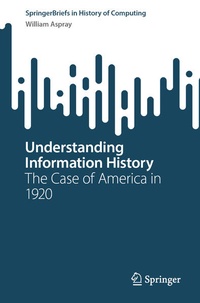
Understanding Information History
Description

Microhistory is a technique that has been used effectively by writers of both fiction and nonfiction. It enables the author to cut through the complexities of large swaths of history by focusing on a particular time and place. Microhistories are particularly useful in historical study when a subfield has recently arisen and there are not yet enough monographic studies from which to draw general patterns. This microhistory focuses on a single year (1920) across the United States, with the goal of understanding the various roles of information in this society. It gives greater emphasis to the informational aspects of traditional historical topics such as farming, government bureaucracy, the Spanish flu pandemic, and Prohibition; and it gives greater attention to information-rich topics such as libraries and museums, schools and colleges, the financial services and office machinery industries, scientific research institutions, and management consultancies.
More details
Other editions
Additional editions
Content
1. America in 1920: The Traditional Account.- 2. Altering the Traditional Account to Give Greater Attention to Information History.- 3. Consumer Technologies, Modernity, and Information Issues.- Information Institutions and Industries.- 4. What is Information History and How Do We Study It?.
