

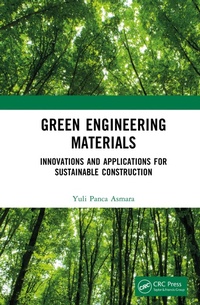
Green Engineering Materials
Innovations and Applications for Sustainable Construction
1st Edition
Published on 13. May 2025
184 pages
978-1-040-35884-9 (ISBN)
Description

The use of green engineering materials represents a promising approach to sustainable development. This book explores various renewable materials and their properties, applications, and technological advancements driving their use in modern engineering and construction.
This book highlights the significance of green engineering materials in sustainable development and explains their effective use in engineering and construction. It covers bamboo as a rapidly growing renewable material in use with significant engineering potential, detailing its unique characteristics, preservation methods, and uses in construction. The book also investigates sustainable plant-based composites, focusing on biopolymer and biomass matrices, cellulose-based materials, lignin, polylactic acid, and natural rubber. It highlights the benefits of plant fibres like rice husk ash and jute while addressing the challenges in adopting these composites in engineering. Green concrete technologies like hybrid geopolymers and green additives and their manufacturing processes are also discussed. Following this, the book discusses bio-based adhesives and then explores the industrial potential of rice husk ash in applications including electronic devices, composites, and reinforced concrete. Palm oil and coconut shells are also examined as versatile renewable resources for various construction and development applications. Finally, the book emphasizes the importance of wood in construction, including its properties, treatment methods, and future trends in sustainable construction practices.
Because this has a broad scope and provides readers with a basic level of technical knowledge, it is an ideal guide for general readers concerned with sustainability as well as anyone starting out in the field, including undergraduate students and readers in the industry who want to keep abreast of current developments and trends in this field.
This book highlights the significance of green engineering materials in sustainable development and explains their effective use in engineering and construction. It covers bamboo as a rapidly growing renewable material in use with significant engineering potential, detailing its unique characteristics, preservation methods, and uses in construction. The book also investigates sustainable plant-based composites, focusing on biopolymer and biomass matrices, cellulose-based materials, lignin, polylactic acid, and natural rubber. It highlights the benefits of plant fibres like rice husk ash and jute while addressing the challenges in adopting these composites in engineering. Green concrete technologies like hybrid geopolymers and green additives and their manufacturing processes are also discussed. Following this, the book discusses bio-based adhesives and then explores the industrial potential of rice husk ash in applications including electronic devices, composites, and reinforced concrete. Palm oil and coconut shells are also examined as versatile renewable resources for various construction and development applications. Finally, the book emphasizes the importance of wood in construction, including its properties, treatment methods, and future trends in sustainable construction practices.
Because this has a broad scope and provides readers with a basic level of technical knowledge, it is an ideal guide for general readers concerned with sustainability as well as anyone starting out in the field, including undergraduate students and readers in the industry who want to keep abreast of current developments and trends in this field.
Reviews / Votes
Green Engineering Materials is a must-read for anyone interested in sustainable development. This book explores renewable materials and their applications in construction, manufacturing, and industry. It covers topics like bamboo as a building material, green concrete technologies, and bio-based adhesives. A comprehensive guide to materials driving a sustainable future in engineering and construction, written by an experienced author.Prof. Sugiman, Professor in adhesive and composite polymer, Mechanical Engineering, Mataram University
The author is highly qualified and credible in writing the book Green Engineering Materials. This essential book explores renewable materials and their applications in construction, manufacturing, and industry, offering valuable insights for advancing sustainable practices.
Prof. Buan Anshari, Professor in timber, wood, concrete, Civil Engineering, Mataram University
The author, with expertise as both a practitioner and engineering consultant, provides practical insights into eco-friendly materials and solutions, effectively addressing key industry concerns.
Endra Sujadmika, Practitioner and Consultant, FEA Engineer, PT 3S Engineering
More details
Edition
1. Auflage
Language
English
Place of publication
London
United Kingdom
Publishing group
Taylor & Francis Ltd
Target group
College/higher education
Professional and scholarly
Illustrations
33 Tables, black and white; 36 Line drawings, black and white; 6 Halftones, black and white; 42 Illustrations, black and white
File size
16,75 MB
ISBN-13
978-1-040-35884-9 (9781040358849)
Copyright in bibliographic data and cover images is held by Nielsen Book Services Limited or by the publishers or by their respective licensors: all rights reserved.
Schweitzer Classification
Other editions
Additional editions
Yuli Panca Asmara
Green Engineering Materials
Innovations and Applications for Sustainable Construction
Book
05/2025
1st Edition
CRC Press
€78.80
Shipment within 15-20 days
Person
Yuli Panca Asmara is an Associate Professor at INTI International University. He obtained his BEng in 1995 from Sepuluh Nopember Institute of Technology, Indonesia; his MS in 2002 from the University of Manchester, UK, and PhD in 2010 from University Technology Petronas, Malaysia. He also provides consultancy services on materials and corrosion issues for local companies, petroleum industry training, and supports the turnaround of Abu Dhabi National Oil Company (ADNOC) Liquefied Natural Gas facilities.
Content
1. Green Engineering Materials: Combining Innovation and Sustainability for a Better Future 2. Bamboo: A Future Renewable Materials Engineering Resource 3. Plant-Based Composites: A Sustainable Resource for Future Engineering 4. Green Concrete for Sustainable Infrastructure Development 5. Bio-based adhesives 6. Utilization of Rice Husk Ash: Sustainable Solutions for the Environment 7. Palm Oil: Renewable Material and Environmental Sustainability 8. Coconut Shell: Solution for Environmental Sustainability 9. Wood in the Construction Industry: Combining Strength and Sustainability 10. Future Opportunities in Green Engineering Materials
