

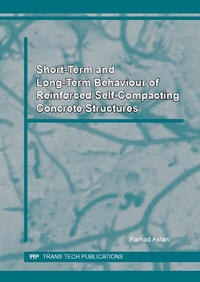
Short-Term and Long-Term Behaviour of Reinforced Self-Compacting Concrete Structures
Published on 24. June 2014
556 pages
978-3-03826-498-9 (ISBN)
Description

Volume is indexed by Thomson Reuters BCI (WoS).
Self-Compacting Concrete (SCC) refers to a 'highly flow-able,non-segregating concrete that can be spread into place, fill the formwork,and encapsulate the reinforcement without the aid of any mechanicalconsolidation. SCC is regarded as one of the most promising developments inconcrete technology due to significant advantages over Conventional Concrete(CC). In this study cracking caused by external loads in reinforced SCC andFRSCC slabs is examined experimentally and analytically. The mechanismsassociated with the flexural cracking due to the combined effects ofconstant sustained service loads and shrinkage are observed. One of theprimary objectives of this study is to develop analytical models thataccurately predict the hardened mechanical properties of SCC and FRSCC.Subsequently, these models have been successfully applied to simulatetime-dependent cracking of SCC and FRSCC one-way slabs.
Self-Compacting Concrete (SCC) refers to a 'highly flow-able,non-segregating concrete that can be spread into place, fill the formwork,and encapsulate the reinforcement without the aid of any mechanicalconsolidation. SCC is regarded as one of the most promising developments inconcrete technology due to significant advantages over Conventional Concrete(CC). In this study cracking caused by external loads in reinforced SCC andFRSCC slabs is examined experimentally and analytically. The mechanismsassociated with the flexural cracking due to the combined effects ofconstant sustained service loads and shrinkage are observed. One of theprimary objectives of this study is to develop analytical models thataccurately predict the hardened mechanical properties of SCC and FRSCC.Subsequently, these models have been successfully applied to simulatetime-dependent cracking of SCC and FRSCC one-way slabs.
More details
Series
Language
English
Place of publication
Zurich-Durnten
Switzerland
Target group
Professional and scholarly
Illustrations
Illustrations
File size
87,40 MB
ISBN-13
978-3-03826-498-9 (9783038264989)
DOI
10.4028/www.scientific.net/MSFo.77
Copyright in bibliographic data and cover images is held by Nielsen Book Services Limited or by the publishers or by their respective licensors: all rights reserved.
Schweitzer Classification
Other editions
Additional editions
Software
06/2014
Trans Tech Publications Ltd
€297.39
Shipment within 10-15 days
Farhad Aslani
Short-Term and Long-Term Behaviour of Reinforced Self-Compacting Concrete Structures
Handbook
Book
06/2014
Trans Tech Publications Ltd
€276.07
Shipment within 10-15 days
Content
Abstract
1. Introduction
2. Literature Review
3. Hardened Concrete Properties
4. Time-Dependent Behaviour of Hardened Concrete
5. Experimental Program (Phase I) - Material Properties of SCC and FRSCC
6. Experimental Program (Phase II) - Short Term Flexural Cracking
7. Experimental Program (Phase III) - Long Term Flexural Cracking
8. Analytical Models for Instantaneous and Time-Dependent Flexural Cracking of SCC and FRSCC
9. Finite Element Modelling of Cracking Behaviour of the Conventional Steel Reinforced and Fibre Reinforced Selfcompacting Concrete Slabs
10. Summary and Conclusions
References
1. Introduction
2. Literature Review
3. Hardened Concrete Properties
4. Time-Dependent Behaviour of Hardened Concrete
5. Experimental Program (Phase I) - Material Properties of SCC and FRSCC
6. Experimental Program (Phase II) - Short Term Flexural Cracking
7. Experimental Program (Phase III) - Long Term Flexural Cracking
8. Analytical Models for Instantaneous and Time-Dependent Flexural Cracking of SCC and FRSCC
9. Finite Element Modelling of Cracking Behaviour of the Conventional Steel Reinforced and Fibre Reinforced Selfcompacting Concrete Slabs
10. Summary and Conclusions
References
