

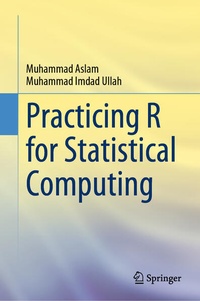
Practicing R for Statistical Computing
Description

This book is designed to provide a comprehensive introduction to R programming for data analysis, manipulation and presentation. It covers fundamental data structures such as vectors, matrices, arrays and lists, along with techniques for exploratory data analysis, data transformation and manipulation. The book explains basic statistical concepts and demonstrates their implementation using R, including descriptive statistics, graphical representation of data, probability, popular probability distributions and hypothesis testing. It also explores linear and non-linear modeling, model selection and diagnostic tools in R.
The book also covers flow control and conditional calculations by using ''if'' conditions and loops and discusses useful functions and resources for further learning. It provides an extensive list of functions grouped according to statistics classification, which can be helpful for both statisticians and R programmers. The use of different graphic devices, high-level and low-level graphical functions and adjustment of parameters are also explained. Throughout the book, R commands, functions and objects are printed in a different font for easy identification. Common errors, warnings and mistakes in R are also discussed and classified with explanations on how to prevent them.
More details
Other editions
Additional editions
Persons
Muhammad Aslam is Professor at the Department of Statistics in Bahauddin Zakariya University, Multan, Pakistan. He holds a Ph.D. in Statistics, a Master's degree in Statistics, and a Post-Graduate Diploma in Computer Programming and Computing Statistics from the same university. He also completed his Post-Doctorate from the Institut de Mathematiques de Bourgogne, Dijon, France. Professor Aslam's research is mainly focused on regression analysis and statistical inference, with a particular interest in simulation studies using computer programming. With more than 25 years of teaching experience, he has published more than 120 research articles in several prestigious international journals. Nine research scholars have successfully completed their Ph.D. degrees under his guidance. Muhammad Imdad Ullah, the co-author of this book, is among these scholars.
Muhammad Imdad Ullah is Assistant Professor at the Department of Statistics, Ghazi University,Dera Ghazi Khan, Pakistan. He received his Ph.D. degree from Bahauddin Zakariya University. He has also earned a Post-Graduate Diploma in Computer Programming and Computing Statistics. His Ph.D. work is about the development of R packages addressing linear regression models with the issue of multicollinearity. This work led to the development of three R packages- mctest , lmridge and liureg -and three research articles based on these packages were published in The R Journal . His area of expertise includes computer programming and statistical computations. With over 14 years of teaching experience, he has authored 11 research publications.
