

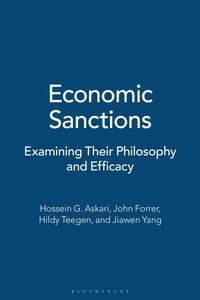
Economic Sanctions
Examining Their Philosophy and Efficacy
1st Edition
Published on 28. February 2003
240 pages
978-0-313-05364-1 (ISBN)
Description

This is the first of three related, empirically based studies examining the broad range of issues raised by the use of economic sanctions. This volume addresses the philosophy behind economic sanctions: why they are used and what they are meant to achieve.
Ashari, Forrer, Teegen, and Yang go back through history to analyze whether or not economic sanctions have ben sucessful by measuinrg their historical impact and modeling their effectiveness, and they offer an analysis of the international and domestic business implications of sanctions in today's global economy. Of particular interest to scholars, students, researchers, and the public policy community involved with international busienss and economics and international relations.
Ashari, Forrer, Teegen, and Yang go back through history to analyze whether or not economic sanctions have ben sucessful by measuinrg their historical impact and modeling their effectiveness, and they offer an analysis of the international and domestic business implications of sanctions in today's global economy. Of particular interest to scholars, students, researchers, and the public policy community involved with international busienss and economics and international relations.
More details
Edition
1. Auflage
Language
English
Place of publication
New York
United States
Publishing group
Bloomsbury Publishing Plc
ISBN-13
978-0-313-05364-1 (9780313053641)
Copyright in bibliographic data and cover images is held by Nielsen Book Services Limited or by the publishers or by their respective licensors: all rights reserved.
Schweitzer Classification
Other editions
Additional editions
Hossein G. Askari | John Forrer | Hildy Teegen
Economic Sanctions
Examining Their Philosophy and Efficacy
Book
02/2003
Praeger Publishers Inc
€114.10
Shipment within 3-4 weeks
Persons
HOSSEIN G. ASKARI is Aryamehr Professor of International Business, The George Washington University. He is the author or coauthor of 14 earlier books and monographs.
JOHN FORRER is Director of the Institute for Global Management and Research, The George Washington University. He has consulted extensivley on international energy and environmental issues.
HILDY TEEGEN is Associate Professor of International Business at The George Washington University. She has written extensively on international negotiations and business partnerships and Latin American economic affairs.
JIAWEN YANG is Assistant Professor of International Business, The George Washington University. He is the author of numerous articles and book chapters on exchange rate pass-through, international capital flows, and the financial crises in Latin America and Asia.
JOHN FORRER is Director of the Institute for Global Management and Research, The George Washington University. He has consulted extensivley on international energy and environmental issues.
HILDY TEEGEN is Associate Professor of International Business at The George Washington University. She has written extensively on international negotiations and business partnerships and Latin American economic affairs.
JIAWEN YANG is Assistant Professor of International Business, The George Washington University. He is the author of numerous articles and book chapters on exchange rate pass-through, international capital flows, and the financial crises in Latin America and Asia.
Content
Preface
Historical Perspectives on Economic Sanctions
Multilateral Economic Sanctions
Definition, Philosophy, and Efficacy of Unilateral Economic Sanctions
The Impact of Economic Sanctions on Trade
Impact of U.S. Economic Sanctions on Trade for the United States, the European Union (E.U.), and Japan
Conclusion
Appendix 1: Sanctioned Countries
Appendix 2: Sanctioned Countries in the Hufbauer et al. (1997) Study
Appendix 3: U.S. Trade Arrangement with Other Countries
References
Bibliography
About the Authors
Historical Perspectives on Economic Sanctions
Multilateral Economic Sanctions
Definition, Philosophy, and Efficacy of Unilateral Economic Sanctions
The Impact of Economic Sanctions on Trade
Impact of U.S. Economic Sanctions on Trade for the United States, the European Union (E.U.), and Japan
Conclusion
Appendix 1: Sanctioned Countries
Appendix 2: Sanctioned Countries in the Hufbauer et al. (1997) Study
Appendix 3: U.S. Trade Arrangement with Other Countries
References
Bibliography
About the Authors
