

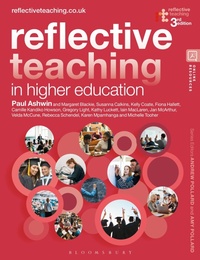
Reflective Teaching in Higher Education
3rd Edition
Published on 27. November 2025
464 pages
978-1-350-49689-7 (ISBN)
Description

Reflective Teaching in Higher Education is the definitive textbook for reflective teachers in higher education. Informed by the latest research in this area, the book offers extensive support for those at the start of an academic career and career-long professionalism. Written by an international collaborative author team of higher education experts led by Paul Ashwin, Reflective Teaching in Higher Education offers two levels of support:
- practical guidance for day-to-day teaching, covering key issues such as strategies for improving learning, teaching and assessment, curriculum design, relationships, communication, and inclusion.
- evidence-informed 'principles to aid understanding of how theories can effectively inform teaching practices, offering ways to develop a deeper understanding of teaching and learning.
This new edition gives greater coverage of contemporary topics, including: the climate and nature emergency; Generative Artificial Intelligence (GenAI) including ChatGPT; the use of digital education and digital capabilities following the global pandemic; consideration of the intended outcomes of higher education for students. This edition features a greater diversity of students, teachers, institutional and disciplinary contexts, and national/international settings. It includes updated case studies, reflective activities, and research briefings, drawing on literature from a broader range of countries.
reflectiveteaching.co.uk provides a treasure trove of additional support. It includes supplementary sector specific material to support for considering questions around society's educational aims, and much more besides.
- practical guidance for day-to-day teaching, covering key issues such as strategies for improving learning, teaching and assessment, curriculum design, relationships, communication, and inclusion.
- evidence-informed 'principles to aid understanding of how theories can effectively inform teaching practices, offering ways to develop a deeper understanding of teaching and learning.
This new edition gives greater coverage of contemporary topics, including: the climate and nature emergency; Generative Artificial Intelligence (GenAI) including ChatGPT; the use of digital education and digital capabilities following the global pandemic; consideration of the intended outcomes of higher education for students. This edition features a greater diversity of students, teachers, institutional and disciplinary contexts, and national/international settings. It includes updated case studies, reflective activities, and research briefings, drawing on literature from a broader range of countries.
reflectiveteaching.co.uk provides a treasure trove of additional support. It includes supplementary sector specific material to support for considering questions around society's educational aims, and much more besides.
More details
Series
Edition
3rd edition
Language
English
Place of publication
London
United Kingdom
Publishing group
Bloomsbury Publishing PLC
Target group
College/higher education
Illustrations
35 bw illus
ISBN-13
978-1-350-49689-7 (9781350496897)
Copyright in bibliographic data and cover images is held by Nielsen Book Services Limited or by the publishers or by their respective licensors: all rights reserved.
Schweitzer Classification
Other editions
Additional editions
Paul Ashwin | Margaret Blackie | David Boud
Reflective Teaching in Higher Education
Book
approx. 11/2025
3rd Edition
Bloomsbury Academic
€43.50
Not yet published
Persons
Paul Ashwin is Professor of Higher Education at Lancaster University, UK.
The author team: Margaret Blackie (Rhodes University, South Africa) | David Boud (Deakin University, Australia) | Susanna Calkins (Rosalind Franklin University of Medicine and Science, USA) | Kelly Coate (Richmond American University, UK) | Fiona Hallett (Edge Hill University, UK) | Camille Kandiko Howson (Imperial College London, UK) | Gregory Light (Northwestern University USA) | Kathy Luckett (University of Cape Town, South Africa) | Jan McArthur (Lancaster University, UK) | Velda McCune (University of Edinburgh, UK) | Iain McLaren (National University of Ireland, Ireland) | Karen Mpamhanga (University of Hertfordshire, UK | Rebecca Schendel (Boston College, USA)) | Michelle Tooher (National University of Ireland, Ireland)
The author team: Margaret Blackie (Rhodes University, South Africa) | David Boud (Deakin University, Australia) | Susanna Calkins (Rosalind Franklin University of Medicine and Science, USA) | Kelly Coate (Richmond American University, UK) | Fiona Hallett (Edge Hill University, UK) | Camille Kandiko Howson (Imperial College London, UK) | Gregory Light (Northwestern University USA) | Kathy Luckett (University of Cape Town, South Africa) | Jan McArthur (Lancaster University, UK) | Velda McCune (University of Edinburgh, UK) | Iain McLaren (National University of Ireland, Ireland) | Karen Mpamhanga (University of Hertfordshire, UK | Rebecca Schendel (Boston College, USA)) | Michelle Tooher (National University of Ireland, Ireland)
Content
Preface
How to Use this Book
Introduction
Part I: Becoming Reflective
1. Principles
2. Reflection
3. Identities
4. Learning
Part II: Creating Conditions for Learning
5. Contexts
6. Relationships
7 Engagement
8. Learning Spaces
Part III: Teaching for Learning
9. Curriculum
10. Teaching
11. Planning
12. Communication
13. Assessment
Part IV: Reflecting on Consequences
14. Quality
15. Inclusion
Part V: Deepening Understanding
16. Expertise
17 Professionalism
Reflective activities
List of case studies, figures and research briefings
Bibliography
Index
How to Use this Book
Introduction
Part I: Becoming Reflective
1. Principles
2. Reflection
3. Identities
4. Learning
Part II: Creating Conditions for Learning
5. Contexts
6. Relationships
7 Engagement
8. Learning Spaces
Part III: Teaching for Learning
9. Curriculum
10. Teaching
11. Planning
12. Communication
13. Assessment
Part IV: Reflecting on Consequences
14. Quality
15. Inclusion
Part V: Deepening Understanding
16. Expertise
17 Professionalism
Reflective activities
List of case studies, figures and research briefings
Bibliography
Index
