

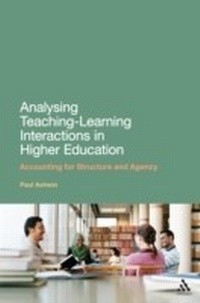
Analysing Teaching-Learning Interactions in Higher Education
Accounting for Structure and Agency
1st Edition
Published on 9. February 2009
176 pages
978-0-8264-3239-1 (ISBN)
Description

Whilst current research into teaching and learning offers many insights into the experiences of academics and students in higher education, it has two significant shortcomings. It does not highlight the dynamic ways in which students and academics impact on each other in teaching-learning interactions or the ways in which these interactions are shaped by wider social processes.
This book offers critical insight into existing perspectives on researching teaching and learning in higher education and argues that alternative perspectives are required in order to account for structure and agency in teaching-learning interactions in higher education. In considering four alternative perspectives, it examines the ways in which teaching-learning interactions are shaped by teaching-learning environments, student and academic identities, disciplinary knowledge practices and institutional cultures. It concludes by examining the conceptual and methodological implications of these analyses of teaching-learning interactions and provides the reader with an invaluable guide to alternative ways of conceptualising and researching teaching and learning in higher education.
This book offers critical insight into existing perspectives on researching teaching and learning in higher education and argues that alternative perspectives are required in order to account for structure and agency in teaching-learning interactions in higher education. In considering four alternative perspectives, it examines the ways in which teaching-learning interactions are shaped by teaching-learning environments, student and academic identities, disciplinary knowledge practices and institutional cultures. It concludes by examining the conceptual and methodological implications of these analyses of teaching-learning interactions and provides the reader with an invaluable guide to alternative ways of conceptualising and researching teaching and learning in higher education.
Reviews / Votes
'A major contribution to the study of teaching and learning in higher education through its perceptive analysis of theoretical frameworks and their implications. Ranging across studies of perception, identity, activity systems, field and pedagogic device, Paul Ashwin offers both an accessible review and a wealth of ideas for the future development of understanding.' Andrew Pollard, Professor of Education and supports educational research, Institute of Education, University of London, UK, University of Bristol, UK, and University of Cambridge, UK 'Ashwin's analysis of teaching-learning interactions is insightful and will be useful to any college teacher who reads it. He writes well so that the book is both thoughtful and readable.' Bill McKeachie, Professor Emeritus, University of Michigan, USA 'The book ends with a call for more empirical studies that examine the relations between "particular sets of structural-agentic process and teaching-learning interactions" (p. 141) where the empirical data and the explicit conceptual framework interrogate each other. I am already recommending it to those engaged in these studies.' British Educational Research Journal 'A really important book to be taken note of by higher education researchers. It will be especially useful to readers who are new to sociological theory. Its key contribution is in offering an even-handed appraisal of existing research, and in pushing the research community to move in new and promising directions. The book provides some very useful assistance for the journey.' Studies in Higher Education 'Analysing Teaching-Learning Interactions in Higher Education does a very good job of examining theoretical frameworks for teaching and learning in higher education contexts and select educational systems of European heritage. If you are fatigued with the same old binary debates in American mainstream publication - teaching versus learning, student-centered versus teaching-centered pedagogies, or disciplinary content versus critical thinking - this book might be right for you.' Journal of Educational Research Reviewed in Teaching Theology and ReligionMore details
Edition
1. Auflage
Language
English
Place of publication
New York
United States
Illustrations
3 illus
ISBN-13
978-0-8264-3239-1 (9780826432391)
Copyright in bibliographic data and cover images is held by Nielsen Book Services Limited or by the publishers or by their respective licensors: all rights reserved.
Schweitzer Classification
Other editions
Additional editions
Paul Ashwin
Analysing Teaching-Learning Interactions in Higher Education
Accounting for Structure and Agency
Book
04/2012
Continuum Publishing Corporation
€62.60
Shipment within 15-20 days
Person
Content
Acknowledgements \ 1. Introduction \ 2. Conceptualising Structure and Agency in Relation to Teaching-Learning Interactions \ 3. Current Ways of Analysing the Relations between Structural-Agentic Processes and Teaching-Learning Interactions \ 4. An Activity Theory Approach to Analysing the Relations Between Student and Academic Identities and Teaching-Learning Interactions \ 5. A Symbolic-Interactionist Approach to Analysing the Relations between Student and Academic Identities and Teaching-Learning Interactions \ 6. A Bernsteinian Approach to Analysing the Relations between Disciplinary Knowledge Practices and Teaching-Learning Interactions \ 7. A Bourdieusian Approach to Analysing the Relations between Institutional Cultures and Teaching-Learning Interactions \ 8. Implications for Researching Teaching-Learning Interactions \ References \ Index
