

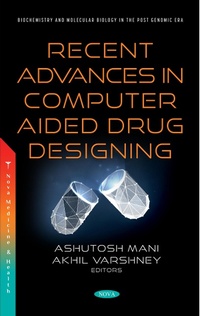
Recent Advances in Computer Aided Drug Designing
Published on 19. July 2021
390 pages
978-1-5361-9904-8 (ISBN)
Description

We are extremely happy to introduce our new book, Recent Advances in Computer Aided Drug Designing. While interacting with many researchers in the field of biotechnology and allied sciences, we felt that there was need for a book that could easily bridge the gap between in silico methods applied in structural bioinformatics for drug designing and wet lab workers. Today, when computational skills in biology and biomedical research are in high demand, this book presents updated content for methods and tools applicable in modern computer-aided drug designing. Researchers are pouring knowledge into databases that are publicly available and laboratories across the globe are accessing this information for analysis and further investigation. There is a battery of data scientists involved in development and maintenance of online databases. Alongside them, there is another class of programmers and scientists involved in development of software tools for analysis of this data. Modern tools based on machine learning are available to provide accuracy and efficiency with speedy analysis of biological and biomedical data. In many cases, analysis of readily available biological data helps to decide future directions for laboratory work. Indications obtained from such analytics save time and resources which could be very crucial in general. Publicly available protein three-dimensional structure and drug databank libraries have facilitated the drug discovery process. Millions of drugs can be screened in a few hours by using virtual screening tools. Molecular viewing tools can be used to visualize macromolecules and their interactions with drugs. Findings from such studies are being used to validate results directly in laboratories. Efforts have been made to cover all areas relevant for computer-aided drug designing to allow this book to serve as a standard reference book and meet the requirements of graduate students and researchers working in drug design and structural bioinformatics. Some chapters are dedicated to basic concepts in computer-aided drug discovery while other chapters present applications of the available tools in the field. Contents from exemplary method-based chapters are easy to follow and will help new researchers in applying contemporary tools for their studies. The book will also stimulate programmers and data scientists interested in developing tools for structural bioinformatics applications to develop new and improved versions of software. Chapters presenting the basic concepts of methods involved in drug design will help new learners in the field to meet the challenges of designing novel therapeutics by using computational tools. Cross-disciplinary research is in trend nowadays and such investigations involving experts of their respective fields are highly promising and fruitful. Drug discovery requires experts from health sciences and medical sciences, molecular biologists, bioinformaticians, biotechnologists, biochemists, statisticians, biophysicists and clinicians. For a complete piece of translated product such as a drug, inputs from specialist researchers are needed. Modern rational drug discovery approaches are truly inter-disciplinary fields which require a systems biology approach for successful ventures. This book covers all steps of drug design, from drug target identification to intermediate steps to successful clinical trials, making it truly essential for modern researchers in the drug discovery and structural bioinformatics fields.
More details
Other editions
Additional editions
Ashutosh Mani
Recent Advances in Computer Aided Drug Designing
Book
07/2021
Nova Science Publishers Inc
€303.05
Shipment within 15-20 days
Content
- Intro
- Contents
- Foreword
- Preface
- Chapter 1
- Online Drug Data Banks and Molecular Libraries
- Abstract
- 1. Introduction
- 2. Expanse of Drug Databanks
- 3. Commercial Molecular Libraries
- 3.1. Reaxys
- 3.2. SciFinder
- 4. Public Data Aggregators
- 4.1. PubChem
- 4.2. ChEMBL
- 4.3. UniChem
- 4.4. ChemSpider
- 5. Scientific Drug Databanks
- 5.1. KEGG COMPOUND
- 5.2. ZINC
- 6. Natural Products Database
- 6.1. MarinLit
- 6.2. Seaweed Metabolite Database (SWMD)
- Conclusion
- References
- Chapter 2
- Computational Approaches for Drug Screening and Pharmacokinetic Studies
- Abstract
- 1. Introduction
- 2. Drug Likeliness Properties
- 3. Virtual Screening
- 3.1. AutoDock
- 3.2. Dock
- 3.3. Glide
- 3.4. PyRx
- 4. Pharmacokinetics and Drug Designing
- 5. Tools for ADMET (Absorption, Distribution, Metabolism, Excretion and Toxicity) Screening
- Conclusion
- References
- Chapter 3
- Introduction to Molecular Modelling and Structure Prediction
- Abstract
- 1. Introduction
- 2. Methods Used in Molecular Modelling
- 2.1. Methods for Structure Prediction
- 2.1.1. Template Based Structure Modelling
- 2.1.1.1. Homology Modeling
- 2.1.1.1.1. Identification of Template Structure Related to Target Sequence
- 2.1.1.1.2. Selection of Template Structure
- 2.1.1.1.3. Sequence Alignment to Template Structure
- 2.1.1.1.4. Homology Modelling Based on the Conserved Fragment
- 2.1.1.1.5. Homology Modelling Based on Atomic Coordinates Reconstruction
- 2.1.1.1.6. Homology Modelling by Satisfaction of Spatial Restraints
- 2.1.1.1.7. Homology Modelling via Combining Structures
- 2.1.1.1.8. Homology Modelling with Meta-Servers
- 2.1.1.2. Molecular Threading Approach for Structure Prediction
- 2.1.1.3. Template-Free or de novo Structure Modelling
- 2.1.1.4. Knowledge-Based Structure Prediction and Refinement
- 2.1.1.5. Physics Based Free-Template Modelling
- 2.2. Structure Evaluation
- 2.3. Structure Visualisation
- 3. Application
- 4. Limitation
- Conclusion
- References
- Chapter 4
- Docking and Molecular Dynamics Simulations for Methotrexate Delivery by Graphene
- Abstract
- 1. Introduction
- 2. Computational Methods
- 2.1. Structure
- 2.2. Molecular Docking Simulation
- 2.3. Molecular Dynamics Simulation Methods
- 3. Results and Discussion
- 3.1. Docking
- 3.2. MD Simulation
- Conclusion
- References
- Chapter 5
- In Silico Approach to Study the Effect of Mutation on Protein Stability, Function and Potential Binding of an Inhibitor
- Abstract
- 1. Introduction
- 2. Drug Resistance and Genetic Polymorphism: Personalized Medicines
- 3. In Silico Approach Applying Molecular Docking Coupled to Molecular Dynamic Simulations
- 3.1. Pipeline to Conduct the In Silico Study
- 3.1.1. Databases for Protein Structures and SNPs
- 3.1.2. In Silico Functional Analysis of the Mutations or SNPs Using Prediction Tools
- 3.1.2.1. Functional Characterization of Mutations or SNPs
- 3.1.2.2. Biophysical Characterization of Altered Amino Acid Residue
- 3.1.3. Prediction of Favorable and Stabilizing Mutations
- 3.1.3.1. Variant Protein Stability Prediction
- 3.1.3.2. Stability Centers Identification
- 3.1.4. Protein Flexibility
- 3.1.5. Residue Interaction Profile and Visualization of Residue
- 3.1.6. Ligand-Binding Pockets Prediction
- 3.1.7. Protein-Membrane Interaction Prediction
- 3.1.8. Protein-Protein Interaction Site Prediction
- 3.1.9. Automatic Online Mapping of Variants on 3D Structure
- 3.1.10. Modeling Variants
- 3.1.11. Molecular Docking Analysis and Virtual Screening
- 3.1.12. Molecular Dynamics Simulations
- Conclusion
- Acknowledgments
- References
- Chapter 6
- Methods for Tertiary Structure Prediction of Protein and Qualitative Assessment
- Abstract
- 1. Introduction
- 2. Need for Tertiary Structure Prediction
- 3. Different Approaches to Tertiary Structure Prediction
- 3.1. Ab-Initio Method
- 3.1.1. Steps in Ab-Initio Modeling
- 3.1.2. Initialization of Conformation
- 3.1.3. Conformational Search
- 3.1.4. Prediction of the Native Fold
- 3.1.5. Model Assessment
- 3.1.6. Webtools and Softwares
- 3.2. Threading Approach
- 3.2.1. Web Tools/Software Used for Threading
- 3.3. Homology Modeling
- 3.3.1. Template Identification and Selection
- 3.3.2. Alignment and Its Correction
- 3.3.3. Model Building
- 3.3.4. Model Optimization
- 3.3.5. Model Evaluation
- 4. Method of Evaluation of Model
- Conclusion
- References
- Chapter 7
- Drug Design Utilizing Molecular Docking Based Binding Analyses of Human 5HT-Transporter Inhibitors to Combat Internet Addiction and Gaming Disorders
- Abstract
- 1. Introduction
- 1.1. Internet Addiction and Gaming Disorders
- 1.2. Role of Serotonin and Dopamine Receptor in IAD and IGD
- 1.2.1. Serotonin
- 1.2.2. Dopamine
- 1.3. Mode of Treatment to Combat IAD and IGD
- 1.4. Mode of Action
- 2. Materials and Methods
- 2.1. Data Set
- 2.2. Computational
- 3. Results and Discussion
- Conclusion
- Conflict of Interest
- References
- Chapter 8
- The Significance and Applicability of Computational Approaches in Combating COVID-19
- Abstract
- 1. Introduction
- 2. Genomic and Proteomic Study
- 3. Phylogenetic Analysis
- 4. Computer-Aided Drug Design
- 5. Vaccine Design
- 6. Systems Biology Approach
- 7. Next-Generation Sequencing
- 8. Artificial Intelligence
- Conclusion
- Contribution of Authors
- References
- Chapter 9
- Molecular Docking of NSAIDs to Cyclooxygenase (COX-2)
- Abstract
- 1. Introduction
- 1.1. Cyclooxygenase Isoforms, Structure and Function
- 1.2. COX Isoforms and Functions
- 1.3. Crucial Aspects of COX-2
- 1.4. Molecular Structures of NSAIDS
- 1.5. Chemical Properties of Selective COX-2 Inhibitors
- 2. Materials and Methods
- 2.1. Servers and Software Applied for the Study
- 2.2. Methodology
- 3. Data Collection and Analysis
- 3.1. Query Sequence-(FASTA Format)
- 3.2. The Sequence (.seq) File of Target for Alignment
- 3.3. The Script for Alignment File Is as Follows
- 4. Results
- 4.1. Docking of Analogs with Receptor
- 5. Comparative Analysis
- 6. Discussion and Conclusion
- Acknowledgments
- References
- Chapter 10
- Molecular Dynamics Simulation in Drug Discovery
- Abstract
- 1. Introduction
- 2. Methods of MD Simulation
- 2.1. Force-Fields for MD Simulation
- 2.2. Energy Minimization
- 2.3. Conformational Search Algorithm
- 3. MDS Analysis Parameters
- 3.1. Root Mean Square Deviation (RMSD)
- 3.2. Root Mean Square Fluctuation (RMSF)
- 3.3. Radius of Gyration (Rg)
- 3.4. Hydrogen Bonding
- 3.5. Binding Free Energy Calculation
- 4. Application of MDS
- 4.1. Structural Analysis of Modeled Protein
- 4.2. Dynamics of Protein-Ligand Complex
- 4.3. Binding Dynamics at Other Sites
- 4.4. Protein Folding/Unfolding Dynamics
- 4.5. Impact of Mutation on Structural Stability and Selectivity
- 4.6. MDS Analysis of Nutrients Processing
- Conclusion
- Conflict of Interest
- References
- Chapter 11
- Pharmacogenomics: Current Trends and Future Possibilities
- Abstract
- 1. Introduction
- 1.1. Adverse Drug Reaction
- 2. Variant of Pharmacogenomics Importance
- 3. Pharmacogenes: Genes of Pharmacogenomics Importance
- 4. Current Trends for Mining of Pharmacogenes
- 4.1. Experimental Trends
- 4.2. Bioinformatics Trends
- 4.3. Bioinformatics Data Resources for Pharmacogenomics
- 4.4. PharmGKB
- 4.5. General Purpose Resources
- 5. Population Specific Genomics Projects
- 5.1. Universal Methodologies and Data Formats
- 5.2. Data Sharing
- 5.3. Associations among Consortiums and Projects (Across Countries)
- 6. Use of Pharmacogenomics in Drug Development Process
- 7. Decision Making Process
- 8. Scope and Barriers of Pharmacogenomics
- Conclusion
- References
- Chapter 12
- Artificial Intelligence: Prospects in Drug Discovery and Health Technology
- Abstract
- 1. Introduction
- 2. Basics of AI with Relation to Machine Learning
- 3. Healthcare and Biomedical Data
- 4. AI Paradigms
- 5. AI Techniques: ML and NLP
- 5.1. Classical ML
- 5.1.1. Support Vector Machine
- 5.1.2. Random Forest
- 5.1.3. Neural Networks
- 5.1.4. Deep Learning
- 6. Natural Language Processing
- 7. AI Applications in Drug Discovery and Healthcare
- 7.1. Personalized Treatment
- 7.2. Epidemic Outbreak Prediction
- 7.3. Drug Discovery
- 7.3.1. Target Identification and Validation
- 7.3.2. Small-Molecule Design and Optimization
- 7.3.3. Predictive Biomarkers
- 8. Discussion
- Conclusion
- References
- Chapter 13
- Bioinformatics Intervention in Microbial Therapeutic Enzymes: An Update
- Abstract
- 1. Introduction
- 2. Recombinant DNA Technology of Microbial Therapeutic Enzymes
- 2.1. Isolation of Gene of Interest
- 2.2. DNA Vector Construction
- 2.3. Gene Transfer to Host Systems
- 3. Manipulation of Microbial Therapeutic Enzymes for Desired Attributes
- 3.1. Site Directed Mutagenesis
- 3.2. Directed Evolution
- 3.3. Metagenomics Approach
- 4. Important Microbial Enzymes in Pharma Industry
- 4.1. L-Asparaginase
- 4.1.1. Therapeutic Application
- 4.1.1.1. Source
- 4.1.2. L-Asparaginases Properties and Activity
- 4.1.3. Enzyme Engineering Studies of L-Asparaginase
- 4.1.4. Commercial L- Asparaginase
- 4.2. Collagenase
- 4.2.1. Therapeutic Application
- 4.2.1.1. Source
- 4.2.2. Property and Activity
- 4.2.3. Engineering
- 4.2.4. Commercial Enzyme
- 4.3. Superoxide Dismutase
- 4.3.1. Therapeutic Application
- 4.3.1.1. Source
- 4.3.2. Properties and Activity
- 4.3.3. Engineering
- 4.3.4. Commercial Enzyme
- 5. Bionformatics Driven Approach in Novel Druug Discovery
- 5.1. Protein Databases
- 5.2. Structure Prediction
- 5.3. Molecular Docking
- 5.4. ADMET Properties
- Conclusion
- References
- Chapter 14
- In Silico Clinical Trials: A Broad-Spectrum Scope of CADD
- Abstract
- 1. Introduction
- 2. Computational Modeling and Algorithms in In Silico Clinical Trials
- 2.1. Phase I In Silico Clinical Trials
- 2.2. Phase II In Silico Clinical Trials
- 2.3.Phase III In Silico Clinical Trials
- 3. Tools and Softwares for In Silico Clinical Trials
- 4. Future Perspectives of In Silico Clinical Trials
- Conclusion
- Acknowledgments
- References
- About the Editors
- Index
- Blank Page
- Blank Page
