

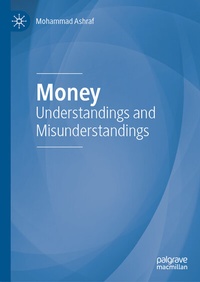
Money
Description

This book clarifies some misunderstandings about money by tying the concept of money to the goods and services sector of the economy. In addition, it demystifies the process of money creation on the part of central banks.
The phenomenon of money is ubiquitous; it has been around for tens of thousands of years, if not longer. Indeed, no modern economy could function without money. For many, however, the concept of money remains elusive. Worse still, misinformation abounds, which leaves the uninitiated vulnerable to fraud. This lack of understanding has serious policy implications as well. When policymakers lack a firm grasp of the concept, policy is likely to be flawed and its effects are likely to be detrimental to the body politic.
After providing a brief history of money, the author details the role of money in the division of labor and specialization, in economic growth, and in an interconnected world. Throughout the book, he points out the pitfalls of fallacious thinking. In recent policy debates, such thinking has led to proposals ranging from the re-institution of the gold standard to supplying limitless money as suggested by Modern Monetary Theory.
More details
Other editions
Additional editions
Person
Mohammad Ashraf is Professor of Economics at the University of North Carolina at Pembroke, USA, where he has taught economics and statistics courses since 1999. His research interests include macroeconomics and monetary economics, economic growth and development, and gender discrimination in the labor market. He is the author of
Formal and Informal Social Safety Nets: Growth and Development in the Modern Economy
(Palgrave Macmillan, 2014) and numerous research articles that have appeared in scholarly journals including
Contemporary Economics Policy, Annals of Economics and Finance, Applied Economic Letters, Journal of Economics (MVEA), Journal of Economic Insight
, and
Journal of Education for Business
.
