

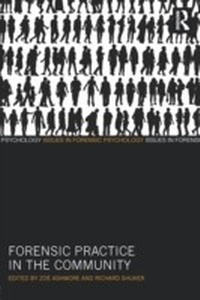
Forensic Practice in the Community
1st Edition
Published on 1. August 2014
318 pages
978-1-135-04978-2 (ISBN)
Description

Forensic practice in the community is a neglected subject. There are many books looking at forensic work in secure settings, such as prisons or hospitals, but very little has been written about forensic practice in the community. This book describes the current and exciting developments in this area, for both young people and adults, by leaders in their field. It is in the community where interventions with those who have offended are all ultimately tested. Bringing together a range of experts from both the practitioner and academic community, this book covers:
*multisystemic therapy for families,
*sexual and violent offending,
*learning disabilities,
*substance misuse,
*risk assessment, prediction and management,
*personality disordered offenders
*resettlement following custody,
*desistance of criminal behaviour,
*community interventions.
Beginning with an overview of forensic practice in the community, the book addresses policy, practice and ethical issues, focusing on the specific dilemmas facing practitioners and providing an analysis of international perspectives. It describes how to meet the challenge of significantly diverting and reducing the prison population through more effective community intervention with adults and young people and also makes suggestions for the future.
This book offers a range of recent case studies, has descriptions of new areas of community practice by those working or studying in that area and covers cutting-edge developments in practice and policy. It will be of interest to academics, practitioners and students in forensic psychology, as well as social workers, probation officers, youth offending officers, police officers, criminal justice agencies and mental health professionals.
*multisystemic therapy for families,
*sexual and violent offending,
*learning disabilities,
*substance misuse,
*risk assessment, prediction and management,
*personality disordered offenders
*resettlement following custody,
*desistance of criminal behaviour,
*community interventions.
Beginning with an overview of forensic practice in the community, the book addresses policy, practice and ethical issues, focusing on the specific dilemmas facing practitioners and providing an analysis of international perspectives. It describes how to meet the challenge of significantly diverting and reducing the prison population through more effective community intervention with adults and young people and also makes suggestions for the future.
This book offers a range of recent case studies, has descriptions of new areas of community practice by those working or studying in that area and covers cutting-edge developments in practice and policy. It will be of interest to academics, practitioners and students in forensic psychology, as well as social workers, probation officers, youth offending officers, police officers, criminal justice agencies and mental health professionals.
Reviews / Votes
'This book should be essential reading for all of those who are interested in working with offenders, young and old. Written by a group of leading practitioners and researchers, the book provides a detailed account of how to work in community settings in ways which not only address the psychological and social needs of offenders, but also effectively manage the risk of further offending occurring.' - Professor Andrew Day, Clinical and Forensic Psychologist, Deakin University, Australia'This book provides a wide-ranging overview of theory and practice in a previously neglected area. This neglect is all the more remarkable because of the area's crucial importance at so many levels. The area - that of forensic practice in the community - now has a major new text to support and stimulate its growth.' - Adrian Needs, Principal Lecturer, Department of Psychology, University of Portsmouth, UK
'This book is a joy: clearly and straight-forwardly written, it addresses subjects which remain under-explored in the academic and professional literature. "Forensic" practice can mean many things, but the focus of this book is on helping criminal justice practitioners working in the community to assess their clients and, indeed, to assess whether they, the practitioners, are doing a good job. Community-based services are often the "poor relation" of custodial services, and not only in funding terms. Yet the job of practitioners working in the community is vitally important, hugely complex, and brings with it equally daunting moral responsibilities. This wise, honest, thoughtful and thought-provoking book will contribute hugely not only to the decision-making of those who have to make these decisions, but also to those academics and students who are thinking about the subject "from the outside".' - Nicola Padfield, Master, Fitzwilliam College, Cambridge and Reader in Criminal and Penal Justice, University of Cambridge, UK This book should be essential reading for all of those who are interested in working with offenders, young and old. Written by a group of leading practitioners and researchers, the book provides a detailed account of how to work in community settings in ways which not only address the psychological and social needs of offenders, but also effectively manages the risk of further offending occurring.
Professor Andrew Day, Clinical and Forensic Psychologist, Deakin University, Australia
This book provides a wide-ranging overview of theory and practice in a previously neglected area. This neglect is all the more remarkable because of the area's crucial importance at so many levels. The area - that of forensic practice in the community - now has a major new text to support and stimulate its growth.
Adrian Needs, Principal Lecturer, Department of Psychology, University of Portsmouth
More details
Series
Language
English
Place of publication
London
United Kingdom
Publishing group
Taylor & Francis Ltd
Target group
College/higher education
Professional and scholarly
Product notice
Reflowable
Illustrations
7 s/w Abbildungen, 18 s/w Tabellen, 7 s/w Zeichnungen
18 Tables, black and white; 7 Line drawings, black and white; 7 Illustrations, black and white
File size
2,86 MB
ISBN-13
978-1-135-04978-2 (9781135049782)
Copyright in bibliographic data and cover images is held by Nielsen Book Services Limited or by the publishers or by their respective licensors: all rights reserved.
Schweitzer Classification
Other editions
Additional editions
Zoe Ashmore | Richard Shuker
Forensic Practice in the Community
Book
07/2014
Routledge
€206.90
Shipment within 15-20 days
Zoe Ashmore | Richard Shuker
Forensic Practice in the Community
Book
06/2014
Routledge
€77.00
Shipment within 15-20 days
Persons
Zoe Ashmore is a Consultant Forensic Psychologist and Multisystemic therapy (MST) Expert. She was the first MST Expert appointed in the UK to train and advise teams in the effective clinical delivery of MST, now being introduced across the UK. She has specialised in intervention programmes for adolescents and their families, both in the community and in custody, for over thirty years, working in the Prison Service, the Home Office, the National Health Service and the Youth Offending Service. In 2011 she was awarded the Senior Practitioner Award by the British Psychological Society for her distinguished lifetime contribution to Forensic Psychology.
Richard Shuker is a Chartered Forensic Psychologist and Head of Psychology and Research at HMP Grendon, a therapeutic community prison for personality disordered offenders. He has managed cognitive behavioural treatment programmes within adult and young offender prisons and is currently lead clinician on the assessment unit at Grendon. His special interests include the assessment and treatment of offenders with personality disorders and other complex needs. He is Series Editor for the book series Issues in Forensic Psychology. He has published in areas including risk assessment, treatment readiness, therapeutic outcome and clinical intervention. He has recently co-edited a book on Grendon's work, research and outcomes.
Richard Shuker is a Chartered Forensic Psychologist and Head of Psychology and Research at HMP Grendon, a therapeutic community prison for personality disordered offenders. He has managed cognitive behavioural treatment programmes within adult and young offender prisons and is currently lead clinician on the assessment unit at Grendon. His special interests include the assessment and treatment of offenders with personality disorders and other complex needs. He is Series Editor for the book series Issues in Forensic Psychology. He has published in areas including risk assessment, treatment readiness, therapeutic outcome and clinical intervention. He has recently co-edited a book on Grendon's work, research and outcomes.
Content
Part 1: Forensic practice in the community - Introduction and Assessment 1. Overview of forensic services in the community, Andrew Bridges & Kasturi Torchia 2. Assessment in Community Settings, Joel Harvey 3. Dilemmas and ethical decision-making: reflective practice in community settings, Gerard Drennan, Sara Casado & Louise Minchin 4. International Perspectives, Natalie Woodier Part 2: Forensic practice in the community- Treatment approaches 5. Working with Sex offenders in Community Settings, Derek Perkins 6. Violent Offending: Developments in Assessment and Treatment in the Community, Matt Bruce 7. Learning Disabilities, Dave Nash 8. Addressing Substance Misuse: Developments in Community-Based Interventions, Matt Gaskell Part 3: Forensic practice in the community- Management in the community 9. Managing risk in the community, Simone Fox and Richard Latham 10. Family Intervention: Multisystemic therapy, Zoe Ashmore 11. Offending Behaviour Programmes: managing the transition from prison into the community, Richard Shuker and Andrew Bates 12. Community risk management for high harm personality disordered offenders, Phil Minoudis 13. Desistance from Crime, Anthony Bottoms 14. Future Directions for Forensic Practice in the Community, Lord Keith Bradley, John Shine and Rebecca Morland.
