

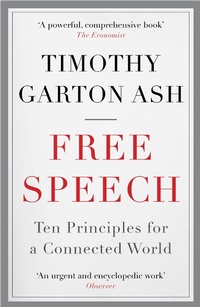
Free Speech
Description

WINNER OF THE 2017 AL-RODHAN PRIZE
Never in human history was there such a chance for freedom of expression. If we have Internet access, any one of us can publish almost anything we like and potentially reach an audience of millions. Never was there a time when the evils of unlimited speech flowed so easily across frontiers: violent intimidation, gross violations of privacy, tidal waves of abuse. A pastor burns a Koran in Florida and UN officials die in Afghanistan.
Drawing on a lifetime of writing about dictatorships and dissidents, Timothy Garton Ash argues that in this connected world that he calls cosmopolis, the way to combine freedom and diversity is to have more but also better free speech. Across all cultural divides we must strive to agree on how we disagree. He draws on a thirteen-language global online project - freespeechdebate.com - conducted out of Oxford University and devoted to doing just that.
With vivid examples, from his personal experience of China's Orwellian censorship apparatus to the controversy around Charlie Hebdo to a very English court case involving food writer Nigella Lawson, he proposes a framework for civilized conflict in a world where we are all becoming neighbours.
Particularly timely. . . Garton Ash argues forcefully that. . . there is an increasing need for freer speech. . . A powerful, comprehensive book - The Economist
More details
Other editions
Additional editions
Person
Content
- Intro
- Also by Timothy Garton Ash
- Title Page
- Copyright
- Dedication
- Contents
- Post-Gutenberg
- Part I
- Cosmopolis
- Speech
- Cosmopolis
- Cyberspace, CA 94305
- The Struggle for Word Power
- Big Dogs
- Big Cats
- P2
- The Power of the Mouse
- 'Innocence of Muslims' and the Lost Innocence of YouTube
- Ideals
- Why Should Speech Be Free?
- How Free Should Speech Be? How Should Free Speech Be?
- Not by Law Alone
- Laws and Norms
- Offended? What's the Harm in That?
- Reading John Stuart Mill in Beijing
- Towards a More Universal Universalism
- Part II
- User Guide
- 1. Lifeblood
- Free and Able
- In Your Own Tongue
- Seek, Receive and Impart
- Regardless of Frontiers
- 2. Violence
- The Assassin's Veto
- Modernising the Brandenburg Test
- Dangerous Speech
- Just War?
- Confronting the Assassin's Veto
- Cartoons and the Republication Dilemma
- Practising Peaceful Conflict
- 3. Knowledge
- Scientifically Speaking
- On Campus
- Legislating History
- Everything Open to Everyone?
- Public Good via Private Power
- From Babel to Babble
- Homo Zappiens
- 4. Journalism
- Media
- Uncensored, but Not Without Limits
- Diverse: Media Pluralism between Money and Politics
- From Daily Me to Daily Kiosk
- Trustworthy: Who Is a Journalist? What Is Good Journalism?
- Towards a Networked Pnyx
- 5. Diversity
- Openness and Robust Civility
- Enforcing Civility?
- Why Mature Democracies Should Move beyond Hate Speech Laws
- Creating a Civil Society
- Art and Humour
- Pornography
- Civility and Power
- 6. Religion
- The Argument for Special Treatment
- But What Is Religion?
- Two Kinds of Respect
- By Law or Custom?
- The Trouble with Islam
- Tolerance
- 7. Privacy
- Are You Ever Alone?
- Privacy, Reputation and the Public Interest
- Battlefields of the Powerful
- Trial by Twitter
- Defending Your Reputation
- A 'Right to Be Forgotten'?
- Don't Be Zuckered
- Janus Anonymous
- 8. Secrecy
- Security and the Challenge Principle
- The Price of Secrecy
- Here We Need Laws
- Who Will Guard the Guardians?
- Whistleblowers and Leakers: An Essential Backstop
- The Trouble with 'Well-Placed Sources'
- The Importance of Not Being Anonymous
- 9. Icebergs
- Icebergs
- One Internet, under Whom?
- Net Neutrality
- Privatising and Exporting Censorship
- Ethical Algorithms?
- Money Speaks (Too Loudly)
- 10. Courage
- Courage
- Two Spirits of Liberty
- Challenge
- Notes
- Bibliography
- Acknowledgements
- Index
- A Note About the Author
