

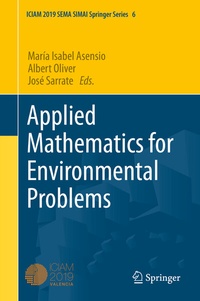
Applied Mathematics for Environmental Problems
Description

This book contains some contributions presented at the Applied Mathematics for Environmental Problems minisymposium during the International Congress on Industrial and Applied Mathematics (ICIAM) held July 15-19, 2019 in Valencia, Spain. The first paper addresses a simplified physical wildfire spread model, based on partial differential equations solved with finite element methods and integrated into a GIS to provide a useful and efficient tool. The second paper focuses on one of the causes of the unpredictable behavior of wildfire, fire-spotting, through a statistical approach. The third paper addresses low -level wind shear which represents one of the most relevant hazards during aircraft takeoff and landing. It presents an experimental wind shear alert system that is based on predicting wind velocities obtained from the Harmonie-Arome model. The last paper addresses the environmental impact of oil reservoirs. It presents high-order hybridizable discontinuous Galerkin formulation combined with high-order diagonally implicit Runge-Kutta schemes to solve one-phase and two-phase flow problems through porous media. All the contributions collected in this volume are interesting examples of how mathematics and numerical modelling are effective tools in the field of environmental problems.
More details
Other editions
Additional editions
Persons
José Sarrate got his PhD in Applied Sciences from the Universitat Politècnica de Catalunya where he is Associate Professor at the Department of Civil and Environmental Engineering in Barcelona. His research interest is the numerical modeling of problems governed by partial differential equations in applied sciences and engineering. He has worked in more than twenty research project founded by public and private institutions that lead to several contributions in indexed journals and international conferences.
Albert Oliver received his PhD from the Universitat Politècnica de Catalunya and is currently an assistant professor at the University of Las Palmas de Gran Canaria. His research interest is the application of the finite element method in environmental problems, and particularly in the simulation of air quality and wind fields at the microscale level; he also works on the generation of tetrahedral adapted meshes for these problems.
