

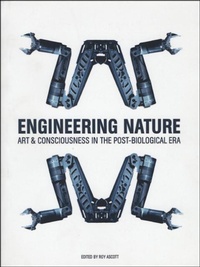
Engineering Nature
Art and Consciousness in the Post-Biological Era
1st Edition
Published on 1. January 2006
328 pages
978-1-84150-928-0 (ISBN)
Description

This third volume in the Consciousness Reframed series, documenting the very latest artistic and theoretical research in new media and telematics including aspects of artificial life, robotics, technoetics, performance, computer music and intelligent architecture. The contributions to this volume represent the work produced at conferences and in journals which are only now emerging into more accessible literature. With over fifty highly respected practitioners and theorists in art and science contributing, there is a stimulating diversity of approach and a rich background of knowledge.
More details
Edition
1. Auflage
Language
English
Place of publication
Bristol
United Kingdom
Publishing group
Intellect
Target group
Professional and scholarly
Product notice
Reflowable
ISBN-13
978-1-84150-928-0 (9781841509280)
Copyright in bibliographic data and cover images is held by Nielsen Book Services Limited or by the publishers or by their respective licensors: all rights reserved.
Schweitzer Classification
Other editions
Additional editions
Book
01/2006
Intellect Books
€49.65
Article not available at the moment
Person
Roy Ascott is Director of the Planetary Collegium, University of Plymouth and Visiting Professor in Design/Media Arts, University of California, Los Angeles. His previous publications include Telematic Embrace: Visionary Theories of Art Technology and Consciousness (University of California Press, 2003)
Content
- Intro
- Contents
- Preface
- Introduction
- 1.1 Towards a Conscious Art - Robert Pepperell
- 1.2 Effing the Ineffable: An Engineering Approach to Consciousness - Steve Grand
- 1.3 (Re)Constructing (Non)Dualism - Andrea Gaugusch
- 1.4 Another View from the Blender - Michael Punt
- 1.5 Bio-electromagnetism: Discrete Interpretations - Nina Czegledy
- 1.6 MEDIATE: Steps Towards a Self-Organising Interface - Paul Newland, Chris Creed and Maestro Ron Geesin
- 1.7 Facts about 'P-E-M' (Psycho-enhanced Memberships) you must know - Armando Montilla
- 1.8 Happenstances - Demnievska Evgenija
- 1.9 Ontological Engineering: Connectivity in the Nanofield - Roy Ascott
- 2.1 Are the Semi-Living Semi-good or Semi-evil? - Ionat Zurr and Oron Catts
- 2.2 Absent Body Project - Yacov Sharir
- 2.3 Our Body as Primary Knowledge Base - Kjell Yngve Petersen
- 2.4 Electronic Cruelty - Gordana Novakovic
- 2.5 Design Against Nature - Anthony Crabbe
- 2.6 Why Look at Artificial Animals? - Geoff Cox and Adrian Ward
- 2.7 Biopoetry - Eduardo Kac
- 3.1 Real Virtuality: Authenticity in Electronic and Non-electronic Environments - Eril Baily
- 3.2 Sharing Virtual Reality Environments across the International Grid (iGrid) - Margaret Dolinsky
- 3.3 Interactive, Responsive Environments: A Broader Artistic Context - Garth Paine
- 3.4 Towards Defining the 'Atmosphere' and Spatial Meaning of Virtual Environments - Ioanna Spanou and Dimitris Charitos
- 3.5 Symbiotic Interactivity in Multisensory Environments - Stahl Stenslie
- 3.6 Aesthetics within Ego Shooter Games - Maia Engeli
- 3.7 Creative Communities in Networked Hybrid Spaces - Mauro Cavalletti
- 3.8 From Multiuser Environments as Space to Space as a Multiuser Environment: Cell Phones in Art and Public Spaces - Adriana de Souza e Silva
- 3.9 Arch-OS v1.1 (Architecture Operating Systems), Software for Buildings - Mike Phillips and Chris Speed
- 3.10 (an)Architecture, Eros, Memory: the Naxsmash Project - Christina McPhee
- 3.11 Who Plays the Nightingale? - Claudia Westermann
- 3.12 Breeding, Feeding, Leeching - Shaun Murray
- 4.1 The Potential of Electronic Textuality - Dene Grigar
- 4.2 Art and Information - David Topping
- 4.3 Metaphorical Vestiges on Info-Viz Trails - Donna J. Cox
- 4.4 Interstellar Messaging, Xenolinguistics and Consciousness: LiveGlide Meets the SETI Enterprise - Diana Reed Slattery and Charles René Mathis
- 4.5 Art and HCI: A Creative Collaboration - Ernest Edmonds, Linda Candy, Mark Fell and Alastair Weakley
- 5.1 The Idea Becomes a Machine: AI and A-Life in Early British Computer Arts - Paul Brown
- 5.2 The Interactivity of the Moving Document as the Diegetic Space of Consciousness - Clive Myer
- 5.3 Assimilating Consciousness: Strategies in Photographic Practice - Jane Tormey
- 5.4 Simultaneity, Theatre and Consciousness - Daniel Meyer-Dinkgräfe
- 5.5 Cinematic Soteriology: Darshanic Effects in the Tamil Bakthi Films - Niranjan Rajah
- 5.6 Search For Utopia: Human Consciousness and Desire - Julia C. Rice
- 5.7 Super Interactivity: Art, Consciousness and the Dawn of the Participatory Age - Alex Shalom Kohav
- 5.8 Pete and Repeat were Sitting on a Fence: Iteration, Interactive Cognition and an Interactive Design Method - Ron Wakkary
- 5.9 Visual Art as an Earning Process: The New Economics of Art - Nicholas Tresilian
- 5.10 Culture, Ecology and the Real - Paul O'Brien
- 5.11 The Immersive Experience of Osmose and Ephémère: An Audience Study - Hal Thwaites
- 5.12 On Making Music with Artificial Life Models - Eduardo Reck Miranda
- 5.13 Artistic Strategies for Using the Arts as an Agent through the Creation of Hyper-Reality Situations - Karin Søndergaard
- 6. The Future 6.1 The Nanomeme Syndrome: Blurring of Fact and Fiction in the Construction of a New Science - Jim Gimzewski and Victoria Vesna
- Contributor Biographies
