

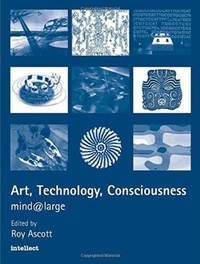
Art, Technology, Consciousness
Mind@large
1st Edition
Published on 1. September 2000
210 pages
978-1-84150-814-6 (ISBN)
Description

Within a technological context, this volume addresses contemporary theories of consciousness, subjective experience, the creation of meaning and emotion, and relationships between cognition and location. Its focus is both on and beyond the digital culture, seeking to assimilate new ideas emanating from the physical sciences as well as embracing spiritual and artistic aspects of human experience. Developing on the studies published in Roy Ascott's successful Reframing Consciousness, the book documents the very latest work from those connected with the internationally acclaimed CAiiA-STAR centre and its conferences. Their artistic and theoretical research in new media and art includes aspects of:
More details
Edition
1. Auflage
Language
English
Place of publication
Bristol
United Kingdom
Publishing group
Intellect
Target group
Professional and scholarly
ISBN-13
978-1-84150-814-6 (9781841508146)
Copyright in bibliographic data and cover images is held by Nielsen Book Services Limited or by the publishers or by their respective licensors: all rights reserved.
Schweitzer Classification
Other editions
Additional editions
Book
09/2000
Intellect Books
€46.40
Shipment within 3-4 weeks
Person
Recipient of the Ars Electronica Golden Nica Award for Visionary Pioneers of Media Art 2014, Roy Ascott has shown at the Shanghai Biennale, Venice Biennale, Biennale do Mercosul Brazil, European Media Festival, Musee d'Art Moderne, Paris, and more. His seminal projects include La Plissure du Texte at Electra, Paris 1984, (Second Life versions in 2010, 2012), and Aspects of Gaia Ars Electronica, 1989. His retrospective The Syncretic Sense was shown at Plymouth Arts Centre, 2009; at the Incheon International Digital Art Festival, Korea, 2010, and at SPACE, Hackney, London, 2011. Roy Ascott: Syncretic Cybernetics was part of the Shanghai Biennale 2012. Roy Ascott: The Analogues, Plug-In ICA Winnipeg in 2013. His work is in the Tate permanent collection.
He is president of the Planetary Collegium (World Universities Forum Award for Best Practice in Higher Education 2011), and the DeTao Master of Technoetic Arts at the Beijing DeTao Masters Academy in Shanghai; and honorary professor of Aalborg University, Copenhagen, and University of West London.
In 1960s London, he established the radical Groundcourse at Ealing and then Ipswich, and taught at the Slade, Saint Martins and the Central Schools of Art. In the 1970s he was president of Ontario College of Art, Toronto, and later vice-president of San Francisco Art Institute. He was professor of communications theory at the University of Applied Arts, Vienna, in the 1980s, and professor of interactive arts at the University of Wales in the 1990s. He is a graduate of King's College, University of Durham. He is now a Doctor Honoris Causa of Ionian University, Corfu, Greece and a Professor Emeritus at University of Plymouth.
Roy lectures and publishes throughout the Americas, Europe, Asia and Australia. Founding editor of Technoetic Arts (Intellect), and honorary editor of Leonard (MIT Press). His books include: The Future is Now: Art, Technology, and Consciousness, Gold Wall Press, Beijing, 2012; Telematic Embrace: Visionary Theories of Art Technology and Consciousness, University of California Press, 2003; Technoetic Arts, Yonsei University Press, 2002; and ??????????????????????(Art & Telematics: Toward the Construction of New Aesthetics), NTT, Tokyo, 1998.
Roy advises new media centres, festivals and juries throughout Europe, Australia, Brazil, Canada, China, Japan, Korea, the USA, CEC and UNESCO.
He is president of the Planetary Collegium (World Universities Forum Award for Best Practice in Higher Education 2011), and the DeTao Master of Technoetic Arts at the Beijing DeTao Masters Academy in Shanghai; and honorary professor of Aalborg University, Copenhagen, and University of West London.
In 1960s London, he established the radical Groundcourse at Ealing and then Ipswich, and taught at the Slade, Saint Martins and the Central Schools of Art. In the 1970s he was president of Ontario College of Art, Toronto, and later vice-president of San Francisco Art Institute. He was professor of communications theory at the University of Applied Arts, Vienna, in the 1980s, and professor of interactive arts at the University of Wales in the 1990s. He is a graduate of King's College, University of Durham. He is now a Doctor Honoris Causa of Ionian University, Corfu, Greece and a Professor Emeritus at University of Plymouth.
Roy lectures and publishes throughout the Americas, Europe, Asia and Australia. Founding editor of Technoetic Arts (Intellect), and honorary editor of Leonard (MIT Press). His books include: The Future is Now: Art, Technology, and Consciousness, Gold Wall Press, Beijing, 2012; Telematic Embrace: Visionary Theories of Art Technology and Consciousness, University of California Press, 2003; Technoetic Arts, Yonsei University Press, 2002; and ??????????????????????(Art & Telematics: Toward the Construction of New Aesthetics), NTT, Tokyo, 1998.
Roy advises new media centres, festivals and juries throughout Europe, Australia, Brazil, Canada, China, Japan, Korea, the USA, CEC and UNESCO.
Content
- Front Cover
- Preliminaries
- Contents
- Preface
- Chapter 1: Beyond Boundaries
- Edge-Life: technoetic structures and moist media - Roy Ascott
- Towards a Third Culture | Being in Between - Victoria Vesna
- The Posthuman Conception of Consciousness: A 10-point Guide - Robert Pepperell
- Genesis: a transgenic artwork - Eduardo Kac
- Techno-Darwinism: artificial selection in the electronic age - Bill Hill
- Not Science, or History: post digital biological art and a distant cousin - Michael Punt
- The Imagination of Matter, Pre-Columbian Cultural DNA and Maize Cultivation - Kathleen Rogers
- Chapter 2: Meaning and Emotion
- Capacity to Conceive New Meanings by Awareness of Conscious Experience - Michio Okuma and Isao Todo
- Motioning Toward the Emergent Definition of E-phany Physics - Bill Seaman
- Emotion Spaces Created from Poems - Tsutomu Miyasato
- The Process Appears: representation and nonrepresentation in computer-based art - Christiane Heibach
- Towards a Physics of Meaning - John Sanfey
- Inquiry into Allegorical Knowledge Systems for Telematic Art - Tania Fraga
- Making Emotional Spaces in The Secret Project: building emotional interactive spaces - Richard Povall
- The Spectactor Project: A Multi-user narrative in 'Mediaspace' - Mike Philips et al
- Interactive Media and the Construction of Dramatic Narrative: becoming and identity in contemporary American drama - Rhona Justice-Malloy
- Two Portraits of Chief Tupa Kupa: the image as an index of shifts in human consciousness - Niranjan Rajah
- Chapter 3: Transmodalities
- The Gift of Seeing: nineteenth-century views from the field - Amy Ione
- Rendering the Viewer Conscious: interactivity and dynamic seeing - Tiffany Holmes
- The Mind's Eye - Nina Czegledy
- Forms of Behaviour and a New Paradigm of Perception to the Production of New Sounds - Edson S. Zampronha
- Music Video, Technology and The Reversal of Perspective - Kevin Williams
- Paradigms of Change in Music and in Digital Communication - Dante Tanzi
- The Space of an Audiovisual Installation within a Real and a Virtual Environment - Dimitrios Charitos and Coti K
- 'Give us the Funk.' Machine Autonomy Meets Rhythmic Sensibility - Jonathan Bedworth and Ben Simmonds
- The Synesthetic Mediator - Malin Zimm
- Chapter 4: Location
- Places of Mind: implications of narrative space for the architecture of information environments - Peter Anders
- Crystal Palace to Media Museum: a conceptual framework for experience and sight - Kylie Message
- Disturbing Territories - Shaun Murray
- Being @ Installations: the space-time of technoetics - Royden Hunt
- Evolutionary Algorithms in Support of Architectural Ground Plan Design - Tomor Elezkurtaj
- Chapter 5: Mind Theory
- There is No Intelligence - Ted Krueger
- Toward a Theory of Creative Inklings - Liane Gabora
- The Bicameral Mind and the Split-Brain Human Computer Interface - Gregory P. Garvey
- Attractors and Vectors: the nature of the meme in visual art - Nicholas Tresilian
- Geo-Aesthetics of Quasi-Objects - Milan Jaros
- A Quantum Mechanical model of Consciousness - John Cowley
- Conceptor: a model of selected consciousness features including emergence of basic speech structures in early childhood - Konrad R. Fialkowski & Boleslaw K. Szymanski
- The Twin-data-stream Theory of Consciousness - Paul Ableman
- Kantian Descriptive Metaphysics and Artificial Consciousness - Susan A. J. Stuart and Chris H. Dobbyn
- Towards a Physics of Subjectivity - Stephen Jones
- Authors' Email Addresses
- Back Cover - Book Description
