

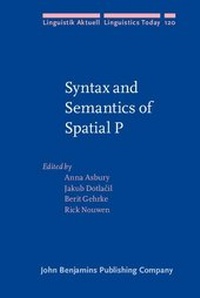
Syntax and Semantics of Spatial P
1st Edition
Published on 21. May 2008
VI, 416 pages
978-90-272-9074-8 (ISBN)
Description

The category P belongs to a less studied area in theoretical linguistics, which has only recently attracted considerable attention. This volume brings together pioneering work on adpositions in spatial relations from different theoretical and cross-linguistic perspectives. The common theme in these contributions is the complex semantic and syntactic structure of PPs. Analyses are presented in several different frameworks and approaches, including generative syntax, optimality theoretic semantics and syntax, formal semantics, mathematical modeling, lexical syntax, and pragmatics. Among the languages featured in detail are English, German, Hebrew, Igbo, Italian, Japanese, and Persian. This volume will be of interest to students and researchers of formal semantics, syntax and language typology, as well as scholars with a more general interest in spatial cognition.
More details
Other editions
Additional editions
Anna Asbury | Jakub Dotlacil | Berit Gehrke
Syntax and Semantics of Spatial P
Book
05/2008
John Benjamins Publishing Co
€127.20
Shipment within 10-15 days
Persons
Content
- Syntax and Semantics of Spatial P
- Editorial page
- Title page
- LCC data
- Table of contents
- Introduction: Syntax and semantics of spatial P
- 1. Basic concepts
- 2. The syntax of spatial P
- 2.1 Boundaries of the category P
- 2.2 The lexical vs. functional debate
- 2.3 Structure of P
- 2.4 Case in PP
- 3. The semantics of spatial P
- 3.1 Locative PPs
- 3.1.1 Regions
- 3.1.2 Vectors
- 3.2 Directional PPs
- 3.2.1 Paths
- 3.2.2 Phase quantifiers
- 3.2.3 Spatiotemporal event modifiers
- 4. Verb-framed and satellite-framed languages
- 5. Paper summaries
- References
- Part I. The general architecture of spatial PPs
- The fine structure of spatial expressions
- 1. Introduction
- 2. The structure of Local PPs
- 3. Aspects of space
- 4. Orientation
- 4.1 Origin
- 4.2 Directions
- 4.2.1 Absolute frames
- 4.2.2 Intrinsic frames
- 4.2.3 Viewer oriented frames
- 4.3 Summary
- 5. Location
- 5.1 Spatial templates
- 5.2 Graded neighbourhoods
- 5.3 Parametrised neighbourhoods
- 5.4 Distance
- 6. Directionality
- 7. The syntactic structure revisited
- 7.1 PLOC
- 7.2 PAXPART
- 7.3 Pstat
- 7.4 PDir
- 8. Resilient cases
- 9. Conclusion
- Appendix A. Mathematical preliminaries
- Appendix B. Types
- References
- Projections of P
- 1. Introduction: The extended projection of P
- 2. Null elements
- 3. Measure expressions and vector spaces
- 4. Immeasurable prepositions: Beside and next to
- 5. Comparison to decomposition in vP
- 6. AxParts
- 6.1 Overt and covert Place
- 6.2 Binding
- 7. Conclusion
- 8. Acknowledgments
- References
- Priorities in the production of prepositions
- 1. Introduction
- 2. Optimality Theory, production and lexicon
- 3. In versus on
- 4. On versus above/over
- 5. Around versus over
- 6. Motivating spatial priorities
- 7. Conclusion
- References
- The grammar of complex particle phrases in English
- 1. What sort of structure under what sort of study?
- 1.1 Some preliminary examples
- 1.2 The framework
- 2. On the term 'particle phrase'
- 2.1 PrtPs are not made up of a particle and the phrasal verb's object NP
- 2.1.1 Problems with the 'PrtP = Prt + Object NP' analysis
- 2.1.2 The alternative: the NP is an immediate constituent of the VP
- 2.1.3 Interim conclusion
- 2.2 The class of PrtPs does not include PPs.
- 2.2.1 Differences between particles (and particle phrases) and prepositional phrases
- 2.2.2 Interim conclusion
- 3. Multiple-particle sequences
- 3.1 Some extreme examples
- 3.2 Finding the head in multiple-particle sequences
- 3.3 Element following the particle: adjunct or complement, and of what?
- 3.4 Back to more complex cases
- 3.5 Interim conclusion
- 4. Peripheral modifiers
- 4.1 Some examples
- 4.2 Some constraints
- 4.3 Quantifying peripheral premodifiers enable a locative reading of particles
- 4.4 Measure NPs expressing a span of time
- 4.5 Right-peripheral modifiers
- 4.6 Freezes
- 5. odification of non-spatial particles
- 5.1 Non-peripheral modification of non- spatial particles
- 5.2 Peripheral modification of non-spatial particles
- 5.3 Discussion
- 6. Conclusion
- References
- Part II. Expressions of directionality
- The correspondence between directionality and transitivity
- 1. Introduction
- 2. Case and adpositions
- 3. A structural approach
- 4. An analysis of spatial adpositions
- 5. The correspondence of directional meaning and transitivity
- 6. On source
- 7. On accusative case
- 8. A BiOT account for adpositional case alternation
- 9. Conclusion
- References
- Pragmatic factors and variation in the expression of spatial goals: The case of into vs. in
- 1. Variation in the expression of spatial goals
- 1.1 Strategies for expressing goals
- 1.2 Co-existing strategies: the problem of into vs. in
- 2. Database
- 3. Contextual inferability of directional meaning
- 3.1 Lexical encoding of the directional meaning
- 3.2 Overriding the default (static) interpretation
- 4. Event construal
- 4.1 Salience of path vs. process of motion
- 4.2 Event construal and expression of goals in languages other than English
- 5. Additional factors: register and transitivity
- 6. Conclusion
- Appendix: Summary of the data
- References
- Complex PPs in Italian
- 1. Introduction
- 2. Prepositions and motion
- 2.1 Italian manner of motion verbs
- 3. Goal of motion structures in Italian: simple prepositions
- 4. Tortora's bounded place
- 5. Complex PPs with a and aspectual heads identification
- 5.1 The first case
- 5.2 The second case
- 5.3 Uunbounded grounds, filled aspectual heads, and concluding remarks
- References
- On the l-syntax of directionality/resultativity
- The case of Germanic preverbs*
- 1. Introduction
- 2. The basic elements of argument structure
- 2.1 Some remarks on the l-syntax of English verb-particle constructions
- 2.2 Generalizing the P(ath) structure
- 3. Stiebels's (1998) challenging patterns of German complex verbs revisited
- 3.1 Complex denominal verbs of the type einrahmen
- 3.2 Complex denominal verbs of the type verslumen
- 3.3 Complex deadjectival verbs of the type eindeutschen
- 3.4 Complex denominal verbs of the type vergärtnern
- 3.5 Complex denominal verbs of the type versanden
- 3.6 Complex locatum verbs of the type unterkellern
- 4. Talmy's (1991, 2000) typology of satellite- vs. verb-framed languages revisited: Path constructions in Germanic vs. Romance
- 5. Concluding remarks
- References
- Part III. Locative PPs
- The distribution and interpretation of adjunct locative PPs
- 1. Introduction
- 1.1 English locatives
- 1.2 Two types of event arguments
- 2. Japanese locatives
- 2.1 The interpretation of adjunct locatives
- 2.2 The subtleties of locative expressions
- 3. The distribution of predicates of e
- 3.1 Lexical vs. syntactic causatives
- 3.2 Restructuring
- 4. Against the complex predicate analysis
- 4.1 Head Movement does not create a complex predicate.
- 5. Beyond adjunct locatives
- 6. Conclusion
- References
- Aspect inside place PPs
- 1. Introduction
- 2. Bounded path, bounded place
- 3. Prepositions in Italian
- 3.1 The lexical preposition dietro
- 3.2 The lexical preposition dentro
- 3.3 A syntactic analysis
- 3.3.1 The "complementizers" a and di
- 4. place PPs in Spanish
- 5. Back to Italian (and some notes on English): mass, plural, and geometrically complex 'figures'
- 5.1 dentro
- dietro (inside
- behind)
- 5.1.1 A note on English
- 5.2 sopra (over/above/on)
- 5.3 sotto (under)
- 6. Conclusion
- References
- Part IV. Silent Ps
- The place of place in Persian
- 1. Introduction
- 2. Silent place now and before
- 2.1 Katz & Postal (1964)
- 2.2 Kayne (2004)
- 2.3 Terzi (2006)
- 2.4 Botwinik-Rotem (this volume)
- 3. The Persian data
- 3.1 General overview and Class 1 Ps
- 3.2 Similarities between Class 2 Ps and nouns
- 3.2.1 The Ezafe linker
- 3.2.2 Demonstratives
- 3.2.3 Pronominal clitics
- 3.2.4 Modifiers
- 3.3 Differences between Class 2 Ps and nouns
- 3.3.1 Class 2 PPs in a subject position
- 3.3.2 Complement of directed motion verbs
- 3.3.3 Adjectival modification and quantifiers
- 3.4 Summary
- 4. Silent place in Persian PPs
- 4.1 Demonstratives and plural morphology
- 4.2 Optionality of Class 1 Ps
- 4.3 Optionality of Ezafe
- 4.4 Clitics and intransitive C2 Ps
- 4.5 Remaining problems
- 5. Conclusion
- References
- Why are they different? An exploration of Hebrew locative PPs
- 1. Introduction
- 2. The unique properties of the Hebrew locatives
- 2.1 Binding
- 2.2 Cross-copular predication
- 2.3 Clausal modification
- 3. The proposal
- 3.1 Nominal structure: initial support and necessary clarifications
- 3.2 Deriving the predicate-hood of locative PPs
- 3.3 Modification by non-locative PPs
- 4. The structure of Hebrew locatives: an exploration
- 4.1 Setting the stage
- 4.2 P in the Hebrew locative structure
- 4.2.1 Hebrew basic locatives and their complex counterparts
- 4.2.2 Additional instances of basic locatives
- 4.3 The function(s) of P enclosing DP of Place
- 4.4 The head of the extended locative projection: N-Place vs. P
- 5. Summary
- References
- Silent prepositions: Evidence from free relatives
- 1. Introduction: silent prepositions
- 2. Two puzzles about free relatives
- 2.1 Puzzle I: Are FRs like NPs or PPs?
- 2.2 Puzzle II: An NP or a PP gap?
- 3. Proposal
- 4. Further evidence
- 4.1 Overt Ps
- 4.2 Complements of P must be NPs
- 4.3 Wh-interrogative clauses
- 4.4 Semantic restrictions on silent P licensing and adverbial NPs
- 5. Problems with alternative accounts
- 5.1 Against an ambiguity account
- 5.2 Against a pied-piping analysis
- 6. Some open issues and conclusions
- References
- Part V. Grammaticalisation
- The grammaticalization of prepositional markers in Igbo : The example of the verb root -nyé 'give'
- 1. Introduction
- 2. The semantics of -nyé 'give'
- 2.1 The literal -nyé
- 2.2 -nyé as the first component of a compound verb
- 2.3 -nyé as an Inherent Complement Verb
- 2.4 -nyé as a second component of a compound verb
- 2.4.1 Semantic change
- 2.4.2 Phonological change
- 3. The spatial aspects of the prepositional markers
- 4. The grammaticalization of -nyé
- 4.1 The paradigmatic aspects
- 4.2 The syntagmatic aspects
- 5. Summary and conclusion
- References
- Index of languages
- Index of authors
- Index of subjects
- The series Linguistik Aktuell/Linguistics Today
