


Critical Discourse in Urdu
Will be published approx. on 28. September 2026
280 pages
E-Book
978-1-042-50275-2 (ISBN)
Description

This volume forms a part of the important multivolume series Critical Discourses in South Asia which explores schools, movements and critical discursive practices in major languages. It brings together English translations of major writings dealing with Urdu literary culture, criticism and theory and re-visiting and re-evaluation of literary concepts and categories over the last one and half centuries that contributed to the making of its critical tradition.
The book with its wide coverage will serve as a useful guide for scholars and researchers of literary and cultural studies. It will be essential reading for those in Urdu language and literature, comparative literature, literary criticism, literary theory, regional language studies, area studies, history, sociology, social and cultural anthropology, politics, gender studies, postcolonial studies, South Asian Studies, and Third World and Global South studies, as well as those working on conservation of languages and cultures, and the Urdu diaspora across the world.
The book with its wide coverage will serve as a useful guide for scholars and researchers of literary and cultural studies. It will be essential reading for those in Urdu language and literature, comparative literature, literary criticism, literary theory, regional language studies, area studies, history, sociology, social and cultural anthropology, politics, gender studies, postcolonial studies, South Asian Studies, and Third World and Global South studies, as well as those working on conservation of languages and cultures, and the Urdu diaspora across the world.
More details
Series
Language
English
Place of publication
London
United Kingdom
Publishing group
Taylor & Francis Ltd
Target group
College/higher education
ISBN-13
978-1-042-50275-2 (9781042502752)
Copyright in bibliographic data is held by Nielsen Book Services Limited or its licensors: all rights reserved.
Schweitzer Classification
Other editions
Additional editions
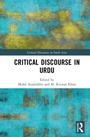
M. Asaduddin | M. Rizwan Khan
Critical Discourse in Urdu
Book
approx. 09/2026
1st Edition
Routledge India
€191.50
Not yet published
Persons
M. Asaduddin is former Professor of English, Jamia Millia Islamia, Delhi, India; and Visiting Professor, University of North Carolina at Chapel Hill, and INALCO, Paris. He was a Charles Wallace Trust Fellow at the university of East Anglia, UK, and Fulbright Scholar-in-Residence at Rutgers University, USA. He is a much-awarded multilingual translator. His research interests and publications span the fields of literary history, language politics, comparative literature and translation studies. Among his works are - Filming Fiction: Tagore, Satyajit Ray and Premchand; and Premchand: The Complete Stories (four volumes)
M. Rizwan Khan is a Professor in the Department of English, Aligarh Muslim University, India; and Visiting Fellow at the Department of Arts and Aesthetics at IULM University, Milan, Italy and at the University of Veszprem, Hungary. As Coordinator of the UGC-SAP DRS-II project on Translation Studies, among various academic activities, he has spearheaded numerous interdisciplinary initiatives and digital advancements in education. Under the Global Initiative of Academic Network (GIAN) program, he has conducted three courses so far.
M. Rizwan Khan is a Professor in the Department of English, Aligarh Muslim University, India; and Visiting Fellow at the Department of Arts and Aesthetics at IULM University, Milan, Italy and at the University of Veszprem, Hungary. As Coordinator of the UGC-SAP DRS-II project on Translation Studies, among various academic activities, he has spearheaded numerous interdisciplinary initiatives and digital advancements in education. Under the Global Initiative of Academic Network (GIAN) program, he has conducted three courses so far.
Content
1. Aab-e Hayat 2. Introduction to Poetry and Poetics (Excerpts) 3. She'rul Ajam (Excerpts) 4. Principles of Literary Criticism 5. Merits of the Poetry of Ghalib 6. Importance of Emotions and Utility of Poetry 7. Poetry and Poet 8. Modern Ghazal 9. Creation and Criticism 10. Introductory Comments on Hafiz 11. Principles of Literary Criticism 12. What is Criticism? 13. Literature and Life 14. Principles of Criticism 15. Some Basic Issues of Criticism 16. The Conflict Between the East and the West 17. Criticism and Ideology 18. Temptation for Sin 19. Poetics of Urdu Ghazal 20. A Conversation with Asif Farrukhi 21. Gabriel and Lucifer 22. Feminism: A Global Perspective 23. Rajinder Singh Bedi:The Metaphorical and Mythical Roots 24. Primary Lesson in Poetry 25. Changing Portrayals of Women in the Urdu Short story: A Brief Assessment 26. The Relationship between Civilization and Criticism 27. Abdur Rahman Bijnauri: The Pioneer of Interdisciplinary Criticism 28. Writing Based Criticism
