

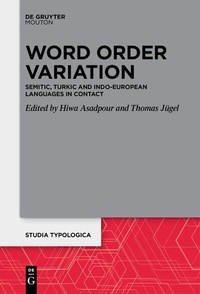
Word Order Variation
Description

In the Iranic-Semitic-Turkic contact area, where many languages are described as verb-final, 'Targets' (Goals, Recipients, etc.) tend to appear in the immediate postverbal position, a pattern violating the alleged 'basic word order'.
Investigating empirical material, the present volume examines the idea of its contact-induced origin by combining various languages from inside and outside this contact area: the Greek variety Romeyka; Indic Domari; Iranic Balochi, Kurdish, Middle Persian, Parthian, Bactrian and Sogdian; Nilotic Maa; Semitic Arabic and Aramaic; Siberian and Iran-Turkic. The contributors investigate word order variation of transitive, ditransitive, and copula structures as well as intransitives with Targets. Their analyses highlight the relevance of grammatical, discourse-pragmatic, and cognitive principles. The volume highlights the importance of Target structures for linguistic theory by offering new perspectives and will be of interest to typologists and linguists interested in word order variation and information structure.
More details
Other editions
Additional editions
Persons
Content
- Intro
- Preface
- Contents
- Factors influencing word ordering
- Proximal to distal: Information flow and order in Maa
- Word order variation in Middle Iranic: Persian, Parthian, Bactrian, and Sogdian
- Word order in Mukri Kurdish - the case of incorporated Targets
- Targets and other postverbal arguments in Southern Balochi: A multidimensional cline
- Word order in contact and the expression of Target in Northern Domari
- The evolution of VO and OV alternation in Romeyka
- Word order in Iran-Turkic
- Word order variation in Chulym Turkic of Siberia
- Copulas and Target phrase positioning in the Arabic dialects of Kurdistan
- Word order typology in North-Eastern Neo- Aramaic
- Index of Authors
- Index of Languages
- Index of Subjects
