

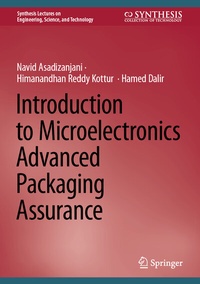
Introduction to Microelectronics Advanced Packaging Assurance
Description

This book offers a comprehensive introduction and in-depth information on all the packaging technologies and fabrication methodologies employed in advanced semiconductor packaging. Coverage includes materials, substrates, and assembly processes, as well as critical areas of testing and reliability, which are crucial for ensuring the utmost quality and reliability of advanced packaging solutions.
More details
Other editions
Additional editions
Persons
Navid Asadizanjani is an associate Professor in the Electrical and Computer Engineering Department at the University of Florida, with affiliation in the Materials Science and Engineering Department. He holds a Ph.D. in Mechanical Engineering and has dedicated his career to advancing research in physical inspection, advanced packaging assurance, non-destructive imaging, multi-modal image analysis, metrology, system- and chip-level decomposition, and counterfeit detection. Dr. Asadizanjani serves as the director of the Security and Assurance (SCAN) Lab, which houses over $12 million in advanced imaging and characterization equipment. He is also the deputy director for research and development within the Florida Semiconductor Institute (FSI). His contributions have been recognized through numerous prestigious awards, including the NSF CAREER Award (2022), multiple best paper awards from IEEE PAINE, ISTFA, ASME ISFA, and the D.E. Crow Innovation Award. Dr. Asadizanjani is the founder and general chair of the IEEE Physical Assurance and Inspection of Electronics (PAINE) Conference. He holds over 20 patents, has authored three books, and has published more than 250 peer-reviewed articles in top-tier conferences and journals. His research projects are funded by various government agencies and industry leaders, including NSF, NIST, AFRL, AFOSR, ONR, the Army, SRC, Meta, Cisco, and Analog Devices.
Himanandhan Reddy Kottur is a senior PhD student in Electrical and Computer Engineering at the University of Florida (UF), USA. He received his B.S. in Electrical Engineering from Anna University, Chennai, India, and his M.S. in Electrical and Computer Engineering from UF in 2021 and 2023, respectively. Before starting his PhD, he spent a year volunteering at UF, where he researched MEMS energy harvesting using PZT materials to power low-power wireless sensors.
His current research focuses on hardware security and counterfeit detection, with an emphasis on utilizing NEMS-based technologies to enhance the security of printed circuit boards (PCBs) and advanced semiconductor packages.
Hamed Dalir is an associate professor in the department of electrical and computer engineering at university of Florida specializes in quantum AI, Semiconductor Laser, and high-speed photonics computing. Dr. Dalir has received numerous accolades for his contributions to the field, including the prestigious Yoshida Foundation Award for the Development of Future Leaders for Changing Times and the JSPS "Young Scientist Fellowship" in 2011 and 2014, respectively. Dr. Dalir's research has been supported by a range of organizations, including AFWERX, AFOSR, NASA, Army, AFRL, NIST, ONR, BAH, Broadcom, and private investors. He has published over sixty scholarly articles in high-impact journals such as Nature Communications, Biosensors and Bioelectronics, Optica, Laser Photonics Review, and Applied Physics Review. In addition, Dr. Dalir has delivered over a hundred keynote addresses, invited talks, and topic lectures at universities and international conferences.
Content
Introduction to IC Packaging Development and Assembly Processes.- Bonding Techniques Interconnects.- CVD in Semiconductor Packaging.- Etching in Semiconductor Manufacturing: Techniques, Applications, and Performance Metrics in Advanced IC Packaging.- Physical Vapor Deposition in Advanced Semiconductor Packaging.
