

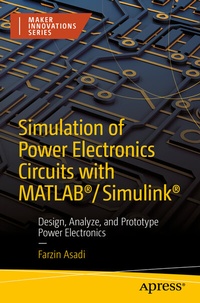
Simulation of Power Electronics Circuits with MATLAB®/Simulink®
Description

Design and analyze electronic components and systems with the help of powerful software and effective skillsets. Balancing theory with practical exploration of the relevant software, you'll start solving power electronics problems like a pro. Using MATLAB®/Simulink®, you'll analyze the circuit in a laptop charger; interface with the power electronics converter controlling a washing machine's motor; turn on lamps with an electronic ballast; convert AC into DC power; and more!
Power electronics are at the bedrock of all the wonderful devices simplifying our daily life. Designing them isn't just about understanding schematics. It also requires measuring twice and cutting once. In order to save time and money, a power electronics circuit must be simulated before construction. So you'll learn how to work with one of the most powerful simulation tools for this purpose. That way you'll know before you even go to make it whether the circuit works as expected.
Learnto work with MATLAB®/Simulink® by directly applying and building the projects in this book. Or use it as a lab manual for power electronics and industrial electronics. Either way, using strong simulations and solid design theory, you'll be able to build power electronics that don't fail.
What You'll Learn
-
Simulate power electronics effectively before building them
-
Select suitable semiconductor components for your circuit based on simulation waveforms
-
Extract dynamic models of converters and design suitable controllers for them
Who This Book Is For
Engineers and students who want to simulate power electronics circuits in MATLAB®/Simulink®.
More details
Other editions
Additional editions
Person
Farzin Asadi received his BSc in Electronics Engineering, MSc in Control Engineering and Phd in Mechatronics Engineering.
Currently he is with the Department of Electrical and Electronics Engineering at the Maltepe University, Istanbul, Turkey.
Dr. Asadi has published more than 40 international papers and 16 books. He is on the editorial board of 7 scientific journals as well. His research interests include switching converters, control theory, robust control of power electronics converters, and robotics.Content
Chapter 1: Introduction to Simulink®.- Chapter 2: Simulation of Dynamical Equations in Simulink®.- Chapter 3: Important Measurements on the Signals.- Chapter 4: Simulation of Uncontrolled Rectifier Circuits.- Chapter 5: Simulation of Controlled Rectifier Circuits.- Chapter 6: Simulation of DC-DC Converters.- Chapter 7: Simulation of Inverters .- Chapter 8: Simulation of Motors and Generators.- Chapter 9: State Space Averaging .- Chapter 10: Input/Output Impedance of DC-DC Converters.- Chapter 11: Review of Some of the Important Theoretical Concepts.- Excerises.
