

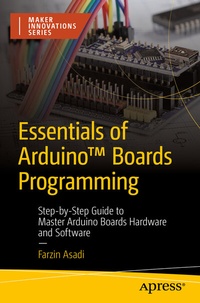
Essentials of ArduinoT Boards Programming
Description

Learn to use the Arduino boards to do big jobs in a simple way. This book is full of real-world examples for Arduino enthusiasts of all experience levels. All of the examples in this book use Arduino UNO, which is an excellent option for educational purposes.
You'll start with an introduction to Arduino and see firsthand how its free multi-platform integrated development environment (IDE) makes coding easier. In many cases, you can edit the given codes to solve your own problems. Arduino boards use a variety of microcontrollers and each board is suitable for a specific application. The Arduino IDE is also preloaded with a broad library of codes that you can modify and practice with. So instead of coding from scratch you can adjust the codes for similar projects. More experienced users will save time by simply copying nuggets of code from the various libraries.
You'll also learn about digital input/output (I/O), analog-to-digital and digital-to-analog converters, LCDs and EEPROM. The book then moves on to serial communication, mathematical functions, and pulse width modulation (PWM), all important features when encoding in telecommunications. Finally, you'll see how to control different types of motors, review interrupts, internal comparators, and timers, and read different sensors with Arduino.
What You Will Learn
- Turn on/off a device using a relay
- Generate analog/digital output
- Read an analog/digital input
- Control motors with a parallel virtual machine (PVM) and serial communication
- Display text with LCDs
- Read sensors with Arduino and use the interrupts
- Write more efficient codes with interrupts and timers
Who This Book Is For
Engineering (electrical/computer/biomedical/robotic/mechatronics/aerospace) and science (math/physic/chemistry) students, makers, and hobbyists. Being familiar with a programming language (especially C) is an advantage, however, it is not necessary.More details
Other editions
Additional editions
Person
Farzin Asadi received his B.Sc. in Electronics Engineering, his M.Sc. in Control Engineering, and his Ph.D. in Mechatronics Engineering. Currently, he is with the Department of Electrical and Electronics Engineering at the Maltepe University, Istanbul, Turkey. Dr. Asadi has published over 40 international papers and 19 books. He is on the editorial board of seven scientific journals as well. His research interests include switching converters, control theory, robust control of power electronics converters, and robotics.
Content
Chapter 1: Introduction to Arduino Boards.- Chapter 2: Digital Input Output (I/O).- Chapter 3: Analog to Digital Converter (ADC) and Digital to Analog Converter (DAC).- Chapter 4: LCD and EEPROM.- Chapter 5: Serial Communication.- Chapter 6: Mathematical Functions.- Chapter 7: Pulse Width Modulation (PWM).- Chapter 8: Control of Different Type of Motors.- Chapter 9: Interrupts and Internal Comparator.- Chapter 10: Timers.- Chapter 11: Reading Different Sensors with Arduino.
