

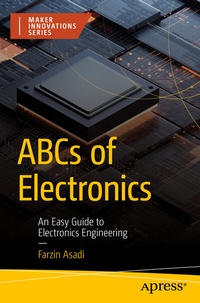
ABCs of Electronics
Description

Completely avoiding unnecessary complex technical concepts and highly mathematical terms, chapters are presented in simple language, using analogies that are familiar to everyone. From deciphering schematics to practical implementation, the knowledge imparted in these pages opens doors to exciting possibilities. You'll gain a solid understanding of crucial components like diodes, transistors, relays, ICs, DC motors, and more.
Whether you're a student looking to grasp the fundamentals or a maker eager to bring your projects to life, ABCs of Electronics is your essential companion.
What You'll Learn
-
Gain the skills to read and implement electronic schematics
- Develop a practical understanding of digital electronics, logic gates, and prototyping platforms.
- Discover how to work with DC motors and relays for various electronic applications.
- Acquire essential electronics knowledge
- Simplify the complexities of electronics and offer practical, hands-on guidance.
Who This Book Is For
Makers, high school and college students pursuing electronic engineering, individuals with a general interest in electronics, and anyone seeking a practical and simplified approach to learning the fundamentals of electronics.
More details
Other editions
Additional editions
Person
Farzin Asadi received his B.Sc. in Electronics Engineering, his M.Sc. in Control Engineering, and his Ph.D. in Mechatronics Engineering. Currently, he is with the Department of Electrical and Electronics Engineering at the Maltepe University, Istanbul, Turkey. Dr. Asadi has published over 40 international papers and 19 books. He is on the editorial board of seven scientific journals as well. His research interests include switching converters, control theory, robust control of power electronics converters, and robotics.
Content
Chapter 1: Power Supply.- Chapter 2: Mechanical Switches.- Chapter 3: Capacitors and Inductors.- Chapter 4: Resistors.- Chapter 5: Diodes and Light-Emitting Diodes (LED's).- Chapter 6: Breadboard.- Chapter 7: Bipolar Junction.- Transistors (BJT).- Chapter 8: Metal-Oxide Semiconductor Field Conductors.- Chapter 9: Relays.- Chapter 10: Integrated Circuits (IC).- Chapter 11: Brushed Permanent Magnet DC Motors.- Chapter 12: Digital Electronics.- Chapter 13: Measurement Devices.
