

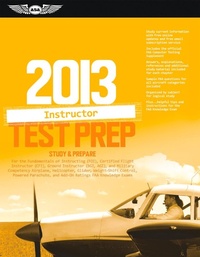
Certified Flight Instructor Test Prep 2013 (PDF eBook)
Pass your test and know what is essential to become a safe, competent pilot from the most trusted source in aviation training
Published on 1. January 2014
496 pages
978-1-56027-918-1 (ISBN)
Description

Applicants studying for the Certified Flight Instructor (CFI) Knowledge Exam will find sample questions from the Federal Aviation Administration exam database along with answers and explanations for them, in this guide. The more than 900 questions from the exam are arranged by subject category, with each section prefaced by text introducing the subject matter and accompanied by specific study material. Each question is followed by the answer, an explanation of the answer, and a Learning Statement Code for further study in FAA materials. Updates are provided to account for FAA test-question changes throughout the publication year via the ASA website or e-mail. Subjects covered include the fundamentals of instructing, the principles of flight, aircraft performance, weather services, en route flight and navigation, airport procedures and operations, and flight physiology.
More details
Other editions
Additional editions
ASA Test Prep Board | U. S. Department of Transportation Federal Aviation Administration
2013 Instructor Test Prep
Study & Prepare for the Ground, Flight, Military Competency and Sport Instructor: Airplane, Helicopter, Glider, Weight-Shift Control, Powered Parachute, Add-on Ratings, and Fundamentals of Instructing Faa Knowledge Exams
Book
07/2012
Aviation Supplies & Academics Inc
€45.99
Article exhausted; check different version
Content
- Intro
- Instructions
- Preface
- Updates and Practice Tests
- Description of the Tests
- Knowledge Test Eligibility Requirements
- Process for Taking a Knowledge Test
- Use of Test Aids and Materials
- Retesting Procedures
- Cheating or Other Unauthorized Conduct
- Eligibility Requirements for the Flight Instructor Certificates
- Knowledge Exam References
- ASA Test Prep Layout
- Chapter 1 Fundamentals of Instructing
- The Learning Process
- Human Behavior
- Effective Communications
- The Teaching Process
- Teaching Methods
- The Instructor as a Critic
- Evaluation
- Instructional Aids
- Flight Instructor Characteristics and Responsibilities
- Techniques of Flight Instruction
- Planning Instructional Activity
- Chapter 2 Aerodynamics and the Principles of Flight
- The Axes of an Aircraft
- Airfoils and Aerodynamic Shapes
- The Aerodynamic Forces
- The Balance of Forces
- Maneuverability, Controllability, and Stability
- Aerodynamic Efficiency
- Load Factors and Maneuvering Speed
- Stalls and Spins
- Wing Shapes
- High-Lift Devices
- Ground Effect
- Principles of Rotorcraft Flight
- Gyroplane Aerodynamics
- Glider Aerodynamics
- Balloon Aerodynamics
- Weight-Shift Control Aerodynamics
- Powered Parachute Aerodynamics
- Chapter 3 Aircraft Systems
- Magnetic Compass
- Pitot-Static Instruments
- Gyroscopic Instruments
- The Electrical System
- Oxygen Systems
- Cold Weather Operation
- The Powerplant
- The Ignition System
- Fuel Systems
- Fuel-Air Mixture Control
- Induction Systems
- Detonation
- Propeller Design
- Propeller Forces
- Critical Engine of a Multi-Engine Airplane
- Constant-Speed Propellers
- Rotorcraft Systems
- Glider Instrumentation
- Balloon Fuel Systems
- Light-Sport Aircraft Systems
- Chapter 4 Aircraft Performance
- Altitude
- Effect of Density Altitude on Aircraft Performance
- Takeoff Performance
- Climb Performance
- Range Performance
- Glide Distance
- Stall Speed Performance
- Landing Performance
- Multi-Engine Performance
- Wind Components
- Helicopter Performance
- Balloon Performance
- Principles of Weight and Balance
- Locating the Balance Point
- Finding the Center of Gravity
- Weight to be Added or Removed
- Weight to be Shifted
- Helicopter Weight and Balance
- Chapter 5 Weather and Weather Services
- The Earth's Atmosphere
- Temperature, Pressure and Density
- Wind
- Moisture and Precipitation
- Stable and Unstable Air
- Clouds
- Air Masses and Fronts
- Turbulence
- Icing
- Thunderstorms
- Common IMC Producers
- High-Altitude Weather
- Soaring Weather
- Aviation Routine Weather Report (METAR)
- Pilot Reports (UA) and Radar
- Terminal Aerodrome Forecast (TAF)
- Aviation Area Forecast (FA)
- Winds and Temperatures Aloft Forecast (FB)
- In-Flight Weather Advisories (WA, WS, WST)
- Surface Analysis Chart
- Weather Depiction Chart
- Radar Summary Chart
- Constant Pressure Analysis Charts
- Significant Weather Prognostic Charts
- Convective Outlook Chart
- Composite Moisture Stability Charts
- Chapter 6 Enroute Flight and Navigation
- Enroute Flight
- The Wind Triangle
- The Flight Computer
- Finding Time, Distance, Ground Speed
- Finding Magnetic Heading and Ground Speed
- Finding Wind Direction and Velocity
- Finding Distance Traveled
- Finding Fuel Required
- Finding Range Available
- Finding the Required Airspeed
- Off-Course Correction
- Automatic Direction Finder (ADF)
- Very High Frequency Omni-Directional Range (VOR)
- Time and Distance to the Station Using VOR
- VOR Test (VOT)
- VORTAC
- Radio Magnetic Indicator (RMI)
- Distance Measuring Equipment (DME)
- Chapter 7 Procedures and Airport Operations
- Airspace
- Airport/Facility Directory
- Runway Gradient
- Control Tower Operating Hours
- Notices to Airmen (NOTAM)
- Communications
- Airport Lighting
- Airport Marking Aids and Signs
- Airport Operation
- Wake Turbulence
- Flight Plans
- Chapter 8 Regulations
- Definitions and Abbreviations
- Accident Reports
- Required Documents
- Medical Certificates
- Student Pilot Certification
- Recreational Pilot Certification
- Private Pilot Certification
- Commercial Pilot Certification
- Ground and Flight Instructor Certification
- Flight Instructors with a Sport Pilot Rating
- Flight Instruction, Reviews and Records
- Required Endorsements
- Pilot Tests
- Presolo Requirements
- Recency of Experience
- Change of Permanent Mailing Address
- Glider Towing
- Emergency Deviation from Rules
- Preflight Planning
- Use of Seatbelts
- Alcohol and Drugs
- Parachutes
- Safety Pilot Requirements
- Fuel Reserve Requirements
- Transponder Requirements
- Minimum Equipment Lists
- Supplemental Oxygen
- Lighting Requirements
- Emergency Locator Transmitter
- Formation Flights and Right-of-Way
- Maximum Authorized Speeds
- Acrobatic Flight
- Distance from Obstructions
- Flight Plan Airspeed
- Flight from Noncontrolled Airports
- VFR Cruising Altitudes
- Maintenance, Preventive Maintenance and Alterations
- Rotorcraft Regulations
- Gyroplane Regulations
- Glider Regulations
- Balloon Regulations
- Chapter 9 Flight Instruction and Maneuvers
- Taxiing
- Takeoffs
- Turns
- Turbulence and Wind Correction
- Approaches and Landings
- Rectangular Course
- Turns Around a Point
- S-Turns
- Eights-On-Pylons
- Stalls and Slow Flight
- Steep Turns
- Chandelles
- Lazy Eights
- Flight by Reference to Instruments
- Helicopter Operation
- Helicopter Controls
- Takeoffs and Hovering
- Autorotation
- Retreating Blade Stall
- Settling with Power
- Slope Operation
- Rapid Decelerations
- Pinnacle Approaches
- Running Landings
- Gyroplane Flight Operation
- Glider Flight Operation
- Balloon Flight Operation
- Chapter 10 Flight Physiology
- Principles of Flight Instruction
- Fitness for Flight
- Supplemental Oxygen
- Spatial Disorientation, Vertigo, and Visual Illusions
- Motion Sickness
- Collision Avoidance
- Cross References
- A: Question Number and Page Number
- B: Learning Statement Code and Question Number
