

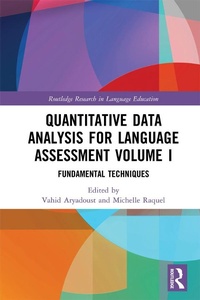
Quantitative Data Analysis for Language Assessment Volume I
Fundamental Techniques
Published on 27. March 2019
288 pages
978-1-351-74122-4 (ISBN)
Description

Quantitative Data Analysis for Language Assessment Volume I: Fundamental Techniques is a resource book that presents the most fundamental techniques of quantitative data analysis in the field of language assessment. Each chapter provides an accessible explanation of the selected technique, a review of language assessment studies that have used the technique, and finally, an example of an authentic study that uses the technique. Readers also get a taste of how to apply each technique through the help of supplementary online resources that include sample data sets and guided instructions. Language assessment students, test designers, and researchers should find this a unique reference as it consolidates theory and application of quantitative data analysis in language assessment.
More details
Series
Language
English
Place of publication
London
United Kingdom
Publishing group
Taylor & Francis Ltd
Target group
College/higher education
Professional and scholarly
Product notice
Reflowable
Illustrations
58 Tables, black and white; 46 Line drawings, black and white
File size
5,58 MB
ISBN-13
978-1-351-74122-4 (9781351741224)
Copyright in bibliographic data and cover images is held by Nielsen Book Services Limited or by the publishers or by their respective licensors: all rights reserved.
Schweitzer Classification
Other editions
Additional editions
Vahid Aryadoust | Michelle Raquel
Quantitative Data Analysis for Language Assessment Volume I
Fundamental Techniques
Book
12/2020
1st Edition
Routledge
€51.98
Shipment within 15-20 days
Vahid Aryadoust | Michelle Raquel
Quantitative Data Analysis for Language Assessment Volume I
Fundamental Techniques
Book
03/2019
1st Edition
Routledge
€206.70
Shipment within 10-20 days
Persons
Vahid Aryadoust is an Assistant Professor of language assessment literacy at the National Institute of Education of Nanyang Technological University, Singapore. He has led a number of language assessment research projects funded by, for example, the Ministry of Education (Singapore), Michigan Language Assessment (USA), Pearson Education (UK), and Paragon Testing Enterprises (Canada), and published his research in, for example, Language Testing, Language Assessment Quarterly, Assessing Writing, Educational Assessment, Educational Psychology, and Computer Assisted Language Learning. He has also (co)authored a number of book chapters and books which have been published by Routledge, Cambridge University Press, Springer, Cambridge Scholar Publishing, Wiley Blackwell, etc. He is a member of the Advisory Board of multiple international journals including Language Testing, Language Assessment Quarterly, Educational Assessment, Educational Psychology, and Asia Pacific Journal of Education. In addition, he has been awarded the Intercontinental Academia Fellowship (2018-2019) which is an advanced research program launched by the University-Based Institutes for Advanced Studies. Vahid's areas of interest include theory-building and quantitative data analysis in language assessment, neuroimaging in language comprehension, and eye tracking research.
Michelle Raquel is a Senior Lecturer at the Centre of Applied English Studies, University of Hong Kong where she teaches language testing and assessment to postgraduate students. She has extensive assessment development and management experience in the Hong Kong education and government sector. In particular, she has either led or been part of a group that designed and administered large-scale computer-based language proficiency and diagnostic assessments such as the Diagnostic English Language Tracking Assessment (DELTA). She specializes in data analysis, specifically Rasch measurement, and has published several articles in international journals on this topic as well as academic English, diagnostic assessment, dynamic assessment of English second-language dramatic skills, and English for specific purposes (ESP) testing. Michelle' research areas are classroom-based assessment, diagnostic assessment, and workplace assessment.
Michelle Raquel is a Senior Lecturer at the Centre of Applied English Studies, University of Hong Kong where she teaches language testing and assessment to postgraduate students. She has extensive assessment development and management experience in the Hong Kong education and government sector. In particular, she has either led or been part of a group that designed and administered large-scale computer-based language proficiency and diagnostic assessments such as the Diagnostic English Language Tracking Assessment (DELTA). She specializes in data analysis, specifically Rasch measurement, and has published several articles in international journals on this topic as well as academic English, diagnostic assessment, dynamic assessment of English second-language dramatic skills, and English for specific purposes (ESP) testing. Michelle' research areas are classroom-based assessment, diagnostic assessment, and workplace assessment.
Content
Preface
List of figures
List of tables
Preface
Editor and contributor biographies
Introduction
Section I Test development, reliability, and generalizability
1. Item analysis in language assessment (Rita Green)
2. Univariate generalizability theory in language assessment (Yasuyo Sawaki and Xiaoming Xi)
3. Multivariate generalizability theory in language assessment (Kirby C. Grabowski and Rongchan Lin)
Section II Undimensional Rasch measurement
4. Applying Rasch measurement in language assessment: Unidimensionality and local independence (Jason Fan and Trevor Bond)
5. The Rasch Measurement Approach to Differential Item Functioning (DIF) analysis in language assessment research (Michelle Raquel)
6. Application of the Rating Scale Model and the Partial Credit Model in language assessment research (Ikkyu Choi)
7. Many-Facet Rasch Measurement: Implications for rater-mediated language assessment (Thomas Eckes)
Section III Unvariate and multivariate statistical analysis
8. Analysis of differences between groups: the t-test and the analysis of variance (ANOVA) in language assessment (Tugba Elif Toprak)
9. Application of ANCOVA and MANCOVA in language assessment research (Zhi Li and Michelle Y. Chen)
10. Application of linear regression in language assessment (Daeryong Seo and Husein Taherbhai)
11. Application of exploratory factor analysis in language assessment (Limei Zhang and Wenshu Luo)
Index
List of figures
List of tables
Preface
Editor and contributor biographies
Introduction
Section I Test development, reliability, and generalizability
1. Item analysis in language assessment (Rita Green)
2. Univariate generalizability theory in language assessment (Yasuyo Sawaki and Xiaoming Xi)
3. Multivariate generalizability theory in language assessment (Kirby C. Grabowski and Rongchan Lin)
Section II Undimensional Rasch measurement
4. Applying Rasch measurement in language assessment: Unidimensionality and local independence (Jason Fan and Trevor Bond)
5. The Rasch Measurement Approach to Differential Item Functioning (DIF) analysis in language assessment research (Michelle Raquel)
6. Application of the Rating Scale Model and the Partial Credit Model in language assessment research (Ikkyu Choi)
7. Many-Facet Rasch Measurement: Implications for rater-mediated language assessment (Thomas Eckes)
Section III Unvariate and multivariate statistical analysis
8. Analysis of differences between groups: the t-test and the analysis of variance (ANOVA) in language assessment (Tugba Elif Toprak)
9. Application of ANCOVA and MANCOVA in language assessment research (Zhi Li and Michelle Y. Chen)
10. Application of linear regression in language assessment (Daeryong Seo and Husein Taherbhai)
11. Application of exploratory factor analysis in language assessment (Limei Zhang and Wenshu Luo)
Index
