

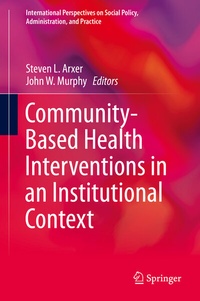
Community-Based Health Interventions in an Institutional Context
Description

Community-Based Health Interventions in an Institutional Context
examines challenges of "institutionalizing" community-based health care. While the community-based or localized model is growing in popularity and importance in the United States, in practice it must often be brought in to larger institutions in order to grow to scale. The typical goals of an institution-standardization, formalization, and control-may be seen as antithetical to those of a community-based healthcare provider, such as spontaneity, customization, and flexibility.
The contributions to this work raise questions about how the community-based model can be scaled up through institutions, and how "institutionalization" can be rethought from a bottom-up approach. They provide not only an overview of community-based organizations, but also delve into practical topics such as establishing budgets, training workers, incorporating technology, as well as more theoretical topics like goal-setting, policy effects (like the ACA), and relationships between patient and community.
This work will be of interest for researchers interested in exploring the community-based health care model, as well as practitioners in health care and health policy.
More details
Other editions
Additional editions
Persons
John W. Murphy is professor of sociology at the University of Miami. He received his doctoral degree in 1981 from Ohio State University. His research interests are sociological theory, social philosophy, and globalization. He has published books related to the community mental health movement, the computerization of social service agencies, and contemporary social theory, including The Symbolization of Globalization, Development, and Aging (Springer, 2013).
