

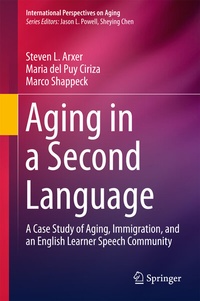
Aging in a Second Language
Description

This unique account of English language acquisition by Latino elders shines intimate light on the increasingly complex concerns of aging immigrant minority populations. Rich qualitative findings detail sociocultural barriers to and social and emotive factors that promote second language acquisition in older age. The book's case study highlights diverse cognitive and social processes as elders establish a sense of self as learners and as part of a learning community, and a sense of place as newcomers navigating a challenging environment. And first-person comments from the group members deftly illustrate the intricacies of being an immigrant in a rapidly changing America as well as the myriad intersections of race/ethnicity, gender, culture, and country that shape immigrant life.
Included in the coverage:-
Minority aging in an immigrant context.
-
Late-life second language acquisition: cognitive andpsycholinguistic changes, challenges, and opportunities.
-
Building emotions for self-identity and learning.
-
Practicing safe language socialization in private and public spaces.
-
Language resocialization and gender allies.
-
Aging, second language acquisition, and health.
More details
Other editions
Additional editions
Persons
Steven L. Arxer, Ph.D. is associate professor at the University of North Texas at Dallas in the Department of Sociology and Psychology. He specializes in qualitative research on minority populations, with a focus on intersectionality, aging and development.
Maria Ciriza-Lope, Ph.D. is assistant professor at the University of North Texas at Dallas in the Department of Languages and Communication. She is an expert on language contact, Spanish heritage language pedagogy and language revitalization movements.
Marco Shappeck, Ph.D.
is assistant professor at the University of North Texas at Dallas in the Department of Teacher Education and Administration. He specializes in linking education applications of sociolinguistic research to the teaching of English and Spanish as a second or foreign language.
