

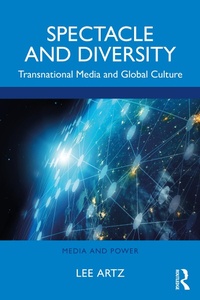
Spectacle and Diversity
Transnational Media and Global Culture
1st Edition
Published on 30. December 2021
260 pages
978-1-000-51523-7 (ISBN)
Description

This book shows how transnational media operate in the contemporary world and what their impact is on film, television, and the larger global culture. Where a company is based geographically no longer determines its outreach or output. As media consolidate and partner across national and cultural boundaries, global culture evolves. The new transnational media industry is universal in its operation, function, and social impact. It reflects a shared transnational culture of consumerism, authoritarianism, cultural diversity, and spectacle. From Wolf Warriors and Sanju to Valerian: City of 1000 Planets and Pokemon, new media combinations challenge old assumptions about cultural imperialism and reflect cross-boundary collaboration as well as boundary-breaking cultural interpretation. Intended for students of global studies and international communication at all levels, the book will appeal to a wide range of readers interested in the way transnational media work and how that shapes our culture.
Reviews / Votes
Praise for Spectacle and Diversity: Transnational Media and Global Culture"Lee Artz masterfully links the political economy of contemporary transnational entertainment media to substantive aspects of our highly mediated and densely saturated global entertainment culture. Artz reveals that our U.S.-centric categories are woefully inadequate. By looking at multiple regions, Artz addresses vast changes in global entertainment media's division of labor, labor practices, financial, distributive, and consumption patterns. Artz's work revives a "cultural industry" approach but Artz is far less speculative about cultures' effects. Rather, he shows us how neoliberalism's master frame suffuses the content of new cultural products. Artz's book is an indispensable critical theory of the present; it aligns global media with an emergent global ideology for capital accumulation.'
Robert F. Carley, Texas A&M University, USA
A very comprehensive, extremely well-researched evidenced-based book for those who are interested to know transnational entertainment media's hidden political economic agenda. With systematically relevant interesting examples, Artz unpacks how TNMCs through film and television present world views, beliefs, and values which support transnational capitalism and blind consumerism. A must read book for all those who consider themselves media scholars and activists.
Bushra Hameedur Rahman, University of the Punjab, Pakistan
"There is no one better than Lee Artz to examine the state of global media. In his latest work, Spectacle and Diversity: Transnational Media and Global Culture, Artz provides detailed analysis of media corporations by using the framework of transnational capitalism to challenge our understanding of cultural imperialism. Original, insightful, revealing and necessary reading for anyone interested in globalization, media, culture and political economy."
Jerry Harris, Director, Global Studies Association of North America
"It is what it?s not. This enigmatic catchphrase may be the dialectic key to understanding the critical perspective that stems out of Artz's thorough analytical and empirical uncovering of transnational media corporations. His skilled and informed `unpacking' of media containers reveals contemporary capitalist development--monopolies that concentrate their market power, political influence and cultural outreach-while our bodies, attention and expectations become the major source of an unprecedented and seemingly infinite, intangible accumulation of surplus value. Media rewrite domination as we click our bodies and souls to exhaustion and unlimited frustration. Whereas multinational corporations already surpassed the boundaries of national frontiers and labor exploitation, it is now capital as a spectacle of delusive diversity that continuously transforms itself into sameness and ludicrosity. Artz helps us understand why our stories `are still being told by someone else.' That someone is actually the eternal return of the same, ghostly spirit of greed, accumulation and mass mediation taken to the extreme of apparent immediacy and passive acceptance of what is, but should not be."
Gilson Schwartz, University of Sao Paulo, Brazil Praise for Spectacle and Diversity: Transnational Media and Global Culture
"Lee Artz masterfully links the political economy of contemporary transnational entertainment media to substantive aspects of our highly mediated and densely saturated global entertainment culture. Artz reveals that our U.S.-centric categories are woefully inadequate. By looking at multiple regions, Artz addresses vast changes in global entertainment media's division of labor, labor practices, financial, distributive, and consumption patterns. Artz's work revives a "cultural industry" approach but Artz is far less speculative about cultures' effects. Rather, he shows us how neoliberalism's master frame suffuses the content of new cultural products. Artz's book is an indispensable critical theory of the present; it aligns global media with an emergent global ideology for capital accumulation.'
Robert F. Carley, Texas A&M University, USA
A very comprehensive, extremely well-researched evidenced-based book for those who are interested to know transnational entertainment media's hidden political economic agenda. With systematically relevant interesting examples, Artz unpacks how TNMCs through film and television present world views, beliefs, and values which support transnational capitalism and blind consumerism. A must read book for all those who consider themselves media scholars and activists.
Bushra Hameedur Rahman, University of the Punjab, Pakistan
"There is no one better than Lee Artz to examine the state of global media. In his latest work, Spectacle and Diversity: Transnational Media and Global Culture, Artz provides detailed analysis of media corporations by using the framework of transnational capitalism to challenge our understanding of cultural imperialism. Original, insightful, revealing and necessary reading for anyone interested in globalization, media, culture and political economy."
Jerry Harris, Director, Global Studies Association of North America
"It is what it?s not. This enigmatic catchphrase may be the dialectic key to understanding the critical perspective that stems out of Artz's thorough analytical and empirical uncovering of transnational media corporations. His skilled and informed `unpacking' of media containers reveals contemporary capitalist development--monopolies that concentrate their market power, political influence and cultural outreach-while our bodies, attention and expectations become the major source of an unprecedented and seemingly infinite, intangible accumulation of surplus value. Media rewrite domination as we click our bodies and souls to exhaustion and unlimited frustration. Whereas multinational corporations already surpassed the boundaries of national frontiers and labor exploitation, it is now capital as a spectacle of delusive diversity that continuously transforms itself into sameness and ludicrosity. Artz helps us understand why our stories `are still being told by someone else.' That someone is actually the eternal return of the same, ghostly spirit of greed, accumulation and mass mediation taken to the extreme of apparent immediacy and passive acceptance of what is, but should not be."
Gilson Schwartz, University of Sao Paulo, Brazil
More details
Series
Edition
1. Auflage
Language
English
Place of publication
London
United Kingdom
Publishing group
Taylor & Francis Ltd
Target group
Professional and scholarly
Illustrations
34 Tables, black and white
ISBN-13
978-1-000-51523-7 (9781000515237)
Copyright in bibliographic data and cover images is held by Nielsen Book Services Limited or by the publishers or by their respective licensors: all rights reserved.
Schweitzer Classification
Other editions
Additional editions
Book
12/2021
1st Edition
Routledge
€61.40
Shipment within 15-20 days
Book
12/2021
1st Edition
Routledge
€207.80
Shipment within 15-20 days
Person
Lee Artz (Ph.D., University of Iowa), a former machinist and union steelworker, is Professor of Media Studies and Director of the Center for Global Studies at Purdue University Northwest. Artz has published twelve books and fifty book chapters and journal articles on media practices, social change, and democratic communication. He speaks regularly on global media, popular culture, media hegemony, and the political economy of the media.
Content
Introduction
Transnational Media: The New Order
Chapter One
Global Entertainment: Not Yet the Democratic Age
Chapter Two
Cultural Imperialism and Transnational Media
Chapter Three
Media in India: From Public to Private to Transnational
Chapter Four
Crouching Tigers: Transnational Media in and from China
Chapter Five
Latin America: From Telenovelas to Transnational Media
Chapter Six
The New Frontiers of Europe: Transnational Media Partnerships
Chapter Seven
The Hegemonic Appeal of Spectacle and Diversity
Transnational Media: The New Order
Chapter One
Global Entertainment: Not Yet the Democratic Age
Chapter Two
Cultural Imperialism and Transnational Media
Chapter Three
Media in India: From Public to Private to Transnational
Chapter Four
Crouching Tigers: Transnational Media in and from China
Chapter Five
Latin America: From Telenovelas to Transnational Media
Chapter Six
The New Frontiers of Europe: Transnational Media Partnerships
Chapter Seven
The Hegemonic Appeal of Spectacle and Diversity
