

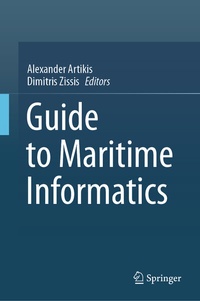
Guide to Maritime Informatics
1st Edition
Published on 8. February 2021
XV, 333 pages
978-3-030-61852-0 (ISBN)
Description

In the last 25 years, information systems have had a disruptive effect on society and business. Up until recently though, the majority of passengers and goods were transported by sea in many ways similar to the way they were at the turn of the previous century. Gradually, advanced information technologies are being introduced, in an attempt to make shipping safer, greener, more efficient, and transparent. The emerging field of Maritime Informatics studies the application of information technology and information systems to maritime transportation.
Maritime Informatics can be considered as both a field of study and domain of application. As an application domain, it is the outlet of innovations originating from data science and artificial intelligence; as a field of study, it is positioned between computer science and marine engineering. This new field's complexity lies within this duality because it is faced with disciplinary barriers yet demands a systemic, transdisciplinary approach. At present, there is a growing body of knowledge that remains undocumented in a single source or textbook designed to assist students and practitioners.
This highly useful textbook/reference starts by introducing required knowledge, algorithmic approaches, and technical details, before presenting real-world applications. The aim is to present interested audiences with an overview of the main technological innovations having a disruptive effect on the maritime industry, as well as to discuss principal ideas, methods of operation and applications, and future developments. The material in this unique volume provides requisite core knowledge for undergraduate or postgraduate students, employing an analytical approach with numerous real-world examples and case studies.
Maritime Informatics can be considered as both a field of study and domain of application. As an application domain, it is the outlet of innovations originating from data science and artificial intelligence; as a field of study, it is positioned between computer science and marine engineering. This new field's complexity lies within this duality because it is faced with disciplinary barriers yet demands a systemic, transdisciplinary approach. At present, there is a growing body of knowledge that remains undocumented in a single source or textbook designed to assist students and practitioners.
This highly useful textbook/reference starts by introducing required knowledge, algorithmic approaches, and technical details, before presenting real-world applications. The aim is to present interested audiences with an overview of the main technological innovations having a disruptive effect on the maritime industry, as well as to discuss principal ideas, methods of operation and applications, and future developments. The material in this unique volume provides requisite core knowledge for undergraduate or postgraduate students, employing an analytical approach with numerous real-world examples and case studies.
More details
Series
Language
English
Place of publication
Cham
Switzerland
Publishing group
Springer International Publishing
Target group
Professional and scholarly
Product notice
Reflowable
Illustrations
XV, 333 p. 114 illus., 111 illus. in color.
File size
13,09 MB
ISBN-13
978-3-030-61852-0 (9783030618520)
DOI
10.1007/978-3-030-61852-0
Schweitzer Classification
Other editions
Additional editions
Alexander Artikis | Dimitris Zissis
Guide to Maritime Informatics
Book
02/2021
Springer
€96.29
Shipment within 7-9 days
Persons
Alexander Artikis is an Assistant Professor at the University of Piraeus and a Research Associate at the National Centre for Scientific Research (NCSR) "Demokritos". His research interests lie in the fields of Artificial Intelligence and Data Science.
Dimitrios Zissis is Associate Professor at the Department of Product and Systems Design Engineering, University of the Aegean, Syros, Greece.
Dimitrios Zissis is Associate Professor at the Department of Product and Systems Design Engineering, University of the Aegean, Syros, Greece.
Content
Maritime Reporting Systems.- Navigating the Ocean of Publicly Available Maritime Data.- Maritime Data Processing in Relational Databases.- Maritime Data Analytics.- Visual Analytics of Vessel Movement.- Online Mobility Tracking against Evolving Maritime Trajectories.- Link Discovery for Maritime Monitoring.- Composite Maritime Event Recognition.- Uncertainty handling for maritime route deviation.- Maritime network analysis: connectivity and spatial distribution.- Shipping economics and analytics.
