

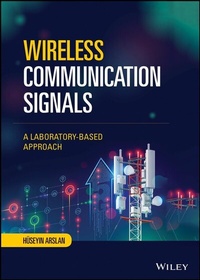
Wireless Communication Signals
Description

A practical guide to wireless communication systems and concepts
Wireless technologies and services have evolved significantly over the last couple of decades, and Wireless Communication Signals offers an important guide to the most recent advances in wireless communication systems and concepts grounded in a practical and laboratory perspective. Written by a noted expert on the topic, the book provides the information needed to model, simulate, test, and analyze wireless system and wireless circuits using modern instrumentation and computer aided design software.
Designed as a practical resource, the book provides a clear understanding of the basic theory, software simulation, hardware test, and modeling, system component testing, software and hardware interactions and co-simulations. This important book:
* Provides organic and harmonized coverage of wireless communication systems
* Covers a range of systems from radio hardware to digital baseband signal processing
* Presents information on testing and measurement of wireless communication systems and subsystems
* Includes MATLAB file codes
Written for professionals in the communications industry, technical managers, and researchers in both academia and industry. Wireless Communication Signals introduces wireless communication systems and concepts from both a practical and laboratory perspective.
More details
Other editions
Additional editions
Person
Hüseyin Arslan is a Professor at the University of South Florida. He has broad research experience in wireless communication systems, digital signal processing, cognitive radio, and channel modeling.
Content
Preface xv
List of Contributors xix
Acronyms List xx
1 Hands-on Wireless Communication Experience 1 Hüseyin Arslan
1.1 Importance of Laboratory-Based Learning of Wireless Communications 1
1.2 Model for a Practical Lab Bench 3
1.3 Examples of Co-simulation with Hardware 6
1.4 A Sample Model for a Laboratory Course 8
1.4.1 Introduction to the SDR and Testbed Platform 11
1.4.2 Basic Simulation 11
1.4.3 Measurements and Multidimensional Signal Analysis 11
1.4.4 Digital Modulation 12
1.4.5 Pulse Shaping 13
1.4.6 RF Front-end and RF Impairments 13
1.4.7 Wireless Channel and Interference 14
1.4.8 Synchronization and Channel Estimation 15
1.4.9 OFDM Signal Analysis and Performance Evaluation 15
1.4.10 Multiple Accessing 16
1.4.11 Independent Project Development Phase 16
1.4.11.1 Software Defined Radio 17
1.4.11.2 Dynamic Spectrum Access and CR Experiment 17
1.4.11.3 Wireless Channel 17
1.4.11.4 Wireless Channel Counteractions 18
1.4.11.5 Antenna Project 18
1.4.11.6 Signal Intelligence 18
1.4.11.7 Channel, User, and Context Awareness Project 19
1.4.11.8 Combination of DSP Lab with RF and Microwave Lab 19
1.4.11.9 Multiple Access and Interference Management 19
1.4.11.10 Standards 20
1.5 Conclusions 20
References 20
2 Performance Metrics and Measurements 23 Hüseyin Arslan
2.1 Signal Quality Measurements 23
2.1.1 Measurements Before Demodulation 24
2.1.2 Measurements During and After Demodulation 25
2.1.2.1 Noise Figure 26
2.1.2.2 Channel Frequency Response Estimation 26
2.1.3 Measurements After Channel Decoding 26
2.1.3.1 Relation of SNR with BER 27
2.1.4 Error Vector Magnitude 27
2.1.4.1 Error-Vector-Time and Error-Vector-Frequency 29
2.1.4.2 Relation of EVM with Other Metrics 30
2.1.4.3 Rho 31
2.1.5 Measures After Speech or Video Decoding 31
2.2 Visual Inspections and Useful Plots 32
2.2.1 Advanced Scatter Plot 39
2.3 Cognitive Radio and SDR Measurements 40
2.4 Other Measurements 42
2.5 Clarifying dB and dBm 44
2.6 Conclusions 45
References 45
3 Multidimensional Signal Analysis 49 Hüseyin Arslan
3.1 Why Multiple Dimensions in a Radio Signal? 49
3.2 Time Domain Analysis 52
3.2.1 CCDF and PAPR 53
3.2.2 Time Selectivity Measure 56
3.3 Frequency Domain Analysis 57
3.3.1 Adjacent Channel Power Ratio 59
3.3.2 Frequency Selectivity Measure 61
3.4 Joint Time-Frequency Analysis 62
3.5 Code Domain Analysis 64
3.5.1 Code Selectivity 66
3.6 Correlation Analysis 67
3.7 Modulation Domain Analysis 68
3.8 Angular Domain Analysis 68
3.8.1 Direction Finding 68
3.8.2 Angular Spread 70
3.9 MIMO Measurements 71
3.9.1 Antenna Correlation 72
3.9.2 RF Cross-Coupling 72
3.9.3 EVM Versus Antenna Branches 73
3.9.4 Channel Parameters 73
3.10 Conclusions 73
References 74
4 Simulating a Communication System 77 Muhammad Sohaib J. Solaija and Hüseyin Arslan
4.1 Simulation: What,Why? 77
4.2 Approaching a Simulation 78
4.2.1 Strategy 78
4.2.2 General Methodology 80
4.3 Basic Modeling Concepts 81
4.3.1 System Modeling 81
4.3.2 Subsystem Modeling 81
4.3.3 Stochastic Modeling 82
4.4 What is a Link/Link-level Simulation? 82
4.4.1 Source and Source Coding 82
4.4.2 Channel Coding 83
4.4.3 Symbol Mapping/Modulation 83
4.4.4 Upsampling 84
4.4.5 Digital Filtering 84
4.4.6 RF Front-end 85
4.4.7 Channel 86
4.4.8 Synchronization and Equalization 87
4.4.9 Performance Evaluation and Signal Analysis 87
4.5 Communication in AWGN - A Simple Case Study 88
4.5.1 Receiver Design 88
4.6 Multi-link vs. Network-level Simulations 88
4.6.1 Network Layout Generation 90
4.6.1.1 Hexagonal Grid 90
4.6.1.2 PPP-based Network Layout 91
4.7 Practical Issues 93
4.7.1 Monte Carlo Simulations 93
4.7.2 Random Number Generation 94
4.7.2.1 White Noise Generation 94
4.7.2.2 Random Binary Sequence 94
4.7.3 Values of Simulation Parameters 95
4.7.4 Confidence Interval 95
4.7.5 Convergence/Stopping Criterion 95
4.8 Issues/Limitations of Simulations 95
4.8.1 Modeling Errors 96
4.8.1.1 Errors in System Model 96
4.8.1.2 Errors in Subsystem Model 96
4.8.1.3 Errors in Random Process Modeling 96
4.8.2 Processing Errors 96
4.9 Conclusions 97
References 97
5 RF Impairments 99 Hüseyin Arslan
5.1 Radio Impairment Sources 99
5.2 IQ Modulation Impairments 102
5.3 PA Nonlinearities 106
5.4 Phase Noise and Time Jitter 110
5.5 Frequency Offset 112
5.6 ADC/DAC Impairments 113
5.7 Thermal Noise 114
5.8 RF Impairments and Interference 114
5.8.1 Harmonics and Intermodulation Products 114
5.8.2 Multiple Access Interference 116
5.9 Conclusions 118
References 118
6 Digital Modulation and Pulse Shaping 121 Hüseyin Arslan
6.1 Digital Modulation Basics 121
6.2 Popularly Used Digital Modulation Schemes 123
6.2.1 PSK 123
6.2.2 FSK 125
6.2.2.1 GMSK and Approximate Representation of GSM GMSK Signal 127
6.2.3 QAM 129
6.2.4 Differential Modulation 132
6.3 Adaptive Modulation 133
6.3.1 Gray Mapping 135
6.3.2 Calculation of Error 135
6.3.3 Relation of Eb No with SNR at the receiver 138
6.4 Pulse-Shaping Filtering 138
6.5 Conclusions 146
References 146
7 OFDM Signal Analysis and Performance Evaluation 147 Hüseyin Arslan
7.1 Why OFDM? 147
7.2 Generic OFDM System Design and Its Evaluation 149
7.2.1 Basic CP-OFDM Transceiver Design 150
7.2.2 Spectrum of the OFDM Signal 151
7.2.3 PAPR of the OFDM Signal 155
7.2.4 Performance in Multipath Channel 157
7.2.4.1 Time-Dispersive Multipath Channel 157
7.2.4.2 Frequency-Dispersive Multipath Channel 161
7.2.5 Performance with Impairments 162
7.2.5.1 Frequency Offset 163
7.2.5.2 Symbol Timing Error 167
7.2.5.3 Sampling Clock Offset 170
7.2.5.4 Phase Noise 171
7.2.5.5 PA Nonlinearities 172
7.2.5.6 I/Q Impairments 175
7.2.6 Summary of the OFDM Design Considerations 177
7.2.7 Coherent versus Differential OFDM 178
7.3 OFDM-like Signaling 180
7.3.1 OFDM Versus SC-FDE 180
7.3.2 Multi-user OFDM and OFDMA 181
7.3.3 SC-FDMA and DFT-S-OFDM 182
7.4 Case Study: Measurement-Based OFDM Receiver 185
7.4.1 System Model 185
7.4.1.1 Frame Format 186
7.4.1.2 OFDM Symbol Format 186
7.4.1.3 Baseband Transmitter Blocks and Transmitted Signal Model 186
7.4.1.4 Received Signal Model 188
7.4.2 Receiver Structure and Algorithms 189
7.4.2.1 Packet Detection 191
7.4.2.2 Frequency Offset Estimation and Compensation 191
7.4.2.3 Symbol Timing Estimation 192
7.4.2.4 Packet-end Detection and Packet Extraction 193
7.4.2.5 Channel Estimation and Equalization 194
7.4.2.6 Pilot Tracking 195
7.4.2.7 Auto-modulation Detection 195
7.4.3 FCH Decoding 196
7.4.4 Test and Measurements 196
7.5 Conclusions 197
References 198
8 Analysis of Single-Carrier Communication Systems 201 Hüseyin Arslan
8.1 A Simple System in AWGN Channel 201
8.2 Flat Fading (Non-Dispersive) Multipath Channel 210
8.3 Frequency-Selective (Dispersive) Multipath Channel 215
8.3.1 Time-Domain Equalization 219
8.3.2 Channel Estimation 223
8.3.3 Frequency-Domain Equalization 226
8.4 Extension of Dispersive Multipath Channel to DS-CDMA-based Wideband Systems 229
8.5 Conclusions 232
References 232
9 Multiple Accessing, Multi-Numerology, Hybrid Waveforms 235 Mehmet Mert ¿Sahin and Hüseyin Arslan
9.1 Preliminaries 235
9.1.1 Duplexing 236
9.1.2 Downlink Communication 237
9.1.3 Uplink Communication 238
9.1.4 Traffic Theory and Trunking Gain 238
9.2 Orthogonal Design 241
9.2.1 TDMA 241
9.2.2 FDMA 242
9.2.3 Code Division Multiple Access (CDMA) 243
9.2.4 Frequency Hopped Multiple Access (FHMA) 245
9.2.5 Space Division Multiple Access (SDMA) 246
9.2.5.1 Multiuser Multiple-input Multiple-output (MIMO) 247
9.3 Non-orthogonal Design 249
9.3.1 Power-domain Non-orthogonal Multiple Access (PD-NOMA) 250
9.3.2 Code-domain Non-orthogonal Multiple Access 251
9.4 Random Access 253
9.4.1 ALOHA 253
9.4.2 Carrier Sense Multiple Accessing (CSMA) 254
9.4.3 Multiple Access Collision Avoidance (MACA) 254
9.4.4 Random Access Channel (RACH) 255
9.4.5 Grant-free Random Access 255
9.5 Multiple Accessing with Application-Based Hybrid Waveform Design 256
9.5.1 Multi-numerology Orthogonal Frequency Division Multiple Access (OFDMA) 256
9.5.2 Radar-Sensing and Communication (RSC) Coexistence 258
9.5.3 Coexistence of Different Waveforms in Multidimensional Hyperspace for 6G and Beyond Networks 260
9.6 Case Study 261
Appendix: Erlang B table 263
References 263
10 Wireless Channel and Interference 267 Abuu B. Kihero, Armed Tusha, and Hüseyin Arslan
10.1 Fundamental Propagation Phenomena 267
10.2 Multipath Propagation 269
10.2.1 Large-Scale Fading 269
10.2.1.1 Path Loss 270
10.2.1.2 Shadowing 271
10.2.2 Small-Scale Fading 272
10.2.2.1 Characterization of Time-Varying Channels 273
10.2.2.2 Rayleigh and Rician Fading Distributions 274
10.2.3 Time, Frequency and Angular Domains Characteristics of Multipath Channel 276
10.2.3.1 Delay Spread 276
10.2.3.2 Angular Spread 279
10.2.3.3 Doppler Spread 281
10.2.4 Novel Channel Characteristics in the 5G Technology 284
10.3 Channel as a Source of Interference 288
10.3.1 Interference due to Large-Scale Fading 288
10.3.1.1 Cellular Systems and CoChannel Interference 288
10.3.1.2 Cochannel Interference Control via Resource Assignment 289
10.3.2 Interference due to Small-Scale Fading 292
10.4 Channel Modeling 293
10.4.1 Analytical Channel Models 294
10.4.1.1 Correlation-based Models 294
10.4.1.2 Propagation-Motivated Models 294
10.4.2 Physical Models 295
10.4.2.1 Deterministic Model 295
10.4.2.2 Geometry-based Stochastic Model 295
10.4.2.3 Nongeometry-based Stochastic Models 296
10.4.3 3GPP 5G Channel Models 297
10.4.3.1 Tapped Delay Line (TDL) Model 297
10.4.3.2 Clustered Delay Line (CDL) Model 298
10.4.3.3 Generating Channel Coefficients Using CDL Model 299
10.4.4 Role of Artificial Intelligence (AI) in Channel Modeling 300
10.5 Channel Measurement 301
10.5.1 Frequency Domain Channel Sounder 303
10.5.1.1 Swept Frequency/Chirp Sounder 303
10.5.2 Time Domain Channel Sounder 304
10.5.2.1 Periodic Pulse/Impulse Sounder 304
10.5.2.2 Correlative/Pulse Compression Sounders 305
10.5.3 Challenges of Practical Channel Measurement 308
10.6 Channel Emulation 308
10.6.1 Baseband and RF Domain Channel Emulators 309
10.6.2 Reverberation Chambers as Channel Emulator 309
10.6.2.1 General Principles 309
10.6.2.2 Emulating Multipath Effects Using RVC 311
10.6.3 Commercial Wireless Channel Emulators 318
10.7 Wireless Channel Control 319
10.8 Conclusion 321
References 321
11 Carrier and Time Synchronization 325 Musab Alayasra and Hüseyin Arslan
11.1 Signal Modeling 325
11.2 Synchronization Approaches 327
11.3 Carrier Synchronization 329
11.3.1 Coarse Frequency Offset Compensation 331
11.3.1.1 DFT-based Coarse Frequency Offset Compensation 331
11.3.1.2 Phase-based Coarse Frequency Offset Compensation 333
11.3.2 Fine Frequency Offset Compensation 335
11.3.2.1 Feedforward MLE-Based Frequency Offset Compensation 335
11.3.2.2 Feedback Heuristic-Based Frequency Offset Compensation 340
11.3.3 Carrier Phase Offset Compensation 344
11.4 Time Synchronization 345
11.4.1 Frame Synchronization 346
11.4.2 Symbol Timing Synchronization 347
11.4.2.1 Feedforward MLE-based Symbol Timing Synchronization 348
11.4.2.2 Feedback Heuristic-based Symbol Timing Synchronization 349
11.5 Conclusion 352
References 353
12 Blind Signal Analysis 355 Mehmet Ali Aygül, Ahmed Naeem, and Hüseyin Arslan
12.1 What is Blind Signal Analysis? 355
12.2 Applications of Blind Signal Analysis 355
12.2.1 Spectrum Sensing 356
12.2.2 Parameter Estimation and Signal Identification 357
12.2.2.1 Parameter Estimation 357
12.2.2.2 Signal Identification 357
12.2.3 Radio Environment Map 358
12.2.4 Equalization 360
12.2.5 Modulation Identification 361
12.2.6 Multi-carrier (OFDM) Parameters Estimation 362
12.3 Case Study: Blind Receiver 363
12.3.1 Bandwidth Estimation 364
12.3.2 Carrier Frequency Estimation 365
12.3.3 Symbol Rate Estimation 366
12.3.4 Pulse-Shaping and Roll-off Factor Estimation 366
12.3.5 Optimum Sampling Phase Estimation 368
12.3.6 Timing Recovery 369
12.3.7 Frequency Offset and Phase Offset Estimation 371
12.4 Machine Learning for Blind Signal Analysis 372
12.4.1 Deep Learning 374
12.4.2 Applications of Machine Learning 375
12.4.2.1 Signal and Interference Identification 375
12.4.2.2 Multi-RF Impairments Identification, Separation, and Classification 375
12.4.2.3 Channel Modeling and Estimation 376
12.4.2.4 Spectrum Occupancy Prediction 377
12.5 Challenges and Potential Study Items 378
12.5.1 Challenges 378
12.5.2 Potential Study Items 379
12.6 Conclusions 379
References 380
13 Radio Environment Monitoring 383 Halise Türkmen, Saira Rafique, and Hüseyin Arslan
13.1 Radio Environment Map 384
13.2 Generalized Radio Environment Monitoring 385
13.2.1 Radio Environment Monitoring with the G-REM Framework 387
13.3 Node Types 388
13.4 Sensing Modes 388
13.5 Observable Data, Derivable Information and Other Sources 389
13.6 Sensing Methods 389
13.6.1 Sensing Configurations 390
13.6.2 Processing Data and Control Signal 391
13.6.2.1 Channel State Information (CSI) 391
13.6.2.2 Channel Impulse Response (CIR) 393
13.6.2.3 Channel Frequency Response (CFR) 393
13.6.3 Blind Signal Analysis 393
13.6.4 Radio Detection and Ranging 394
13.6.4.1 Radar Test-bed 401
13.6.5 Joint Radar and Communication 402
13.6.5.1 Coexistence 403
13.6.5.2 Co-Design 403
13.6.5.3 RadComm 405
13.6.5.4 CommRad 406
13.7 Mapping Methods 407
13.7.1 Signal Processing Algorithms 407
13.7.2 Interpolation Techniques 408
13.7.2.1 Inverse Distance Weighted Interpolation 408
13.7.2.2 Kriging's Interpolation 409
13.7.3 Model-Based Techniques 410
13.7.4 Learning-Based Techniques 410
13.7.5 Hybrid Techniques 410
13.7.6 Case Study: Radio Frequency Map Construction 410
13.7.6.1 Radio Frequency Map Construction Test-bed for CR 411
13.7.7 Case Study: Wireless Local Area Network/Wi-Fi Sensing 413
13.7.7.1 WLAN Sensing Test-bed for Gesture Detection 415
13.8 Applications of G-REM 416
13.8.1 Cognitive Radios 417
13.8.2 Security 417
13.8.2.1 PHY Layer Security 417
13.8.2.2 Cross-Layer Security 417
13.8.3 Multi-Antenna Communication Systems 418
13.8.3.1 UE and Obstacle Tracking for Beam Management 418
13.8.3.2 No-Feedback Channel Estimation for FDD MIMO and mMIMO Systems 418
13.8.4 Formation and Management of Ad Hoc Networks and Device-to-Device Communication 418
13.8.5 Content Caching 419
13.8.6 Enabling Flexible Radios for 6G and Beyond Networks 419
13.8.7 Non-Communication Applications 419
13.9 Challenges and Future Directions 420
13.9.1 Security 420
13.9.2 Scheduling 421
13.9.3 Integration of (New) Technologies 421
13.9.3.1 Re-configurable Intelligent Surfaces 421
13.9.3.2 Quantum Radar 421
13.10 Conclusion 422
References 422
Index 425
Preface
Wireless technologies have been evolving enormously over the last couple of decades. This ever-changing communication industry is in severe need of a highly skilled workforce to shape and deploy future generation communication systems. Therefore, well-designed training is needed to satisfy the telecommunication industry's thirst for resilient professionals. Distinguished telecommunication engineers must have a solid understanding of the fundamental theory, an ability to translate this theoretical knowledge to numerical implementation, and the capability of implementing them in hardware. Also, they must be equipped with independent thinking and creative problem-solving skills to pioneer future telecommunication systems. Furthermore, these prodigious engineers have to express their ideas clearly and function effectively on a team.
In this book, wireless communication systems and concepts are introduced from a practical and laboratory perspective with a goal to provide readers valuable experience to analyze wireless systems (along with wireless circuits) using modern instrumentation and computer-aided design software. The book is aimed to provide readers the knowledge to understand basic theory, software simulation, hardware test and modeling, system and component testing, and software and hardware interactions and co-simulations.
Broad Topical Coverage
This book aims to cover the following main categories:
- Wireless systems.
- Basic digital communications theory.
- Signal and waveform analysis.
- Digital transceiver algorithm design.
- Modeling, designing, testing, and measurement.
- Components (hardware) used for communication.
- Test-equipment and software defined radios.
- Component testing/modeling/evaluation.
- Advanced computer-aided simulation techniques.
- Interaction of simulation with hardware and test equipment.
- Understanding the real wireless channel environment.
- Wireless testbeds and hands-on experiments.
The objectives and overarching goals of the book can be listed as:
- Providing a platform to master the design, implementation, and experimentation of a communication system.
- Understand the impact of hardware on the performance of communication algorithms.
- Enable trainees to be able to send and receive actual communication waveforms; design, analyze, test, and measure these signals.
- Connect different disciplines of communication and teach cross-layer aspects of communication systems so that trainees can understand the relations and interactions between various layers.
- Provide basics of different tools (hardware emulation and software simulation) and utilize low cost and/or high-end SDR platforms.
- Enable learning the concepts with hands-on experiments.
- Allow instructors to develop their version of laboratory-based teaching of wireless and digital communication.
- Provide online laboratory teaching experience for those who do not have access to the equipment and wireless components.
- Provide reference Matlab codes (with very simple and basic isolated simulations) so that trainees can test the theory in a simulation environment.
- Developing link-level and system-level simulation tools that can allow students to test, evaluate, visualize, confirm, and interpret communication systems in multilayer and cross-layer domain.
- Providing trainees the ability to think/design a complete (and basic) communication system, and to design/conduct experiments in wireless communication systems.
- Shed light for future research and enable insights for interdisciplinary research.
Audience
This book is intended to provide both introductory theoretical aspects for beginners and advanced technical overview of practical aspects intended for university graduate and undergraduate students, technical professionals in the communications industry, technical managers, and researchers in both academia and industry. The book addresses concepts that are useful in several disciplines including digital baseband signal processing, radio frequency (RF) and microwave engineering, wireless communication systems, digital communications, antennas and propagation, radio frequency integrated circuits, machine learning-aided wireless communications, etc. In this respect, this is one of the rare books that bring many disciplines together.
Basic background of wireless communications and digital communications is preferable for a full understanding of the topics covered by the book.
Course Use
The book is structured in such a way that it can be used in support of various wireless courses at all levels and can serve as a reference for research projects of both undergraduate and graduate students. This book complements traditional theoretical textbooks by introducing some practical aspects and hands-on experiments.
The book provides an organic and harmonized coverage of wireless communication systems from radio hardware and digital baseband signal processing, all the way to testing and measurement of the systems and subsystems. Within this framework, the book chapters are quite independent from one another. Even though each chapter is self-contained, there is very good harmony between chapters and all the chapters complement each other. Therefore, different options are possible according to different course structures and lengths, as well as targeted audience backgrounds. The topics are covered in both descriptive and technical manners and can therefore cater to different readers needs. For each chapter we expect that a reader may skip the advanced technical description and still greatly benefit from the book.
The author of the book has been teaching a wireless laboratory course since 2007. This book is the result of the experience gained through this laboratory course. Hence, the book is structured in a way that it can be used as a text material for this course and for similar courses. The book can also be used to teach practical aspects of digital communication courses. Several laboratory-based teaching (in-lab or online) implementations can be applied utilizing the book. The following are some of the options among many:
- A lab course that contains theory and simulation.
- Theory, simulation, and RF components can be used with high-end test and measurement equipment like vector signal generators and vector signal analyzers in classical laboratory test benches.
- Similar to above, low-cost software-defined radio kit (with required RF components) can be utilized for home and remote experimentation in conjunction with the online teaching of the theory and simulation.
- Theory and simulation can be complemented with the real data captured and provided. We will provide large sets of data that are captured with the equipment. However, the data set can be enriched with others as well.
- Students can access the laboratory equipment remotely and carry out the experiments online either with or without partners (through remote equipment access).
Chapters
The book is structured with the following chapters:
- Chapter 1 Hands-On Wireless Communication Experience
- Chapter 2 Performance Metrics and Measurements
- Chapter 3 Multidimensional Signal Analysis
- Chapter 4 Simulating a Communication System
- Chapter 5 RF Impairments
- Chapter 6 Digital Modulation and Pulse Shaping
- Chapter 7 OFDM Signal Analysis and Performance Evaluation
- Chapter 8 Analysis of Single Carrier Communication Systems
- Chapter 9 Multiple Accessing
- Chapter 10 Wireless Channel and Interference
- Chapter 11 Carrier and Time Synchronization
- Chapter 12 Blind Signal Analysis
- Chapter 13 Radio Environment Monitoring
Acknowledgements
This book was made possible by the extensive support of numerous individuals and organizations throughout the career of Dr. Arslan. The adventure started with Ericsson research where Dr. Arslan has learned applied and practical research upon completing his PhD. Ericsson research laboratory has taught him the real meaning of communication theory, advanced digital baseband algorithm design, and wireless communication. Even though the time at Ericsson was extremely rewarding, something was missing. He was not able to connect the digital world with the RF front-end. He has learned hardware and RF first through interactions with his colleagues at the Electrical Engineering Department of USF, special thanks to wireless and microwave group and its members. But the significant leap came with his interaction with Anritsu Company. He had the pleasure of working with Anritsu for several years, and during this period he was able to connect the digital world with the RF world. He has also learned the importance of the test equipment in the design of wireless communication systems. Still something was missing, he was always a part of a subsystem. He did not design a complete end-to-end system. He has finally learned how to design an end-to-end communication system during his interactions with the great research institutions of Tubitak. He had the opportunity of designing several standard based and propriety systems. Dr. Arslan is deeply indebted to all these companies and institutions for giving him the opportunity to learn. One of the best parts of being a university professor is the opportunity for lifelong learning. He was very lucky...
