

Macrolides
Description

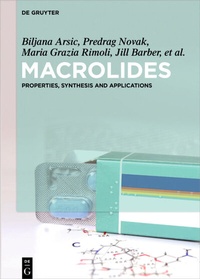
Macrolide antibiotics represent a class of natural macrocyclic products, one of the most clinically important antibiotics. Unfortunately, the production and development of new macrolide antibiotics are not represented enough in the pharmaceutical industry today. The intention of the book is therefore not only to be a teaching tool for students and experts, but also to draw the attention of the general public to this extremely useful, cheap and relatively unharmful effective anti-macrobials, and potential anti-malarials. The authors introduce the different classes of macrolides and their derivatives, principles of their biological activity, their structure and interactions with biological targets as well as synthetic methods to produce new macrolide antibiotics of similar or improved properties. Special emphasis was put on conjugates of macrolides with nucleobases or nucleosides with numerous applications; among them the most important remains the attempt to overcome bacterial resistance.
More details
Other editions
Additional editions
Persons
Macrolide antibiotics represent a class of natural macrocyclic products, one of the most clinically important antibiotics. Unfortunately, the production and development of new macrolide antibiotics are not represented enough in the pharmaceutical industry today. The intention of the book is therefore not only to be a teaching tool for students and experts, but also to draw the attention of the general public to this extremely useful, cheap and relatively unharmful effective anti-microbials, and potential anti-malarials. The authors introduce the different classes of macrolides and their derivatives, principles of their biological activity, their structure and interactions with biological targets as well as synthetic methods to produce new macrolide antibiotics of similar or improved properties. Special emphasis was put on conjugates of macrolides with nucleobases or nucleosides with numerous applications; among them the most important remains the attempt to overcome bacterial resistance.
Content
- Intro
- Preface
- Contents
- 1. The macrolide antibiotics and their semi-synthetic derivatives
- 2. The semisynthetic routes towards better macrolide antibiotics
- 3. Interactions of macrolides with their biological targets
- 4. Hybrids of macrolides and nucleobases or nucleosides: synthetic strategies and biological results
- Index
