

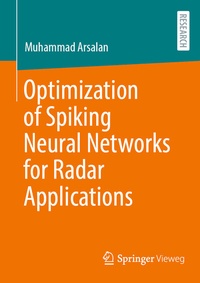
Optimization of Spiking Neural Networks for Radar Applications
Description

This book offers a comprehensive exploration of the transformative role that edge devices play in advancing Internet of Things (IoT) applications. By providing real-time processing, reduced latency, increased efficiency, improved security, and scalability, edge devices are at the forefront of enabling IoT growth and success. As the adoption of AI on the edge continues to surge, the demand for real-time data processing is escalating, driving innovation in AI and fostering the development of cutting-edge applications and use cases. Delving into the intricacies of traditional deep neural network (deepNet) approaches, the book addresses concerns about their energy efficiency during inference, particularly for edge devices. The energy consumption of deepNets, largely attributed to Multiply-accumulate (MAC) operations between layers, is scrutinized. Researchers are actively working on reducing energy consumption through strategies such as tiny networks, pruning approaches, and weight quantization. Additionally, the book sheds light on the challenges posed by the physical size of AI accelerators for edge devices. The central focus of the book is an in-depth examination of SNNs' capabilities in radar data processing, featuring the development of optimized algorithms.
More details
Other editions
Additional editions
Person
Muhammad Arsalan received the M.Sc. degree in Computational Engineering from the University of Rostock, and the M.Sc. degree in Biomedical Computing from the Technical University of Munich. He is currently working as a Senior Data Scientist.
Content
Introduction.- Background.- Signal Processing Chain with Spiking Neural Networks for Radar-based Gesture Sensing.- Radar-based Air-writing for Embedded Devices.- Time Series Forecasting of Healthcare Data.- Conclusion and Future Directions.
