

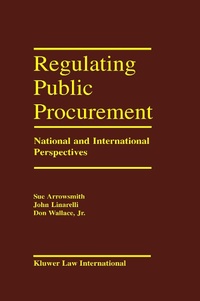
Regulating Public Procurement
National and International Perspectives
Published on 1. April 2000
890 pages
978-90-411-7938-8 (ISBN)
Description

Because of its enormous economic power and susceptibility to corruption, public procurement--the purchase by government of goods and services--has come under increasing regulation as world trade expands. Spurred on by domestic policies, trade agreements, and international organizations such as the World Bank, a new international system to regulate this strategic economic force is rapidly evolving--a system this is the first book to explore and elucidate.
In unprecedented depth, three international leaders in public procurement law fully explain how the procurement award process must be managed to achieve its goals in today's global market economy. Regulating Public Procurement will educate government officials, trade lawyers, and students in how to comply with existing and emerging regulatory schemes as they:
- select a contractor and plan the contract, with detailed attention to terms, conditions and specifications;
- allow for national security, national industrial development, and environmental protection;
- get value for money and avoid waste of public funds publicize contracts;
- combat corruption;
- secure successful completion of contracts;
- balance pressures to buy from domestic sources with the economic benefits of international competition;
- harness procurement power to promote social and environmental goals; enforce compliance with public procurement rules;
- recognise circumstances under which discretion-based (rather than rules-based) initiatives may be more effective.
Drawing on their extensive experience and expertise, the authors clarify the important distinctions between the realities of public procurement in industrialized, developing, and transitioning economies.
Throughout the book the reader will find detailed practical examples and important texts, including significant public procurement decisions of courts and other tribunals; resolutions of various national and international councils; and pertinent excerpts from legal commentators.
In unprecedented depth, three international leaders in public procurement law fully explain how the procurement award process must be managed to achieve its goals in today's global market economy. Regulating Public Procurement will educate government officials, trade lawyers, and students in how to comply with existing and emerging regulatory schemes as they:
- select a contractor and plan the contract, with detailed attention to terms, conditions and specifications;
- allow for national security, national industrial development, and environmental protection;
- get value for money and avoid waste of public funds publicize contracts;
- combat corruption;
- secure successful completion of contracts;
- balance pressures to buy from domestic sources with the economic benefits of international competition;
- harness procurement power to promote social and environmental goals; enforce compliance with public procurement rules;
- recognise circumstances under which discretion-based (rather than rules-based) initiatives may be more effective.
Drawing on their extensive experience and expertise, the authors clarify the important distinctions between the realities of public procurement in industrialized, developing, and transitioning economies.
Throughout the book the reader will find detailed practical examples and important texts, including significant public procurement decisions of courts and other tribunals; resolutions of various national and international councils; and pertinent excerpts from legal commentators.
More details
Other editions
Additional editions
John Linarelli
Regulation Public Procurement - National and International Perspectives
National and International Perspectives
Book
04/2000
1st Edition
Kluwer Law International
€219.35
Shipment within 10-20 days
Content
- Cover
- Half Title Page
- Title Page
- Copyright Page
- Table of Contents
- Acknowledgement of Permissions
- Preface
- Acknowledgements
- 1 Introduction
- I. WHAT IS PUBLIC PROCUREMENT?
- II. THE IMPORTANCE OF PUBLIC PROCUREMENT
- (i) Taxpayers and funding agencies
- (ii) The beneficiaries of goods and services
- (iii) Government contractors
- (iv) Economic development
- (v) Social and environmental objectives
- (vi) Integrity of the administration
- III. THE MARKET FRAMEWORK FOR GOVERNMENT PROCUREMENT
- IV. THE CONTRACTUAL BACKGROUND
- V. THE REASONS FOR REGULATING PUBLIC PROCUREMENT AND THE RECENT "GLOBAL REVOLUTION
- VI. THE LIMITS OF LEGAL REGULATION AND THE IMPORTANCE OF THE PROCUREMENT ENVIRONMENT
- A. The Procurement Environment
- B. The Relationship Between the Procurement Environment and Legal Regulation
- VII. OUTLINE OF THE BOOK
- 2 The Domestic Regulation of Procurement
- I. INTRODUCTION
- II. THE OBJECTIVES OF DOMESTIC PROCUREMENT POLICY: AN INTRODUCTION
- A. Value for Money
- B. Efficiency of the Procurement Process
- C. Probity (Integrity)
- 1. The Objective of Probity
- 2. The Relationship Between Probity and Other Procurement Objectives
- 3. Measures for Combatting Corruption
- (i) Transparency
- (ii) Conflict of interest rules
- (iii) "Procurement" sanctions on bidders
- (iv) Criminal and disciplinary sanctions
- (v) Requirements for internal control mechanisms by contractors
- (vi) Supplementary and structural measures
- (vii) Anti-corruption measures by foreign countries
- D. Fair and Equal Treatment of Contractors
- E. Industrial, Social and Environmental Objectives
- F. Outsourcing Policies
- 1. The Background to Outsourcing
- 2. Implications of Outsourcing for Procurement Regulation
- III. Regulatory Strategy
- A. The Concept of Transparency and Rules Versus Discretion
- B. Law and Administrative Rules
- IV. THE UNCITRAL MODEL LAW ON PROCUREMENT OF GOODS, CONSTRUCTION AND SERVICES
- 3 International Development Institutions and Public Procurement
- I. INTRODUCTION
- II. AN OVERVIEW OF THE INSTITUTIONS
- A. Types of Institutions
- B. Multilateral Development Banks
- C. Development Institutions That are not Development Banks
- III. PROCUREMENTS FINANCED BY THE MULTILATERAL DEVELOPMENT BANKS
- A. Questions Considered
- B. The Role and Legal Status of Procurement Guidelines and Standard Bidding Documents
- C. The Requirement of International Competitive Bidding (ICB)
- 1. The World Bank Model
- 2. The Purposes of International Competitive Bidding
- 3. Domestic Preferences in the World Bank Model
- 4. Other Methods of Procurement
- 5. A Critique
- 6. Note on Procurement Reform
- D. Consultants
- E. Adjustment Versus Investment Operations
- F. Co-Financing
- G. The Disbursement Process
- H. How Do Development Banks Deal With Corruption?
- IV. REMEDIES: DOES A FIRM HAVE LEGAL REDRESS AGAINST A DONOR OR LENDER?
- V. TIED AID
- 4 International Free Trade Agreements
- I. THE DEVELOPMENT OF INTERNATIONAL AGREEMENTS ON PUBLIC PROCUREMENT
- II. THE OBJECTIVES OF FREE TRADE AGREEMENTS AND THE OBSTACLES TO SUCCESS
- III. PROCUREMENT WITHIN THE WORLD TRADE ORGANISATION (WTO)
- A. Development of the WTO's Government Procurement Agreement (GPA)
- B. Obligations Under the GPA
- 1. General Principles of the GPA: National Treatment and the Most Favoured Nation Obligation
- a. National Treatment
- b. The Most Favoured Nation (MFN) Obligation
- c. Rules of Origin
- 2. Award Procedures Under the GPA
- 3. Provision of Information by Governments
- C. Coverage of the GPA
- 1. The General Approach to Coverage
- 2. Entities Covered
- 3. Types of Contracts Covered
- 4. Thresholds
- 5. Derogations Based on Reciprocity
- 6. Other Derogations
- D. Expanding Participation in WTO Disciplines on Government Procurement
- E. Remedies and Enforcement
- IV. REGIONAL AND BILATERAL AGREEMENTS
- A. The Extent of Regional and Bilateral Agreements on Public Procurement
- B. Regional Agreements and the Global Trading System
- V. THE RELATIONSHIP BETWEEN INTERNATIONAL AND NATIONAL PROCUREMENT RULES
- 5 Industrial, Social and Environmental Concerns in Public Procurement
- I. INTRODUCTION
- II. INDUSTRIAL OBJECTIVES IN PUBLIC PROCUREMENT
- A. Preferential Procurement Policies
- 1. Policies to Support Domestic Industries Against Competitive Imports
- 2. Policies to Correct Market Imperfections
- 3. Policies to Create a Comparative Advantage in Imperfect Markets
- 4. Policies to Reduce Government Procurement Costs
- 5. Preferential Procurement Based on the Need to Pay Economic Rents
- 6. Preferential Procurement as a Bargaining Tool in Trade Negotiations
- 7. Policies Directed at Non-Economic Objectives
- 8. Potential Problems
- B. Industrial Objectives Under the UNCITRAL Model Law
- 1. General Principles
- 2. The Provisions in the Model Law
- III. SOCIAL AND ENVIRONMENTAL OBJECTIVES IN PUBLIC PROCUREMENT
- A. The Use of Procurement for Social and Environmental Objectives
- 1. Contract Compliance and the Development of Disadvantaged Groups
- 2. Contract Compliance and Fair Labour Practices
- 3. Other Secondary Policies in Procurement
- B. Adopting and Designing a Contract Compliance Policy: Theoretical and Practical Concerns
- 1. The Legitimacy of Contract Compliance
- 2. Methods of Policy Implementation
- 3. Costs of Social and Environmental Policies
- 4. Monitoring and Enforcement
- C. Social and Environmental Policies Under the UNCITRAL Model Law
- IV. TRANSPARENCY IN IMPLEMENTING SECONDARY OBJECTIVES
- V. INDUSTRIAL, SOCIAL AND ENVIRONMENTAL OBJECTIVES UNDER INTERNATIONAL TRADE AGREEMENTS
- A. The Impact of Trade Agreements on Industrial Objectives
- 1. The Impact of National Treatment Rules
- 2. Should Exceptions be Made for Industrial Policy Measures?
- B. The Impact of Trade Agreements on Social and Environmental Objectives
- 6 The Coverage of Public Procurement Rules
- I. INTRODUCTION
- II. WHICH ENTITIES ARE COVERED?
- A. Delimiting and Defining Entity Coverage in Domestic Law
- 1. The Problem of Defining "Public" Procurement
- 2. The Provisions of the UNCITRAL Model Law
- 3. Legislative Techniques for Defining Coverage: The Example of the European Union Procurement Directives
- 4. Should the Rules be the Same for all Regulated Entities?
- B. Entity Coverage Under International Procurement Agreements
- III. WHICH TYPES OF TRANSACTIONS ARE COVERED?
- A. Application of Rules
- B. Defence and Security Issues
- C. Are Privately Financed Public Projects "Procurement"?
- D. Classification of Contracts
- IV. VALUE THRESHOLDS
- 7 Procurement Planning
- I. INTRODUCTION
- II. PROCUREMENT DOCUMENTATION
- A. The Contents of Procurement Documentation
- 1. Standardised Documents
- 2. The UNCITRAL Model Law
- 3. The World Bank
- 4. Indonesia - Recent Practice by a Developing Country
- 5. Who Bears the Cost of Documentation?
- B. Contract Types
- 1. Introduction
- 2. Classification by Price Term
- a. Fixed Price Contracts
- i. The Firm Fixed Price Contract
- ii. The Fixed Price Contract With Adjustment Mechanism
- iii. The Fixed Price Incentive Contract
- iv. Other Types of Firm Fixed Price Contracts
- b. Cost Reimbursement Contracts
- i. The Cost Plus a Percentage of Cost Contract
- ii. The Cost Plus Fixed Fee Contract
- iii. The Cost Plus Incentive Fee Contract
- iv. Cost Plus No Fee Contracts
- 3. Classification by Quantity or Delivery Term
- 4. Turnkey or Design-Build Contracts
- 5. Private Finance
- C. Drafting Specifications
- 1. Ensuring Adequate Competition: Domestic Regulation, UNCITRAL and the World Bank
- 2. Specifications Under International Trade Agreements
- D. Drafting Evaluation Criteria
- E. Price or Cost Estimates
- III. RECORD KEEPING, DEBRIEFING AND DISCLOSURE OF INFORMATION
- A. The Requirement to Keep Records of Procurement Proceedings
- B. Debriefing and Disclosure of Information on the Procurement Proceedings
- 8 Methods of Procurement
- I. INTRODUCTION
- II. FORMAL TENDERING PROCEDURES
- A. Introduction
- B. Types of Tendering
- 1. Open Tendering
- 2. Restricted Tendering
- C. Some Controversial Issues in Tendering
- 1. Should there be a Preference for Tendering?
- 2. Is There a Need for Clear and Precise Specifications in Formal Tendering?
- 3. Should There be Restrictions on Negotiations or Discussions Following Submission of Tenders?
- a. Post-Tender Communications
- b. Pre-Tender Communications
- D. The Mechanics of Tendering
- 1. Submission of Tenders
- 2. The Opening of Tenders
- 3. Late Tenders
- 4. Withdrawals and Modifications of Tenders
- III. TWO STAGE TENDERING
- IV. REQUESTS FOR PROPOSALS (RFP)
- V. COMPETITIVE NEGOTIATION
- VI. SINGLE SOURCE PROCUREMENT
- VII. REQUESTS FOR QUOTATIONS OR SHOPPING
- 9 Publicity for Contract Opportunities
- I. INTRODUCTION
- II. GENERAL NOTICES GIVING ADVANCE PUBLICITY OF PROCUREMENT OPPORTUNITIES
- III. NOTICES ADVERTISING SPECIFIC PROCUREMENTS
- IV. THE PLACE AND METHOD OF PUBLICATION
- V. CONTENT OF NOTICES
- A. Information Required in Notices
- B. The Language of Notices
- VI. SHOULD A CONTRACT BE READVERTISED WHEN REQUIREMENTS CHANGE?
- VII. EXCEPTIONS TO PUBLICITY REQUIREMENTS
- A. Competitive Procedures Without Publicity
- B. Single Tendering
- 10 Qualification, Prequalification and Shortlisting
- I. INTRODUCTION
- II. MINIMUM FINANCIAL AND TECHNICAL CRITERIA
- A. Financial and Technical Criteria Under National Systems and World Bank Guidelines
- 1. Financial Criteria
- 2. Technical Criteria
- B. Procedural Aspects
- 1. Qualification Generally and "Postqualification
- 2. Prequalification Procedures
- a. The Concept
- b. How to Conduct Prequalifications
- C. Financial and Technical Criteria Under International Agreements
- III. QUALIFICATION CRITERIA OTHER THAN FINANCIAL AND TECHNICAL CRITERIA
- IV. THE USE OF LISTS IN CONTRACTOR QUALIFICATION
- A. Types of Lists
- B. Optional Lists
- C. Mandatory Lists
- V. SHORTLISTING
- 11 Examination, Evaluation, Selection and Award
- I. INTRODUCTION
- II. RESPONSIVENESS
- III. EVALUATION
- A. Introduction
- B The Nature of Evaluation/Award Criteria
- 1. The Types of Factors
- 2. Distinguishing Evaluation from Qualification
- C. The Evaluation Process
- 1. Technical Evaluation
- 2. Price or Cost Evaluation
- D. Selecting the Winner
- E. The Requirement to State Evaluation/Award Criteria in Advance
- F. The Problem of Biased Evaluation Criteria
- IV. CONTRACT AWARD AND NOTIFICATION OF UNSUCCESSFUL FIRMS
- V. REJECTION OF ALL OFFERS
- 12 Enforcement and Remedies
- I. INTRODUCTION
- II. REVIEW PROCEDURES
- A. Introduction to Review Procedures
- 1. Review Procedures in Domestic Law and the UNCITRAL Model Law
- 2. Review Procedures Under International Liberalisation Agreements
- 3. Review Procedures and the International Financing Institutions
- 4. Designing a Review System
- 5. Review Procedures in Context
- B. Designing Review Procedures
- 1. The Importance of Speed: Length of Proceedings and Time Limits for Bringing Proceedings
- 2. The Forum and Procedure for Review
- a. The UNCITRAL Model Law
- b. The GPA
- 3. Reviewable and Non-Reviewable Decisions
- 4. Who May Initiate a Complaint?
- 5. Suspension (Interim Measures)
- 6. Remedies to Correct the Breach
- 7. The Problem of Concluded Contracts
- a. Introduction
- b. The Right of Aggrieved Firms to Challenge a Concluded Contract
- c. Can the Parties to the Contract Deny its Legal Effects?
- d. What are the Consequences of Setting Aside a Contract?
- 8. Damages
- a. Availability of Compensatory Damages
- b. The Principles for Assessing Compensatory Damages
- c. "Punitive" or "Exemplary" Damages
- 9. Standards for Review
- 10. Documentation of Award Procedures and Reasons for Decisions
- 11. Example of a System of Challenge Procedures: the Case of Japan
- III. CRIMINAL, ADMINISTRATIVE AND DISCIPLINARY SANCTIONS
- IV. EXTERNAL ENFORCEMENT AUTHORITIES
- V. INTER-GOVERNMENTAL DISPUTE SETTLEMENT
- A. Introduction
- B. The Dispute Settlement Mechanism Under the GPA
- 1. Procedures Under the DSU
- 2. Remedies Under the DSU
- C. Inter-Governmental Dispute Resolution and Enforcement Within the European Union
- Back Cover
