

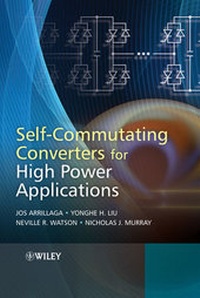
Self-Commutating Converters for High Power Applications
Description

More details
Other editions
Additional editions
Persons
Professor Jos Arrillaga, Electrical and Computer Engineering Building, University of Canterbury, Christchurch, New Zealand
Professor Arrillaga has been a professor at the University of Canterbury since 1975. He led the Power Systems group at the Manchester Institute of Science and Technology (UMIST) between 1970 and 1974. In 1997 he achieved the IEEE Uno Lamm Medal in Berlin for pioneering work in the field of High Voltage Direct Current, also the John Munganest International Power Quality Award of the Power Industry in the US. Between 1998 and 2006 he won numerous awards for his work in Paris and New Zealand, including the J.R. Scott medal of the Royal Society of New Zealand for services to Electrical Engineering education and research. So far he has published 8 books with Wiley and over 200 papers on the subjects of HVDC Transmission and Power System Harmonics.
Yonghe H. Liu, Inner Mongolia University of Technology, China
Professor Liu is currently a professor at Inner Mongolia University of Technology. He spends 6 months of the year in the Department of Electrical and Computer Engineering at the University of Canterbury as a researcher through the EPCA (Electric Power Computer Applications) Fellowship. His work has had a large impact on the development of modern HVDC power transmission. Before joining the Department of Computer Science and Engineering, University of Texas, Arlington in January 2004, he worked at the DSPS R&D Center of Texas Instruments.
Professor Liu has won the College of Engineering Outstanding Young Faculty Award, Research Excellence Award and writes for various transactions and journals. He was on the program committee for IEEE MASS 2008 and IEEE SECON 2008, amongst others.
Neville R. Watson, University of Canterbury, New Zealand
Professor Watson has been working at the University of Canterbury since 1987. He has taught undergraduate courses on electric power engineering, power systems engineering and the fundamentals of power electronics, and a graduate course on advanced power system engineering. He writes for many journals including the IEEE Transactions on Power Delivery and has co-written 3 books with Professor Arrillaga, all published by Wiley.
Nicholas J. Murray, University of Canterbury, New Zealand
Nicholas J. Murray- Received? his BE (Hon) in Electrical and Electronic Engineering from the University of Canterbury (NZ) in 2001, where he has just completed a PhD degree on the topic "Flexible reactive power control in large power current source conversion". He spent 8 years in the pulp and paper industry, the last four as a high voltage and control system engineer. His present interests include power system modelling, artificial intelligence and transient analysis of high ac/dc converters.
