

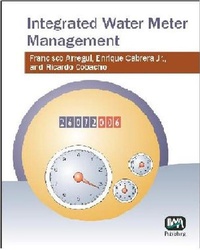
Integrated Water Meter Management
Published on 1. January 2007
286 pages
978-1-78040-225-3 (ISBN)
Description

Water meters are the cornerstone of commercial systems for water utilities throughout the world; revenue is directly derived from the, figures provided by meters. Despite this, little attention has been paid, in terms of selection, replacement period and return on investment, to the management and optimization of water meters.
Integrated Water Meter Management is a comprehensive reference for engineers and managers alike, providing: in-depth technical information allowing the true nature and behaviour of meters to be understood; a comprehensive review and comparison of relevant global water meter technologies - a useful tool to help decide which water meter is best for your utility; discussion of key decisions concerning the use of water meters (when to replace them, which one to use, how to control their quality) from a managerial perspective. Integrated Water Meter Management is an invaluable resource for those involved in urban water management, including water utility managers, engineering technical staff, operations and maintenance specialists, meter-reading personnel and scientific researchers in this discipline.
Integrated Water Meter Management is a comprehensive reference for engineers and managers alike, providing: in-depth technical information allowing the true nature and behaviour of meters to be understood; a comprehensive review and comparison of relevant global water meter technologies - a useful tool to help decide which water meter is best for your utility; discussion of key decisions concerning the use of water meters (when to replace them, which one to use, how to control their quality) from a managerial perspective. Integrated Water Meter Management is an invaluable resource for those involved in urban water management, including water utility managers, engineering technical staff, operations and maintenance specialists, meter-reading personnel and scientific researchers in this discipline.
More details
Language
English
Place of publication
London
United Kingdom
Target group
College/higher education
Professional and scholarly
File size
6,64 MB
ISBN-13
978-1-78040-225-3 (9781780402253)
Copyright in bibliographic data and cover images is held by Nielsen Book Services Limited or by the publishers or by their respective licensors: all rights reserved.
Schweitzer Classification
Other editions
Additional editions
F. Arregui | Enrique Cabrera | R. Cobacho
Integrated Water Meter Management
Book
01/2007
IWA Publishing
€175.58
Shipment within 3-4 weeks
Content
- Cover
- Copyright
- Contents
- Preface
- Acknowledgements
- About the authors
- 1. Introduction
- 1.1. Introduction
- 1.2. An interdisciplinary matter
- 1.3. Structure of this book
- 2. Water meters
- 2.1. Single jet meters
- 2.2. Multiple jet meters
- 2.3. Oscillating piston meters
- 2.4. Nutating disc meters
- 2.5. Woltmann meters
- 2.6. Combination (compound) meters
- 2.7. Paddle wheel meters
- 2.8. Proportional meters
- 3. Flow meters
- 3.1. Ultrasonic flow meters
- 3.2. Electromagnetic flow meters
- 3.3. Insertion flow meters
- 4. Remote meter reading
- 4.1. Introduction
- 4.2. Traditional meter reading
- 4.3. Remote meter reading
- 4.4. Data handling stages
- 4.5. Information provided by a remote reading system
- 5. Integrated water meter management
- 5.1. Introduction
- 5.2. Selection of the meter model
- 5.3. Quality control
- 5.4. General recommendations for the installation of meters
- 5.5. Metering systems audits
- 5.6. Maintenance and renewal of meters in a utility
- 5.7. Conclusions
- 6. How accurate are your meters?
- 6.1. Introduction
- 6.2. Determining the demand patterns
- 6.3. Obtaining the error curve
- 6.4. Calculating how accurate your meters are
- 6.5. Other methods to assess the weighted error of a meter
- 6.6. Factors affecting the quality of water consumption measurement
- 7. Maintenance and renewal of meters in a utility
- 7.1. Introduction
- 7.2. Restrictions
- 7.3. Choosing the right meter
- 7.4. Economic study
- 7.5. Case study
- 7.6. Is it worth going from Class B to Class C?
- 7.7. Using the commercial information system to analyse the behaviour of meters
- 8. Meter testing
- 8.1. Introduction
- 8.2. Types of test benches
- 8.3. Test bench layout
- 8.4. Testing procedures
- 8.5. Testing for error curve verification on the field
- 8.6. Uncertainty analysis during tests
- 8.7. Reference standards
- 9. Quality control
- 9.1. Introduction
- 9.2. Sampling plans
- 9.3. Definitions
- 9.4. Description of the quality control procedure
- 9.5. Application to the reception of meter batches
- 10. Standards and technical guidelines
- 10.1. Introduction
- 10.2. Metrological characteristics
- 10.3. Technical parameters
- 10.4. ISO Standards
- 10.5. Recommendations of the International Organization of Legal Metrology
- 10.6. Standards from the European Committee for Standardization (CEN)
- 10.7. American Water Works Association/American National Standard Institute Standards
- 10.8. European Union Directives
- Bibliography
- Index
