

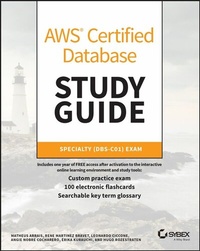
AWS Certified Database Study Guide
Description

Validate your AWS Cloud database skills!
AWS Certified Database Study Guide: Specialty (DBS-C01) Exam focuses on helping you to understand the basic job role of a database administrator / architect and to prepare for taking the certification exam. This is your opportunity to take the next step in your career by expanding and validating your skills on the AWS Cloud, and performing a database-focused role. AWS is the frontrunner in cloud computing products and services, and this study guide will help you to gain an understanding of core AWS services, uses, and basic AWS database design and deployment best practices. AWS offers more than relational and nonrelation databases, they offer purpose built databases, which allow you to utilize database services prebuilt to meet your business requirements. If you are looking to take the Specialty (DBS-C01) exam, this Study Guide is what you need for comprehensive content and robust study tools that will help you gain the edge on exam day and throughout your career.
AWS Certified Database certification offers a great way for IT professionals to achieve industry recognition as cloud experts. This new study guide is perfect for you if you perform a database-focused role and want to pass the DBS-C01 exam to prove your knowledge of how to design and deploy secure and robust database applications on AWS technologies. IT cloud professionals who hold AWS certifications are in great demand, and this certification could take your career to the next level!
- Master all the key concepts you need to pass the AWS Certified Database Specialty (DBS-C01) Exam
- Further your career by demonstrating your cloud computing expertise and your knowledge of databases and database services
- Understand the concept of purpose built databases, allowing you to pick the right tool for the right job.
- Review deployment and migration, management and operations, monitoring and troubleshooting, database security, and more
- Access the Sybex online learning environment and test bank for interactive study aids and practice questions
Readers will also get one year of FREE access after activation to Sybex's superior online interactive learning environment and test bank, including hundreds of questions, a practice exam, electronic flashcards, and a glossary of key terms.
ABOUT THE AUTHORS
Matheus Arrais is a Senior Partner Solutions Architect at Amazon Web Services.
Rene Martinez Bravet is a Solutions Architect at AWS focused on enterprise and financial services customers.
Leonardo Ciccone is a Senior Database Migration Specialist at Amazon Web Services, with a focus on database migration and modernization.
Angie Nobre Cocharero is the Database Specialist Solution Architect at Amazon Web Services for Latin America.
Érika Kurauchi is the Specialist Solution Architecture Manager at Amazon Web Services for Latin America.
Hugo Rozestraten is a Principal Data Strategy Solutions Architect and author of several AWS blog posts.
More details
Other editions
Additional editions
Content
- Cover
- Title Page
- Copyright Page
- Contents at a Glance
- Contents
- Table of Exercises
- Introduction
- What Does This Book Cover?
- Interactive Online Learning Environment and Test Bank
- AWS Certified Database Study Guide - Specialty (DBS-C01) Exam Objectives
- Objective Map
- Part I Workload-Specific Database Design
- Chapter 1 Databases-from Your Server to AWS Cloud
- Databases from the Beginning
- 1960s
- 1970s
- 1980s
- 1990s
- 2000-2010
- 2010-Today
- Databases on Premises
- Basic Infrastructure
- Complex Infrastructure and Resiliency
- Management
- Databases in the Cloud
- Data Remains Data
- DBAs Are the Initial DevOps
- DBA Career-Now What?
- Summary
- Chapter 2 Basic AWS Concepts
- AWS Global Infrastructure
- AWS Regions
- AWS Availability Zones
- AWS Local Zones
- AWS Wavelength Zones
- Points of Prescence
- Networking
- IP Addressing
- Subnets
- VPC Routing
- Gateways and Connectivity Options
- Security
- Network Security
- AWS Shared Responsibility Model
- Identity and Access Management
- Data Encryption
- Storage at AWS
- Amazon Elastic Block Storage
- Amazon Elastic File System
- Amazon Simple Storage Service
- Operations
- Monitoring and Logging
- Amazon CloudWatch
- AWS CloudTrail
- Summary
- Chapter 3 Purpose-Built Databases
- Data store Concepts
- Data Access Patterns
- Latency
- Scaling
- Transaction Support
- Consistency
- Volume
- Durability
- Availability
- Security/Compliance
- Business Logic
- Cost
- Purpose-Built Databases on AWS
- Relational Databases
- Nonrelational Databases
- Summary
- Exam Essentials
- Review Questions
- Part II Management and Operations, Database Security, Monitoring and Troubleshooting per Workload
- Chapter 4 Relational Databases on AWS
- Relational Databases
- Structured Query Language
- Install and Manage Databases Yourself
- I/O Requirement
- Managing Databases on EC2
- Monitoring Databases on EC2
- Scaling Databases
- Upgrading Databases
- Managed Services for Relational Databases
- Launching an RDS Instance
- Managing High Availability and Scalability
- Configuring RDS Parameter Groups
- Configuring RDS Option Groups
- Deletion Protection
- RDS Pricing Model
- Amazon Aurora Cloud-Native Relational Database
- Amazon Aurora Storage
- Amazon Aurora DB Clusters
- Amazon Aurora High Availability
- Amazon Aurora Global Database
- Amazon Aurora Read Replica Across Regions
- Amazon Aurora Serverless
- Amazon Aurora Multi-master
- Patch Management and Upgrade
- Monitoring and Performance Management
- Backup and Restore
- Backtrack
- Cloning an Amazon Aurora DB Cluster Volume
- Auditing
- Database Activity Stream in Amazon Aurora
- Security
- Migrating Databases
- Summary
- Exam Essentials
- Exercises
- Review Questions
- Chapter 5 Low-Latency Response Time for Your Apps and APIs
- Getting Started with Modern Applications and NoSQL Databases
- Amazon DynamoDB
- Design Considerations
- Migrating Your Data into DynamoDB
- Query Considerations
- Amazon DynamoDB Index Options
- DynamoDB Capacity Modes
- Other Features of DynamoDB
- Backup/Restore
- Scalability
- Security
- Monitoring
- Amazon Keyspaces
- Design Considerations
- Migrating Your Data into Keyspaces
- Query Considerations
- Keyspaces Capacity Modes
- Consistency Models
- Use Cases
- Best Practices
- Backups
- Scalability
- Security
- Monitoring
- Summary
- Exam Essentials
- Exercises
- Review Questions
- Chapter 6 Document Databases in the Cloud
- Introducing Document Databases
- Getting Started with Amazon DocumentDB
- Creating an Amazon DocumentDB Cluster
- Amazon DocumentDB Architecture
- Security
- Access Control
- Data Protection
- Other Features
- Backup and Restore
- Performance and Scaling
- Compatibility between Amazon DocumentDB and MongoDB
- Migrating from MongoDB to Amazon DocumentDB
- Amazon DocumentDB Monitoring
- Developing with Amazon DocumentDB
- When to Use DynamoDB vs. DocumentDB
- Amazon DocumentDB Pricing
- Summary
- Exam Essentials
- Exercises
- Review Questions
- Chapter 7 Better Places Than Databases to Store Large Objects
- Databases and Large Objects
- Introducing Amazon S3
- Costs of Amazon S3 vs. Elastic Block Storage
- Moving LOBs to Amazon S3
- Creating an S3 Bucket
- Putting or Uploading Objects
- Indexing LOBs in Amazon S3
- Additional S3 Features
- Backup and Dump Files
- Other Use Cases
- Pay per Usage and Scalability
- Availability and Durability
- Security
- Access Control
- Data Encryption
- Summary
- Exam Essentials
- Exercises
- Review Questions
- Chapter 8 Deliver Valuable Information at the Speed Your Business Needs
- Information Latency
- Data Warehouses
- Database Engines for Data Warehouses
- Migrating Data Warehouses to Amazon Redshift Using AWS SCT
- Amazon Redshift
- Redshift Cluster Architecture
- Table Design in Redshift
- Loading Data into Redshift
- Data Lakes in AWS
- Redshift Spectrum
- Redshift Federated Queries
- Data Lakehouse
- Redshift Cluster Node Types
- Redshift Monitoring
- Redshift Scalability
- Redshift Security
- Redshift Data Resilience and Backup
- Time-Series Databases
- Amazon Timestream
- Amazon Timestream Architecture
- Loading Data into Amazon Timestream
- Querying Data from Amazon Timestream
- Amazon Timestream Monitoring
- Amazon Timestream Scalability
- Amazon Timestream Security
- Amazon Timestream Data Resilience and Backup
- Amazon OpenSearch Service
- Amazon OpenSearch Service Domain Architecture
- Loading Data to Amazon OpenSearch Service
- Searching for Data in Amazon OpenSearch Service
- Amazon OpenSearch Service Monitoring
- Amazon OpenSearch Service Scalability
- Amazon OpenSearch Service Security
- Amazon OpenSearch Service Data Resilience and Backup
- Summary
- Exam Essentials
- Exercises
- Review Questions
- Chapter 9 Discovering Relationships Using Graph Databases
- Graph Databases
- When to Use Graph Databases
- Common Use Cases
- Amazon Neptune
- High-Level Architecture
- Graph Models and Query Languages
- Using and Extracting Data from Amazon Neptune
- Storage Architecture
- Data Resilience
- Read Replicas
- Scalability
- Availability
- Failover Policy
- Security
- Automatic Backup and Restore
- Monitoring
- Summary
- Exam Essentials
- Review Questions
- Chapter 10 Immutable Database and Traceable Transactions
- Amazon Quantum Ledger Database
- Amazon QLDB Components
- Working with Amazon QLDB
- Backup and Durability
- Performance and Scalability
- Security
- Monitoring
- Best Practices
- Summary
- Exam Essentials
- Exercises
- Review Questions
- Chapter 11 Caching Data with In-Memory Databases
- Built-in Database Cache
- Local Application Cache
- In-Memory Databases
- Caching Use Cases
- Remote Cache Strategies
- Caching Data in AWS
- Caching Data with ElastiCache
- Memcached or Redis?
- Memcached Architecture on Amazon ElastiCache Service
- Redis Architecture on the Amazon ElastiCache Service
- Backup and Restore
- Security
- Monitoring
- Amazon MemoryDB for Redis
- Summary
- Exam Essentials
- Exercises
- Review Questions
- Part III Deployment and Migration
- Chapter 12 Migrating Your Data to AWS
- Network Communication and Data Migration
- Optimizing Bandwidth Usage
- Database Migration to AWS
- AWS Schema Conversion Tool
- AWS Data Migration Service
- Setting Up AWS DMS
- AWS DMS Continuous Replication
- AWS DMS Best Practices
- AWS DMS Security
- AWS DMS Resilience
- Other AWS Services for Data Migration
- AWS DataSync
- AWS Snow Family
- AWS Storage Gateway
- Choosing the Migration Path
- One or Many Target Databases
- Small, Noncritical Databases
- Very Large Databases
- Summary
- Exam Essentials
- Exercises
- Review Questions
- Chapter 13 Disaster Recovery
- Understanding and Planning Disaster Recovery Requirements
- Recovery Point Objective and Recovery Time Objective
- Challenges in Disaster Recovery
- Managing Disaster Recovery Strategies
- Backup and Recovery Strategy
- Database Replication Methods: Multi-AZ and Cross-Region Replication
- Databases Deployed on EC2
- Amazon RDS
- Amazon Aurora
- Amazon Neptune
- Summary
- Exam Essentials
- Review Questions
- Chapter 14 Save Time and Reduce Errors Automating Your Infrastructure
- AWS CloudFormation
- Components
- Important Concepts
- Updating AWS CloudFormation Stacks
- Deleting AWS CloudFormation Stacks
- AWS Systems Manager Parameter Store
- AWS Secrets Manager
- Summary
- Exam Essentials
- Review Questions
- Appendix: Answers to Review Questions
- Chapter 3: Purpose-Built Databases
- Chapter 4: Relational Databases on AWS
- Chapter 5: Low-Latency Response Time for Your Apps and APIs
- Chapter 6: Document Databases in the Cloud
- Chapter 7: Better Places Other Than Databases to Store Large Objects
- Chapter 8: Deliver Valuable Information at the Speed Your Business Needs
- Chapter 9: Discovering Relationships Using Graph Databases
- Chapter 10: Immutable Database and Traceable Transactions
- Chapter 11: Caching Data with In-Memory Databases
- Chapter 12: Migrating Your Data to AWS
- Chapter 13: Disaster Recovery
- Chapter 14: Save Time and Reduce Errors Automating Your Infrastructure
- Index
- EULA
