

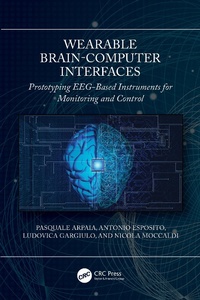
Wearable Brain-Computer Interfaces
Prototyping EEG-Based Instruments for Monitoring and Control
1st Edition
Published on 15. June 2023
286 pages
978-1-000-85057-4 (ISBN)
Description

This book presents a complete overview of the main EEG-based Brain-Computer Interface (BCI) paradigms and the related practical solutions for their design, prototyping, and testing. Readers will explore active, reactive, and passive BCI paradigms, with an emphasis on the operation for developing solutions, addressing the need for customization.
Readers will familiarize themselves with the main steps for the realization of low-cost wearable BCIs which include: identification of the most suitable neuro signals for a specific application; definition of the hardware, firmware, and software, with a focus on wearable, non-invasive, and low-cost solutions; development of algorithms for data processing and classification; and, lastly, experimental campaigns for the validation of the prototyped solutions. BCI systems based on electroencephalography (EEG) are investigated and a complete overview of all BCI paradigms is offered. The aim of this book is to drive the reader, from the beginning to the end, along a research-and-development process of a working BCI prototype.
This book is a guide for designers, biomedical engineers, students, biotechnologists, and those in the biomedical instrumentation field that would like to conceive, design, prototype, and test an innovative low-cost wearable EEG-based BCI.
Readers will familiarize themselves with the main steps for the realization of low-cost wearable BCIs which include: identification of the most suitable neuro signals for a specific application; definition of the hardware, firmware, and software, with a focus on wearable, non-invasive, and low-cost solutions; development of algorithms for data processing and classification; and, lastly, experimental campaigns for the validation of the prototyped solutions. BCI systems based on electroencephalography (EEG) are investigated and a complete overview of all BCI paradigms is offered. The aim of this book is to drive the reader, from the beginning to the end, along a research-and-development process of a working BCI prototype.
This book is a guide for designers, biomedical engineers, students, biotechnologists, and those in the biomedical instrumentation field that would like to conceive, design, prototype, and test an innovative low-cost wearable EEG-based BCI.
More details
Edition
1. Auflage
Language
English
Place of publication
London
United Kingdom
Publishing group
Taylor & Francis Ltd
Target group
Professional and scholarly
Product notice
Reflowable
Illustrations
38 Tables, black and white; 37 Line drawings, black and white; 109 Halftones, color; 111 Illustrations, color; 35 Illustrations, black and white
ISBN-13
978-1-000-85057-4 (9781000850574)
Copyright in bibliographic data and cover images is held by Nielsen Book Services Limited or by the publishers or by their respective licensors: all rights reserved.
Schweitzer Classification
Other editions
Additional editions
Pasquale Arpaia | Antonio Esposito | Ludovica Gargiulo
Wearable Brain-Computer Interfaces
Prototyping EEG-Based Instruments for Monitoring and Control
Book
01/2025
1st Edition
CRC Press
€93.00
Shipment within 10-20 days
Pasquale Arpaia | Antonio Esposito | Ludovica Gargiulo
Wearable Brain-Computer Interfaces
Prototyping EEG-Based Instruments for Monitoring and Control
Book
06/2023
1st Edition
CRC Press
€217.90
Shipment within 10-20 days
Persons
Pasquale Arpaia earned a master's degree and PhD in Electrical Engineering at University of Napoli Federico II (Italy), where he is a professor of Instrumentation and Measurements. He is Head of the Instrumentation and Measurement for Particle Accelerators Laboratory (IMPALab) and the Augmented Reality for Health Monitoring Laboratory (ARHeMlab). He is Team Leader at European Organization for Nuclear Research (CERN) and Deputy Chairman of the Interdepartmental Center for Research on Management and Innovation of Health (CIRMIS), Head of the Hi-Tech Academic FabLab Unina DIETI and Chairman of the Stage Project of the University Federico II. He was also a professor at University of Sannio, associate at Institutes of Engines and Biomedical Engineering of CNR, and now of INFN Section of Naples. Currently, he is an Associate Editor of the Institute of Physics Journal of Instrumentation, Elsevier Journal Computer Standards & Interfaces, MDPI Instruments, and in the past also of IEEE Transactions on Electronics Packaging and Manufacturing. He was Editor at Momentum Press of the Book Collection "Emerging Technologies in Measurements, Instrumentation, and Sensors". He continuously serves as organizing and scientific committee member in IEEE and IMEKO Conferences. He is plenary speaker in several scientific conferences. His main research interests include instrumentation and measurement for magnets, advanced materials, beam, superconductors, power converters. and cryogenics of particle accelerators, biomedical instrumentation, Augmented Reality, Brain Computer Interfaces, evolutionary diagnostics, distributed measurement systems, ADC modelling and testing. In these fields, he published 3 books, several book chapters, and about 300 scientific papers in journals and national and international conference proceedings.
Antonio Esposito was born in 1993. He received a master's degree in Electronic Engineering from the University of Naples Federico II in 2017 and a Ph.D. in Metrology in 2022 from the Politecnico di Torino. His main research activities focus on the measurement of electroencephalographic signals in wearable brain-computer interfaces. He has been working with visually evoked potentials elicited through smart glasses and he participated in the development of a BCI prototype addressed to both industry and healthcare applications. He is currently studying extended reality applications exploiting either evoked or spontaneous brain activity.
Ludovica Gargiulo received a M.S. Degree (cum laude) in Biomedical Engineering at the University of Naples Federico II in 2020. She is currently a Ph.D. student in Information and Communication Technology at the University of Naples Federico II. Her research interests include "Brain-Computer Interfaces" for daily-life applications and biosignal measurement and processing for biomedical applications with a focus on Evoked-Related Potential elicited by cognitive tasks.
Nicola Moccaldi received a M.A. degree in Communication Science at the University of Salerno, the M.Sc. degree in Electronic Engineering and a Ph.D. in Information Technologies and Electrical Engineering at the University of Naples Federico II. Currently he is Senior Researcher of ARHeMLab of DIETI Excellence Department (Laboratory of Augmented Reality for Health Monitoring). His research interests include biomedical instrumentation and measurement. In this field, he published several scientific papers in journals and national and international conference proceedings.
Antonio Esposito was born in 1993. He received a master's degree in Electronic Engineering from the University of Naples Federico II in 2017 and a Ph.D. in Metrology in 2022 from the Politecnico di Torino. His main research activities focus on the measurement of electroencephalographic signals in wearable brain-computer interfaces. He has been working with visually evoked potentials elicited through smart glasses and he participated in the development of a BCI prototype addressed to both industry and healthcare applications. He is currently studying extended reality applications exploiting either evoked or spontaneous brain activity.
Ludovica Gargiulo received a M.S. Degree (cum laude) in Biomedical Engineering at the University of Naples Federico II in 2020. She is currently a Ph.D. student in Information and Communication Technology at the University of Naples Federico II. Her research interests include "Brain-Computer Interfaces" for daily-life applications and biosignal measurement and processing for biomedical applications with a focus on Evoked-Related Potential elicited by cognitive tasks.
Nicola Moccaldi received a M.A. degree in Communication Science at the University of Salerno, the M.Sc. degree in Electronic Engineering and a Ph.D. in Information Technologies and Electrical Engineering at the University of Naples Federico II. Currently he is Senior Researcher of ARHeMLab of DIETI Excellence Department (Laboratory of Augmented Reality for Health Monitoring). His research interests include biomedical instrumentation and measurement. In this field, he published several scientific papers in journals and national and international conference proceedings.
Content
Part 1: Background. 1. Electroencephalography-based Brain-Computer Interfaces. 2. Design of Daily-life Brain-Computer Interfaces. Part 2: Reactive Brain-Computer Interfaces. 3. Fundamentals. 4. SSVEP-based Instrumentation. 5. Case Studies. Part 3: Passive Brain-Computer Interfaces. 6. Fundamentals. 7. EEG-Based Monitoring Instrumentation. 8. Case Studies. Part 4: Active Brain-Computer Interfaces. 9. Fundamentals. 10. Motor Imagery-Based Instrumentation. 11. Case Studies.
