

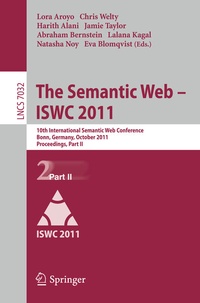
The Semantic Web -- ISWC 2011
10th International Semantic Web Conference, Bonn, Germany, October 23-27, 2011, Proceedings, Part II
Published on 19. October 2011
XXIV, 395 pages
978-3-642-25093-4 (ISBN)
Description

The two-volume set LNCS 7031 and 7032 constitutes the proceedings of the 10th International Semantic Web Conference, ISWC 2011, held in Bonn, Germany, in October 2011.
Part I, LNCS 7031, contains 50 research papers which were carefully reviewed and selected from 264 submissions. The 17 semantic web in-use track papers contained in part II, LNCS 7032, were selected from 75 submissions. This volume also contains 15 doctoral consortium papers, selected from 31 submissions.
The topics covered are: ontologies and semantics; database, IR, and AI technologies for the semantic web; management of semantic web data; reasoning over semantic web data; search, query, integration, and analysis on the semantic web; robust and scalable knowledge management and reasoning on the web; interacting with semantic web data; ontology modularity, mapping, merging and alignment; languages, tools, and methodologies for representing and managing semantic web data; ontology, methodology, evaluation, reuse, extraction and evolution; evaluation of semantic web technologies or data; specific ontologies and ontology pattern for the semantic web; new formalisms for semantic web; user interfaces to the semantic web; cleaning, assurance, and provenance of semantic web data; services, and processes; social semantic web, evaluation of semantic web technology; semantic web population from the human web.
More details
Other editions
Additional editions
Lora Aroyo | Chris Welty | Harith Alani
The Semantic Web -- ISWC 2011
10th International Semantic Web Conference, Bonn, Germany, October 23-27, 2011, Proceedings, Part II
Book
10/2011
Springer
€53.49
Shipment within 7-9 days
Content
- Title page
- Preface
- Conference Organization
- Table of Contents
- Doctoral Consortium
- Semantic Web In-Use Track
- KOIOS: Utilizing Semantic Search for Easy-Access and Visualization of Structured Environmental Data
- Introduction
- KOIOS Overview
- KOIOS Semantic Search Process
- Indexing
- Keyword Query Interpretation and Structured Query Generation
- Faceted Search and Selectors
- Implementation
- Related Work
- Conclusion and Future Work
- References
- Wiki-Based Conceptual Modeling: An Experience with the Public Administration
- Introduction
- The ProDe Project
- Modeling Flows of Documents: The Conceptual Schema
- The MoKi Architecture and Tool
- The MoKi Customization for the ProDe Project
- Evaluation
- Quantitative Evaluation Results
- Qualitative Evaluation Results
- Discussion and Lesson Learned
- Concluding Remarks
- References
- Linking Semantic Desktop Data to the Web of Data
- Introduction
- Background
- Semantic Desktop and Nepomuk
- Related Work
- The Process of Finding Web Aliases
- Implementing the Process
- The Query Modules
- The Matching Module
- Evaluation
- Data Collection
- Relevance Judgements from Experts
- Evaluation Results of the Matching Algorithm
- Performance
- Discussion and Future Work
- Conclusion
- References
- Linking Data across Universities: An Integrated Video Lectures Dataset
- Introduction
- Related Work
- Generating RDF
- Selecting and Extracting Educational Information from Various Sources
- Reusing Vocabularies to Describe Educational Data
- Structuring Information According to the Previously Selected Vocabularies
- Integrating Educational Information
- Selecting a Common Categorization Scheme
- Analyzing the Categorization Schemes of Each Information Source
- The Categorization Approach
- Evaluating the Categorization Problem
- Conclusions and Discussion
- References
- Mind Your Metadata: Exploiting Semantics for Configuration, Adaptation, and Provenance in Scientific Workflows
- Introduction
- Motivation: Environmental Science
- Approach: Provenance-Aware Systems That Manage Metadata
- Data Preparation and Integration with Karma: Metadata about Origins, Type, and Characteristics
- Data Processing with Wings: Metadata about Analysis Processes
- Results
- Related Work
- Conclusions
- References
- Using Semantic Web Technologies to Build a Community-Driven Knowledge Curation Platform for the Skeletal Dysplasia Domain
- Introduction
- Requirements
- The SKELETOME Platform
- Common Terminology and Data Integration
- Knowledge Transfer and Sustainable Knowledge Evolution
- Privacy and Access Control
- Capturing Provenance and Expertise
- Preliminary Evaluation
- Related Work
- Conclusions
- References
- Cyber Scientific Test Language
- Introduction
- Experiment Design and Planning in CSTL
- Experiment Types
- Objectives and Hypotheses
- Treatments, Factors, and Response Variables
- Designs
- Test Environment
- Network Topology Concepts
- Test Procedures
- Asset Description
- Hardware and Software Assets
- Recipes, Images, and Asset Controllers
- Test Execution
- Event Execution Language
- Test Execution Control Infrastructure
- Artificial Network Traffic Generation
- Data Analysis and Visualization
- Sensors and Metrics
- Data Archiving and Analysis Subsystem
- Templates
- Templates for Cloning
- Templates for Test Infrastructure
- Sparse Descriptions
- Transforms
- Query Library
- Challenges
- Reasoner Support and OWL 2 Features
- Second-Order Reasoning and Punning
- Summary
- References
- How to "Make a Bridge to the New Town" Using OntoAccess
- Introduction
- Background
- Evolizer
- SOFAS
- OntoAccess as a Bridge to the New Town
- Architectural Principles of OntoAccess
- Mapping Principles of OntoAccess
- A Case Study on Bridging Software Analysis Data
- Data Schema of Software Analysis within Evolizer
- Ontologies of Software Analysis within SOFAS
- OntoAccess as a Bridge to the New Town of Software Analysis
- Discussion
- Related Work
- Conclusions
- References
- The MetaLex Document Server Legal Documents as Versioned Linked Data
- Introduction
- Use Cases and Requirements
- Use Cases
- Wetten.nl and the Basiswettenbestand
- CEN MetaLex
- Conversion and Publication
- Mapping Legacy Elements to CEN MetaLex
- Minting Identifiers
- Producing Metadata
- Serialization
- Publication
- Conclusion and Results
- Meeting Requirements
- References
- Leveraging Community-Built Knowledge for Type Coercion in Question Answering
- Introduction
- Background: Open Domain Question Answering
- DeepQA
- Type Coercion (TyCor)
- Acquiring Community-Built Knowledge for TyCor
- DBpedia and YAGO
- Wikipedia-Based Folksonomies
- TyCor Algorithms
- Shared EDM Algorithm
- YAGO TyCor
- Wiki-Category and Wiki-List TyCors
- Experiments
- Evaluating EDM on Wikipedia Link Anchors
- Evaluating Typing on Ground Truth
- Impact on End-to-End Question Answering
- Related Work
- Conclusion
- References
- Privacy-Aware and Scalable Content Dissemination in Distributed Social Networks
- Introduction
- Background
- Distributed Social Networks and PubSubHubbub
- Semantics in Distributed Social Networks
- WebID
- PPO - The Privacy Preference Ontology
- Extending PubSubHubbub for Privacy-Aware Content Dissemination
- Motivations for Extending PuSH
- PuSH Extension
- Distributed Social Graph
- Generating Privacy Preference
- Semantic Dissemination of Content
- Implementation and Use Case in SMOB
- SMOB Hub-User Initial Interaction
- SMOB Followee - Publishing
- SMOB Semantic Hub - Distribution
- Related Work
- Conclusion
- References
- BookSampo-Lessons Learned in Creating a Semantic Portal for Fiction Literature
- Introduction
- The BookSampo Data Model
- Ontology Creation and Participation in the FinnONTO Infrastructure
- System Description
- Data Import and Integration
- Collaborative Semantic Web Editing Environment
- End-User Portal
- Discussion
- References
- SCMS - Semantifying Content Management Systems
- Introduction
- Related Work
- The SCMS Framework
- Tools and Vocabularies
- Wrapper
- Orchestration Service
- FOX
- OntoWiki
- Use Case
- Evaluation
- Conclusion
- References
- Zhishi.me - Weaving Chinese Linking Open Data
- Introduction
- Semantic Data Extraction
- Extraction Approach
- Extraction Results and Discussions
- Data-Level Mapping among Different Datasets
- Mappings within CLOD
- Using Original Labels.
- Punctuation Cleaning.
- Extending Synonyms.
- Linking CLOD with LOD
- Web Access to Zhishi.me
- Linked Data
- Lookup Service
- SPARQL Endpoint
- Conclusions and Future Work
- References
- An Implementation of a Semantic, Web-Based Virtual Machine Laboratory Prototyping Environment
- Introduction
- Use Cases, User Requirements and a Case Example
- Use Cases and User Requirements
- Case Example
- Environment Design and Implementation
- Semantic Process
- Semantic Model and Ontology
- Environment
- Semantic Viewer Application
- Virtual Machine Laboratory Prototype
- Hydraulics
- CANopen Design
- Connecting the Design Domains
- Discussion
- Conclusions
- References
- Rule-Based OWL Reasoning for Specific Embedded Devices
- Introduction
- Related Work
- Reasoning on an Embedded Device with Standard DL Reasoners
- Pellet
- FaCT++
- CEL
- Rule-Based OWL Reasoning
- CLIPS
- Rule-Based Reasoning
- Reasoning Component
- Queries
- Formal Analysis
- Evaluation
- Evaluation Environment
- Evaluation Results
- Evaluation Summary
- Embedded Reasoning Applications
- Predictive Maintenance
- Decentralized Manufacturing Control
- Situation Recognition in Assisted Living
- Conclusion
- References
- A Semantic Portal for Next Generation Monitoring Systems
- Introduction
- Ecological and Environmental Information Systems Challenges
- Modeling Domain Knowledge for Environmental Monitoring
- Collecting Environmental Data
- Semantic Web Approach
- Domain Knowledge Modeling and Reasoning
- Data Integration
- Provenance Tracking and Provenance-Aware Computing
- SemantAqua: Semantic Water Quality Portal
- System Implementation
- Scaling Issues
- Discussion
- Linking to a Health Domain
- Time as Provenance
- Regulation Mapping and Comparison
- Scalability
- Maintenance Costs for Data Service Provider
- System Evaluation
- Related Work
- Conclusions and Future Work
- References
- DC Proposal: PRISSMA, Towards Mobile Adaptive Presentation of the Web of Data
- Introduction
- Related Work
- Towards Mobile Adaptive RDF Representation
- PRISSMA Vocabulary Overview
- Discussion and Perspectives
- References
- DC Proposal: Towards an ODP Quality Model
- Research Problem
- Related Work
- Ontology Design Patterns
- Ontology Evaluation
- Conceptual Model Quality
- Contribution
- Current State
- Quality Metamodel
- Initial Data Gathering
- Hypotheses
- The Road Ahead
- References
- DC Proposal: Automation of Service Lifecycle on the Cloud by Using Semantic Technologies
- Research Motivation
- Related Work
- Research Contribution: Service Lifecycle Ontology
- Service Requirements Phase
- Service Discovery Phase
- Service Negotiation Phase
- Service Composition Phase
- Service Consumption/Monitoring Phase
- Summary
- References
- DC Proposal: Knowledge Based Access Control Policy Specification and Enforcement
- Introduction
- Research Objectives and Plan
- Approach
- Access Control Model.
- Policy Language.
- Enforcement Framework.
- Methodology
- Evaluation
- Related Work
- Conclusions and Future Work
- References
- DC Proposal: Online Analytical Processing of Statistical Linked Data
- Introduction
- Related Work
- Research Plan
- Conclusion
- References
- DC Proposal: Model for News Filtering with Named Entities
- Introduction
- Main Contributions
- Related Work
- Proposed Methodology
- Articles Processing Pipeline
- User Feedback Collection
- Modelling News Articles
- User Profile Creation
- Naive Approach.
- Apriori Algorithm.
- Clustering.
- Formal Concept Analysis.
- Test Data Collection
- Research Progress
- Conclusion
- References
- DC Proposal: Graphical Models and Probabilistic Reasoning for Generating Linked Data from Tables
- Introduction
- Motivation
- Related Work
- Interpreting a Table
- Approach
- Evaluation Plan
- References
- DC Proposal: Evaluating Trustworthiness of Web Content Using Semantic Web Technologies
- Introduction
- Related Work
- The Proposed Model
- Basic Concept
- Evaluation Criteria
- Architecture
- Methodology
- Conclusion
- References
- DC Proposal: Decision Support Methods in Community-Driven Knowledge Curation Platforms
- Background and Problem Statement
- Aim and Objectives
- Related Work
- Research Plan
- Evaluation
- Conclusions
- References
- DC Proposal: Towards Linked Data Assessment and Linking Temporal Facts
- Problem Definition
- State of the Art
- Proposed Approach and Methodology
- Results and Conclusions
- References
- DC Proposal: Towards a Framework for Efficient Query Answering and Integration of Geospatial Data
- Background and Problem Statement
- Related Work
- Expected Contributions
- Proposed Methods
- Query Rewriting and Reasoning
- Architecture
- Conclusion and Future Work
- References
- DC Proposal: Automatically Transforming Keyword Queries to SPARQL on Large-Scale Knowledge Bases
- Introduction
- Research Challenges
- Methodology
- A Synopsis of the Current Situation
- State of the Art
- References
- DC Proposal: Enriching Unstructured Media Content about Events to Enable Semi-automated Summaries, Compilations, and Improved Search by Leveraging Social Networks
- Introduction
- Related Work
- Proposed Approach
- Evaluation
- Future Work
- Conclusion
- References
- DC Proposal: Ontology Learning from Noisy Linked Data
- Motivation
- Related Work
- Proposed Approaches
- How to Learn from Noisy Linked Data?
- How to Guide the Search?
- How Many Partiality and Errors Are There?
- Results and Evaluation
- DLP Learning from Uncertain Data
- Learning ALCI from Noisy Data by Markov Logic
- Evaluation
- Future Works
- References
- DC Proposal: Capturing Knowledge Evolution and Expertise in Community-Driven Knowledge Curation Platforms
- Introduction
- Aims and Objectives
- Significance and Innovation
- Related Work
- Approach and Methodology
- Provenance and Change Management Model
- Profile Building
- Profile Refinement
- Evaluation
- Conclusion
- References
- Invited Talks-Abstracts
- Keynote: 10 Years of Semantic Web Research: Searching for Universal Patterns
- Keynote: Building a Nervous System for Society: The 'New Deal on Data' and How to Make Health, Financial, Logistics, and Transportation Systems Work
- Keynote: For a Few Triples More
- Author Index
