

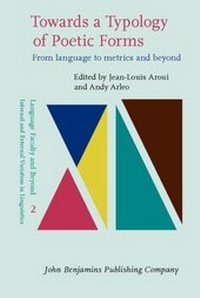
Towards a Typology of Poetic Forms
From language to metrics and beyond
1st Edition
Published on 30. September 2009
XIV, 428 pages
978-90-272-8904-9 (ISBN)
Description

Metrics is often defined as a discipline that concerns itself with the study of meters. In this volume the term is used in a broader sense that more or less coincides with the traditional notion of "versification". Understood this way, metrics is an eminently complex object that displays variation over time and in space, that concerns forms of a great variety and with different statuses (meters, rhymes, stanzas, prescribed forms, syllabification rules, nursery rhymes, slogans, musical textsetting, ablaut reduplication etc.), and that as a cultural manifestation is performed in a variety of ways (sung, chanted, spoken, read) that can have direct consequences on how it is structured. This profusion of forms is thought to correspond, at the level of perception, to a limited number of cognitive mechanisms that allow us to perceive and to represent regularly iterating forms. This volume proposes a relatively coherent overall vision by distinguishing four main families of metrical forms, each clearly independent of the others and amenable to separate typologies.
More details
Other editions
Additional editions
Book
09/2009
John Benjamins Publishing Co
€111.30
Shipment within 10-15 days
Persons
Content
- Towards a Typology of Poetic Forms
- Editorial page
- Title page
- LCC data
- Table of contents
- Contributors
- Acknowledgments
- Introduction
- 1. Introduction
- 2. Metrical typologies
- 3. Isochronous metrics
- 3.1 Properties of isochronous meters
- 3.2 Musical Textsetting
- 4. Prosodic Metrics
- 4.1 Classification
- 4.2 Cæsura, line ending, bridge and alliteration
- 5. Para-metrical phenomena
- 6. Macrostructural metrics
- 6.1. Rhymes
- 6.2 Stanzas
- 6.3 Prescribed forms
- 7. Presentation of the volume
- References
- Part I Isochronous metrics
- Textsetting as constraint conflict
- 1. Introduction
- 2. Halle and Lerdahl's analysis
- 3. Evaluating the syllabic distribution algorithm
- 3.1 Leftward greed
- 3.2 Squeezing the Stressless Syllables
- 3.3 More than four stresses
- 3.4 Consecutive stressed syllables
- 3.5 Altering stress?
- 4. Toward an alternative
- 5. Analysis: Constraints and ranking
- 6. Analysis: Assessment
- 7. Postscript: More metrics needed
- References
- Comparing musical textsetting in French and in English songs
- 1. Preliminaries
- 2. Prominence matching in English
- 3. Prominence matching in French
- 4. Positional parallelism in strophic songs
- 5. Conclusions
- References
- Bavarian Zwiefache
- 1. Introduction
- 2. The interface between rhythm, metrics and song
- 3. Language-based hypothesis about the emergence of Zwiefache
- 4. Preconditions for the language-based hypothesis
- 5. Empirical study
- 5.1 Corpus
- 5.2 Categories for quantifying the linguistic foundation of Zwiefache
- 5.3 Results
- 5.4 Interpretation
- 5.4.1 Rule of Natural Text Setting for the Zwiefache
- 5.4.2 Parallel evidence I: German rap
- 5.4.3 Parallel evidence II: English folk songs
- 5.4.4 Supporting the diachronic argument: Text setting in the older stages of German
- 6. Conclusions
- References
- Natural versification in French and German counting-out rhymes
- 1. Introduction
- 1.1 Claims predicting universals of metrical form
- 1.2 Claims predicting cross-linguistic differences
- 1.3 Some general properties of counting-out rhymes
- 2. French counting-out rhymes
- 2.1 Data
- 2.2 Results
- 2.3 Comparative remarks
- 3. High and low German counting-out rhymes
- 3.1 Data
- 3.2 Results
- 3.2.1 Ternary feet
- 3.2.2 Word-internal stress clash
- 3.2.3 The distribution of nonce words
- 4. Conclusion
- References
- Primary sources
- Further references
- Minimal chronometric forms
- 1. Chronometric and glossometric
- 2. Isochronous notation, metrical instants and strokes
- 2.1 Isochronous notation
- 2.2 Metrical instant and stroke
- 2.3 Durational equivalence and superimposed isochronies
- 3. The strict chronometric minimum: Three vowels?
- 3.1 The 3-stroke group as an a priori metrical minimum
- 3.2 Several metrical 3-stroke groups
- 4. The 2-2-stroke group as a metrical minimum
- 4.1 The 4-stroke group
- 4.2 stroke binary structure
- 5. Regularisation of the interval of the 2-2-stroke group
- 6. Linear combination into open sequences
- 7. Linear combination into a (bounded) group or (indefinite) sequence
- 8. Non-linear combination by development
- 9. Ambivalence and rhythmic switch-over
- 10. Development of rhyme
- References
- Symmetry and children's poetry in sign languages
- 1. Introduction
- 2. Symmetry in poetry: A review of the literature
- 2.1 Children's oral folklore
- 2.2 Signed poetry
- 3. Examining children's signed register and its theoretical implications
- 3.1 Children's poetry
- 3.2 The tortoise and the hare fable: An LSQ version
- 3.2.1 Discourse Motif
- 3.2.2 Spatial Motif
- 3.2.3 Rhythmic Motif
- 3.2.4 Mirror effect
- 4. Conclusion and discussion
- References
- Videos
- Part II Prosodic metrics
- Pairs and triplets
- 1. Introduction: Lineation
- 2. English metrical verse: Counting and rhythm
- 3. Lines of different lengths
- 4. Some traditional accounts of English meters
- 5. The simple meters of French verse
- 6. The compound meters of French
- 7. Conclusion
- References
- Generative linguistics and Arabic metrics
- 1. Introduction
- 2. The basi? meter
- 3. Ragaz and the Greek iambic trimeter
- 4. Sari' between ragaz and basi?
- 5. What does an "optimal" Arabic verse-pattern look like?
- List of symbols in Table 22
- References
- On the meter of Middle English alliterative verse
- 1. What sets Middle English alliterative verse apart from other vernacular verse?
- 2. Informal accounts of the "alliterative revival" meter
- 3. Philological issues in reconstructing phonological representations
- 4. The repertoire of patterns
- 5. What makes a b-verse metrical?
- References
- The Russian Auden and the Russianness of Auden
- 1. Introduction
- 2. Background assumptions and Auden's meter
- 3. Why Brodsky ESCHEWS the dol'nik in this case
- 4. Why Brodsky used hexameter
- 5. Conclusion
- References
- Appendix: Brodsky's iambic hexameter
- Towards a universal definition of the caesura
- 1. Introduction
- 2. The caesura in the dactylic hexameter and the iambic trimeter
- 3. The metrical structure of the dactylic hexameter and the iambic trimeter
- 3.1 Positions and subpositions
- 3.2 The foot: Resolution and contraction
- 3.3 Metrical trees
- 4. The contour contrasts of the dactylic hexameter and the iambic trimeter
- 4.1 Contour contrasts between the clausula and the expansion
- 4.2 Contour contrasts between metron 1 and metron 2
- 4.3 Contour contrasts between strong and weak feet
- 4.4 Contour contrasts between strong feet (hexameter) or weak feet (trimeter)
- 4.5 Contour contrasts between strong and weak positions
- 5. The location of the caesura
- 5.1 Synthetical and analytical caesuras
- 5.2 The caesura and the verse design
- References
- Metrical alignment
- 1. Introduction
- 2. European decasyllables
- 2.1 The English iambic pentameter
- 2.2 The Italian endecasillabo
- 2.3 The French décasyllabe
- 3. Alignment in grammar
- 4. Metrical "exceptions"
- 4.1 Inversion
- 4.2 Extrametricality
- 5. Conclusion
- Principal references
- Rephrasing line-end restrictions
- 1. Introduction
- 2. A contradiction in standard analyses
- 3. The role of intonational primitives
- 4. Unstressed disyllables and the preference for paroxytonic lines
- 5. Some general considerations
- References
- Part III Para-metrical phenomena
- Pif paf poof
- 1. Introduction
- 2. Why counting-out rhymes?
- 3. The corpus and methodological issues
- 3.1 Construction of the corpus
- 3.2 The identification of AR sequences
- 3.3 Nonsense syllables
- 3.4 The database
- 4. Findings
- 4.1 Frequency of AR sequences in counting-out rhymes
- 4.2 Vowel contrasts
- 4.2.1 Overall frequencies by segment
- 4.2.2 Vowel contrasts in binary sequences
- 4.2.3 Vowel contrasts in ternary sequences
- 4.3 Discussion
- 5. Reduplication and rhythm
- 6. Conclusion
- References
- Primary sources
- Further references
- Appendix: Counting-rhyme corpus
- Indo-European (322/1824)
- Non-Indo-European (24/60)
- The phonology of elision and metrical figures in Italian versification
- 1. Introduction
- 2. Elision in Italian phonology
- 3. Examination of the corpus
- 4. Conclusions
- References
- Part IV Macrostructural metrics
- Convention and parody in the rhyming of Tristan Corbière
- 1. Les amours jaunes
- 1.1 Floating consonants other than s, x, z
- 1.2 The floating consonants s, x, z
- 2. The marginalia
- 3. Conclusion
- References
- The metrics of Sephardic song
- References
- A rule of metrical uniformity in old Hungarian poetry
- Terminological clarification
- The Iso-rule
- The Iso-rule at the syllable count level
- The Iso-rule at the rhyme level
- The Iso-rule at the stanza level
- A regional level Iso-rule?
- Another principle of composition: The "magyaresque"
- A musical parallel: The music of recruits or "verbunkos"
- Summary
- References
- Metrical structure of the European sonnet
- 1. Preliminaries
- 2. Italian sonnet (abba, abba, cde, cde) and French sonnet (abba, abba, ccd, eed)
- 2.1 Octave and Sestet
- 2.2 Hierarchical form and structural form
- 2.3 Justification of levels
- 2.3.1 Octave and Sestet
- 2.3.2 Quatrains vs. Tercets
- 2.3.3 Tercets vs. Modules
- 2.3.4 Main Rhymes vs. Secondary Rhymes
- 2.3.5 Unmarked Rhymes level
- 2.4 A few words on the French form
- 3. Italian sonnet (abba, abba, cdc, dcd) and French sonnet (abba, abba, ccd, ede)
- 3.1 Italian sonnet (abba, abba, cdc, dcd)
- 3.2 French sonnet (abba, abba, ccd, ede)
- 4. English sonnet
- 4.1 Shakespearian sonnet
- 4.2 Spenserian sonnet
- References
- Persons
- Languages
- Subjects
- The Language Faculty and Beyond series
