

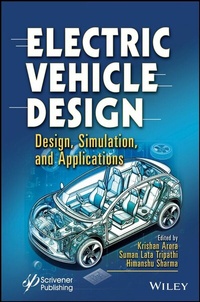
Electric Vehicle Design
Description

This book will serve as a definitive guide to conceptual and practical knowledge about the design of hybrid electrical vehicles (HEV), battery electrical vehicles (BEV), fuel cell electrical vehicles (FCEV), plug-in hybrid electrical vehicles (PHEV), and efficient EV charging techniques with advanced tools and methodologies for students, engineers, and academics alike.
This book deals with novel concepts related to fundamentals, design, and applications of conventional automobiles with internal combustion engines (ICEs), electric vehicles (EVs), hybrid electric vehicles (HEVs), and fuel cell vehicles (FCVs). It broadly covers vehicle performance, configuration, control strategy, design methodology, modeling, and simulation for different conventional and hybrid vehicles based on mathematical equations.
Fundamental and practical examples of conventional electrical machines, advanced electrical machines, battery energy sources, on-board charging and off-board charging techniques, and optimization methods are presented here. This book can be useful for students, researchers, and practitioners interested in different problems and challenges associated with electric vehicles.
Furthermore, in explaining the design methodology of each drive train, design examples are presented with simulation results.
More details
Other editions
Additional editions
Persons
Krishan Arora, PhD, is associated with Lovely Professional University as an associate professor with more than thirteen years of experience in academics. He has been the head of the department of power systems in the School of Electronics and Electrical Engineering, Lovely Professional University since February 2017. He has published more than 55 research papers and organized several workshops, summer internships, and expert lectures for students.
Suman Lata Tripathi, PhD, is working as a professor at Lovely Professional University with more than 20 years of experience in academics. She has also been a remote post-doc researcher at Nottingham Trent University, London, UK since 2022. She has published more than 74 research papers and has also published 13 Indian patents and two copyrights. She has edited and authored more than 17 books in different areas of electronics and electrical engineering.
Himanshu Sharma, PhD, is associated with Lovely Professional University as an assistant professor with more than four years of experience in academics. He has published more than ten research papers and organized several workshops, summer internships, and expert lectures for students. He has supervised five postgraduate thesis and more than 15 undergraduate student projects.
Content
Preface xv
1 Development of Braking Systems in Fuel Cell Electric Vehicles 1
Harpreet Singh Bedi, Shakti Raj Chopra and Krishan Arora
1.1 Introduction 1
1.2 Historical Background of Fuel Cell 2
1.3 ADVISOR 3
1.4 Why Hydrogen is Preferred 4
1.5 What is a Fuel Cell? 4
1.6 Working of Fuel Cells 4
1.7 Types of Fuel Cells 5
1.8 Block Diagram of Vehicle on MATLAB/Simulink 8
1.9 Braking System in Vehicle 8
1.10 Regenerative Braking System 9
1.11 Anti-Lock Braking System (ABS) 10
1.12 Conclusion 15
2 Design and Applications of Fuel Cells 19
Pradeep Singh, Krishan Arora and Umesh C. Rathore
2.1 Introduction 20
2.2 Types of Electric Vehicles 21
2.3 Design Equations of Fuel Cells 25
2.4 Designing of Fuel Cells 29
2.5 Types of Fuel Cells 30
2.6 Solid Oxide FCs (SOFCs) 31
2.7 Alkaline Fuel Cells (AFCs) 35
2.8 Molten Carbonate Fuel Cell (MCFC) 39
2.9 Phosphoric Acid Fuel Cells (PAFCs) 43
2.10 Polymer Electrolyte Membrane Fuel Cell (PEMFC) 46
2.11 Direct Methanol Fuel Cells (DMFCs) 50
2.12 Parameters Affecting the Performance of FCs 54
3 Smart Energy Management and Monitoring System for Electric Vehicles with IoT Integration 57
Challa Krishna Rao, Sarat Kumar Sahoo and Franco Fernando Yanine
3.1 Introduction 58
3.2 The Control of Electric Vehicles Using IoT 59
3.3 IoT Management Issues with Electric Vehicles 61
3.4 Monitoring and Management Benefits of IoT 62
3.5 Predictive Maintenance System with Fault Alerts 64
3.6 IoT Management and Monitoring Issues with Electric Vehicles 65
3.7 Microcontroller 68
3.8 IoT-Based Systems for Battery Management and Monitoring 71
3.9 Design of Battery Charge Control and Monitoring System 71
3.10 Results and Discussion 73
3.11 Conclusions 74
3.12 Future Scope of IoT in Electric Vehicles 75
4 A Review of Electric Vehicles: Technologies and Challenges 81
N. Suthanthira Vanitha, L. Manivannan, K. Radhika, A. Karthikeyan and T. Meenakshi
4.1 Introduction 82
4.2 Electric Motors 82
4.3 Power Electronic Converters 87
4.4 Battery in Electric Vehicles 92
4.5 Conclusion 97
5 Electric Vehicle and Design Using MATLAB 101
Vinay Anand and Himanshu Sharma
5.1 Introduction 102
5.2 Motivation 103
5.3 Basic Fundamentals of EVs 104
5.4 Why Electric Vehicles? 106
5.5 Comparison Between ICV and EV 106
5.6 Classification of EVs 107
5.7 Design and Structure of EV 108
5.8 Mathematical Model of an Electric Vehicle 115
5.9 Control Strategy of EVs 116
5.10 Design Methodology for Electric Vehicles (EVs) 117
5.11 Latest Emerging Technology in EV 118
5.12 Performance Valuation of BLDC Motor and Induction Motor for Electric Vehicle Propulsion Application 119
5.13 Conclusion 125
6 Model Order Reduction of Battery for Smart Battery Management System 129
Dheeraj Kumar Dhaked, Aswant Kumar Sharma, Dhanesh Kumar Sambariya and Dinesh Birla
6.1 Introduction 129
6.2 Problem Formulation 131
6.3 Modeling of Battery 132
6.4 Methodology for Model Order Reduction 134
6.5 Result and Discussion 137
6.6 Conclusion 141
7 Power Electronic Converters for Electric Vehicle Application 147
P. Swati Patro, Sarat Kumar Sahoo and Fernando Yanine
7.1 Introduction 148
7.2 Types of Electrical Vehicle and Role of Power Electronic Converter 151
7.3 Recent Development in Power Electronic Converter 158
7.4 Power Electronic Converters in Electric, Hybrid, and Fuel Cell Vehicles 161
7.5 Challenges in Power Electronic Vehicular System 162
7.6 Conclusion 164
8 Integrating Electric Vehicles Into Smart Grids Through Data Analytics: Challenges and Opportunities 167
Vikram Kulkarni, Sarat Kumar Sahoo, Ketan Shah and Prapita Thanarak
8.1 Introduction 168
8.2 Smart Grid and Electric Vehicle 169
8.3 Impact of Electric Vehicle--Based Data Analytics for Smart Grids 169
8.4 Importance of Resource Availability, Price, and Load for EV 171
8.5 Electric-Tariff Design Based on Impact of Electric Vehicle Usage 173
8.6 Data Analytics for Electric Vehicles 174
8.7 Machine Learning for EV Analytics 176
8.8 What are the Different ML Algorithms Used by Authors for EV Analytics? 177
8.9 Importance of Data Analysis in the EV Industry Using an Open Source Data 178
8.10 Description of the Dataset 179
8.11 Features and Factors That Influence the Prices of EVs 179
8.12 Price Prediction of EVs 180
8.13 Random Forest--Based Price Prediction of Electric Vehicles 185
8.14 Machine Learning Model 187
8.15 Electric Vehicle Usage in India 189
8.16 The Challenges of Adopting EV in India 190
8.17 How to Increase Renewable Energy in India to Meet EV Demand 191
9 Hybrid Electrical Vehicle Designs 197
T. Meenakshi, K. Mahendran, N. Suthanthira Vanitha and C. Shanmugam
9.1 Introduction 197
9.2 Plug-In Hybrid Electric Vehicles 198
9.3 Classification of HEVs 199
9.4 Fuel Cell Electric Vehicles (FCEVs) 201
9.5 Hybrid Electric Vehicle System Design and Analysis 203
9.6 Control Strategy in Series Hybrid Drivetrain Configuration 204
9.7 Design of Fuel Cell Electric Vehicles with Fuel Economy 209
9.8 Conclusion 213
10 EV Battery Charging System 215
Balamurugan M., Narendiran S., Sarat Kumar Sahoo and Fernando Yanine
10.1 Introduction 216
10.2 Electric Vehicle Charging Infrastructure 217
10.3 Power Electronics Converters Used for Charging System 219
10.4 Control Strategies of EV Charging System 221
10.5 Various Modes of Charging System 226
10.6 Real-Time Challenges of EV Charging Infrastructure 227
11 Optimization Algorithms and Computing Techniques for Electric Vehicles: Advancements in Computing and Algorithms 235
S. Arun Mozhi, J. Nishanthy, S. Charles Raja and J. Jeslin Drusila Nesamalar
11.1 Introduction 236
11.2 Fundamental Optimization Techniques 238
11.3 Problem Formulation of Optimal Solution 238
11.4 Optimization Techniques 241
11.5 Electric Vehicle 244
11.6 Challenges in EV Implementation 250
11.7 Optimization Techniques for Electric Vehicles 252
11.8 Conclusion 261
12 Economic Load Dispatch Solutions at Small, Medium, and Large Scales Utilizing Chaotic Spotted Hyena Optimization 265
Tanuj Mishra, Amit Kumar Singh and Vikram Kumar Kamboj
12.1 Introduction 266
12.2 Unit Commitment and Economic Dispatch Process 267
12.3 Optimization in Power System 268
12.4 Hybrid Optimization Algorithm 273
12.5 Chaotic Spotted Hyena Optimization Technique 274
12.6 Economic Load Dispatch Problem 276
12.7 Power Balance Equality Constraints 277
12.8 Generator Power Limit Inequality Constraints 278
12.9 Test Systems Results and Discussion 278
12.10 Conclusion 288
13 Simulation of Automatic Search of Charging Station for Electric Bikes 295
Saroja S., Haseena S., Hariharan M. and Raghul Priyadharshan M.
13.1 Introduction 296
13.2 Related Works 298
13.3 Methodology 299
13.4 Load Balancing of Smart Grid 303
13.5 Electric Bike Supply Equipment (EBSE) Algorithm 304
13.6 Simulation 305
13.7 Performance Metrics 307
13.8 Method and Existing Method 308
14 Self-Charging Electrical Vehicle Design and Analysis with MATLAB 313
Ramchandra Sahani, Ishak Jamatia, Manas Daga, Pavan Kumar and Suman Lata Tripathi
14.1 Introduction 313
14.2 Natural Energy Sources for Self-Charging Electrical Vehicles 314
14.2.1 Wind Energy 315
14.3 Arduino-Based Control Systems in Electric Vehicles 323
14.4 MATLAB-Based Simulation and Modeling for Self-Charging Electric Vehicles 325
14.5 Electric Motor Model 327
14.6 Results for Vehicle Performance 329
14.7 Power Electronics Model 330
14.8 Energy Management System 330
14.9 Conclusion 333
References 333
Index 335
1
Development of Braking Systems in Fuel Cell Electric Vehicles
Harpreet Singh Bedi*, Shakti Raj Chopra and Krishan Arora
School of Electronics and Electrical Engineering, LPU, Punjab, India
Abstract
Researchers are developing environmentally friendly, zero-emission cars to address concerns about greenhouse gas emissions. One promising solution is fuel cell vehicles, which use hydrogen as the primary energy source. These vehicles generate electricity by combining hydrogen with oxygen from the air, powering electric motors that drive the wheels. Additionally, they incorporate electric batteries to store excess energy during braking and aid during driving. The paper discusses the implementation of regenerative and anti-lock braking systems and models of vehicle components using MATLAB/Simulink software. The goal is to analyze the vehicle's performance under real working conditions using ADVISOR GUI models and demonstrate the benefits of fuel cell technology and advanced braking systems.
Keywords: Vehicle model, braking systems, advisor
1.1 Introduction
Automotive engineers are concerned that burning fossil fuels in cars will lead to increased air pollution, increased carbon levels in the environment, and global warming. For this reason, engineers adopt electric vehicles. These vehicles are environmentally friendly. Battery electric vehicles are the most common vehicles on the market, but these vehicles require external charging. As a result, they are limited and require charging infrastructure to travel several kilometers. Recognizing these limitations of EVs, engineers introduced the fuel cell electric vehicle (FCEV). In this car, hydrogen was generated for locomotion and charging the onboard battery. Hydrogen is a clean fuel that does not pollute the environment. In a hydrogen society, FCEVs are not just eco-cars. The FCEVs with hydrogen fuel cells require stable performance, robust durability, and powerful performance. Therefore, automakers could test new technologies. Considering that the hydrogen required for fuel cell vehicles can be stored indefinitely and the manufacturing process is environmentally friendly, it will also help boost the growth of related industries such as power, steel, chemicals, and new materials needed for infrastructure. Such drive systems are not only used in urban traffic.
In this paper, we have also discussed the braking system used in this vehicle. The braking system discussed here is a regenerative braking system, which is also known as a kinetic energy recovery system which converts the kinetic energy of a moving object into potential or stored energy during the slowing down of the vehicle, which improves fuel economy. Another type of braking system discussed in this article is the anti-lock braking system (ABS). It is a security system used in ground vehicles such as cars, buses, motorcycles, and trucks. The ABS keeps the clutch in touch with the ground surface and gives a driver greater control of the vehicle, which prevents wheel lockup when braking. It is most impressive when traveling long distances of hundreds of miles. Fuel cell electric vehicles excel even with short refuelling times of just a few minutes. The fuel cell electric drive consists of various components that Bosch introduces into series production through appropriate research and development.
1.2 Historical Background of Fuel Cell
Keeping in mind the need to satisfy the energy requirements of the world, researchers have found an alternative source to fulfill the energy requirements. In the 1800s, English scientist William Nicholson described the process of generating electricity by separating hydrogen from water through the process named electrolysis.
Various researchers have further led to the development of hydrogen fuel cells. The first fuel cell was invented by Sir William Robert Grove in mid-1838 and was used commercially for over a hundred years. Francis Thomas Bacon is the inventor of [1] hydrogen-oxygen in 1932. In 1959, a team led by Harry Gehrig built a 15-kW tractor. Alkaline fuel cells are also known as Bacon fuel cells. It has been one of the most advanced technologies since its invention. This technology was used by NASA on the Apollo space missions in the late 1990s to generate electricity for satellites and spacecraft [1]. In today's terms of fuel cell technology, these gadgets were used as a primary or secondary power source in many facilities, including industrial and commercial centers and dwellings.
1.3 ADVISOR
This paper was written at the National Sustainable Energy Lab, and it refers to one of the US Department of Energy's (DOE) Advanced Vehicle Simulation (ADVISOR) applications built in the MATLAB/Simulink environment. ADVISOR provides the automotive engineering community with easy-to-use, customized, supported, and resilient analysis tools for a wide variety of vehicle models as shown in Figure 1.1 [2]. This tool is primarily used to measure fuel efficiency, vehicle performance, and emissions for vehicles using alternative technologies. This tool is great at calculating the relative change to be expected from technology usage compared to a reference situation [2].
Figure 1.1 Advanced vehicle simulation interface.
1.4 Why Hydrogen is Preferred
Hydrogen is not an energy source, but it is an energy carrier. This means that energy can be stored or it can be released in a working form. As an energy conveyor, hydrogen has several edges. It can be created utilizing a variety of domestic energy sources, including nuclear power, solar energy, wind energy, biomass energy, and fossil fuels like natural gas and coal [3]. We are not reliant on any one energy source or external energy source because of the diversity of our energy sources [4]. Emissions of greenhouse gases are produced when hydrogen is produced using nuclear, renewable, and fossil fuel-based systems that also sequester carbon. All areas of the economy, including transportation, energy, business, and structures, can be powered by hydrogen. But for this, fuel cells are necessary [3].
1.5 What is a Fuel Cell?
A fuel cell is an electrochemical cell that uses two redox reactions to dynamically convert the chemical energy of a fuel (primarily hydrogen) and an oxidant (primarily oxygen) into electricity [3]. Fuel cells differ from most batteries in that they require a constant supply of fuel and oxygen (usually from the air) to sustain the chemical reaction, whereas chemical energy is typically derived from substances already present in the cell in batteries. As long as fuel and oxygen are available, fuel cells can keep producing electricity [3]. Two electrodes-anode and cathode-that are separated by a membrane known as an electrolyte make up the structure of fuel. Researchers are now working to improve the efficiency of fuel cells.
1.6 Working of Fuel Cells
Using fuel cells, the reaction between hydrogen and oxygen may be exploited to produce energy. These cells were utilized for two distinct reasons during the Apollo space program. Both fuel and drinking water were obtained from it (the condensed water vapors generated by the cells is appropriate for human use).
As seen in Figure 1.2, this fuel cell works by transferring hydrogen and oxygen through a carbon electrode into a concentrated sodium hydroxide solution. The reaction of an element can be written as
Figure 1.2 Fuel cell.
1.7 Types of Fuel Cells
Fuel cells are one of the energy sources that could help address the coming energy crisis and power the world of the future. The fuel's chemical energy is converted into electricity through an electrochemical process [4]. They are like batteries in action. However, fuel cells can be refilled when chemical reactants run low. The types of fuel cells are as follows.
1.7.1 Direct Methanol Fuel Cell (DMFC)
Many fuel cells use hydrogen, which may be created from modern high hydrogen fuels like ethanol, methanol, and hydrocarbon fuels, either directly into the fuel cell system or within the fuel cell system. Nevertheless, DMFCs need real methanol, often mixed with water, and delivered directly to the fuel cell anode.
Unlike some fuel cell systems, DMFCs have fewer complications regarding the fuel storehouse because the energy density of methanol is significantly greater than hydrogen. However, it is lower than diesel and gasoline [4]. Because it is a fluid, like gasoline, the transportation and supply of methanol to the people are also simple with the present infrastructure. In general, portable devices such as laptops and mobile phones can use DMFC as their power supply.
1.7.2 Phosphoric Acid Fuel Cell (PAFC)
A proton exchange membrane (PEM) is another name for a phosphoric acid fuel cell (PEMFC). PEMFC operate at relatively low temperatures, around 80°C (176°F). At low temperature, function enables quick start-up (low warm-up time), reducing wear and extending the life of system components. To divide the electrons and protons of hydrogen, however, necessitates the use of precious metal catalysts, mostly platinum, which raises the system's cost and makes a second reactor necessary because platinum catalysts are extremely vulnerable to carbon monoxide poisoning. This is because when hydrocarbon fuels produce hydrogen, the carbon monoxide content of the fuel gas must be reduced. These reactors also require...
