

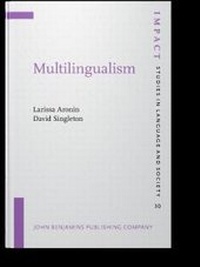
Multilingualism
1st Edition
Published on 8. February 2012
IX, 230 pages
978-90-272-7498-4 (ISBN)
Description

This book is an authoritative account of multilingualism in the present era, a phenomenon affecting a vast number of communities, thousands of languages and millions of language users. The book's focus is specifically on the knowledge and use of multiple languages, but its treatment of the topic is very wide-ranging. It deals with both bilingualism and polyglottism, at the level of the individual speaker as well as at the societal level. The volume addresses not only linguistic facets of multilingualism but also multilingualism's cultural, sociological, educational, and psychological dimensions, moving from classic perspectives to recent and emerging directions of interest. The book's extensive coverage takes in topics ranging from the 'new linguistic dispensation' in our globalized world to child development in multilingual environments, from the classification of multilingual groupings to characteristics of the multilingual mind. This breadth makes Multilingualism an ideal advanced textbook for undergraduate and postgraduate students in the areas of linguistics, education and the social sciences.
More details
Other editions
Additional editions
Larissa Aronin | David Singleton
Multilingualism
Book
02/2012
John Benjamins Publishing Co
€104.94
Shipment within 10-15 days
Persons
Content
- Multilingualism
- Editorial page
- Title page
- LCC Data
- Dedication page
- Table of contents
- Acknowledgments
- Chapter 1. Introduction
- What this book is about
- What is multilingualism? Terminology and definitions
- The structure of the book
- Chapter 2. Multilingualism: Some preliminary considerations
- Human language, communication in other species and multilingualism
- Language as a unique human possession
- Use of the vocal-auditory channel
- Arbitrariness
- Semanticity
- Cultural transmission
- Duality (or double articulation)
- Displacement
- Structure dependence
- Creativity (or open-endedness or productivity)
- Language as a tool and language as ability
- Societal awareness of language and languages
- The 'monolingual stage' of societal awareness in respect of language
- The 'bilingual stage' of societal awareness in respect of language
- The current, 'multilingual beyond bilingual stage' of societal awareness of language
- Chapter 3. Multilingualism as a new linguistic dispensation
- The globalization phenomenon
- Globalization and language use
- Time, space and technology
- Mobility and flux, borders and exclusions
- Recognition of the ubiquity of contemporary multilingualism
- The new linguistic dispensation
- Scale and significance
- 'Historical multilingualism' vs. 'current multilingualism'
- Two trends
- The properties and developmental directions of the new linguistic dispensation
- Suffusiveness
- Complexity
- Liminality
- Developments characterizing the new linguistic dispensation
- Shifts in norms
- New focal issues
- Expansion of affordances
- Ambience of awareness
- Malleability
- Concluding summary
- Chapter 4. The Dominant Language Constellation (DLC)
- What is a Dominant Language Constellation?
- Language repertoire versus DLC
- How many languages constitute a DLC?
- The characteristic features of a DLC
- Theoretical and practical dimensions of deploying the construct of DLC
- Possible DLC-based research directions
- Co-terms
- Concluding summary
- Chapter 5. Multilinguality and personal development
- Introductory
- Individual multilingualism and societal factors
- Terminology and concepts referring to individual aspects of multilingualism
- Multilinguality
- Characteristics of users of a multiplicity of languages
- Models of multilingualism
- Levelt's influence
- Activation/inhibition
- Language mode
- Factors involved in multilingual acquisition
- The dynamic model of multilingualism
- An ecological perspective
- Third language acquisition and tertiary didactics
- Individual differences in multilinguals
- Factors leading to individual differences
- Complexity and diversity with reference to multilingual individuals
- Dominant Language Constellations, individual repertoires and personal life trajectories: Emerging te
- Concluding summary
- Chapter 6. Language development in multilingual conditions
- Language development under bilingual and multilingual conditions
- The contexts of multilingual language development
- Simultaneous and sequential multilingual development and outcomes
- The process of multilingual acquisition
- Separation or integration?
- The advantages/disadvantages of multilinguality
- Concluding summary
- Chapter 7. Classifications of multilinguals, multilingual contexts and languages in multilingual env
- Introductory
- Why typologies?
- Bilingualism and bilinguals
- Classifications and typologies
- Classifications of users
- Classifications of environments
- Classifications in education
- Typologies of multilingual societies
- Typologies of languages
- Concluding summary
- Chapter 8. A multilingual monolith?
- Introductory
- Languages together
- Separatist arguments
- Striking a balance
- Cross-linguistic interaction as blur
- Concluding summary
- Chapter 9. Towards a comprehensive view of multilingualism
- Classic and emerging perspectives
- Conceptualization and re-conceptualization
- Some emerging investigative avenues
- The philosophy of multilingualism
- The material culture of multilingualism
- Affordances in multilingualism
- Complexity thinking and multilingualism
- Concluding summary
- Chapter 10. Concluding thoughts
- Bibliography
- Language index
- Name index
- Subject index
