

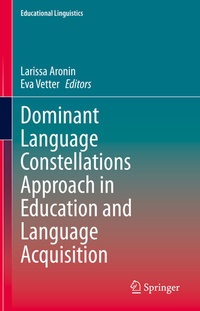
Dominant Language Constellations Approach in Education and Language Acquisition
Description

Larissa Aronin is an Associate Professor at the Oranim Academic College of Education, Israel. She has published in a range of international journals on a wide array of topics connected with multilingualism. She has served two terms as a Board Member of the International Association of Multilingualism and is as an Editorial Board member of a number of peer-reviewed journals. Her most recent co-edited books are Twelve Lectures on Multilingualism (2019, Multilingual Matters) and The Material Culture of Multilingualism (2018, Springer).
Eva Vetter
is a Professor at the University of Vienna, Austria. She has published on multilingualism (linguistic minorities, historical multilingualism, language policy and language teaching and learning. She is particularly interested in equity in education. Her most recent co-edited book is Current International Research on Multilingualism
together with Ulrike Jessner (2019, Springer). She is currently the co-editor of the International Journal of Multilingualism (together with Danuta Gabrys-Barker).
Reviews / Votes
This volume is a strong contribution to the work on dominant language constellations. Comprised primarily of clearly laid out empirical studies which show how the DLC approach can be used and useful for studies in educational linguistics, the volume is satisfying reading for scholars who are new to DLC and those already familiarly with this approach to understanding multilingualism.Rita Elaine Silver, National Institute of Education (NIE), Singapore
Each chapter gives a very strong and insightful glance into individual and societal DLCs and picture of the absolutely overwhelming and alarming predominance of English in the world. The chapters deal with a broad variety of topics, institutions and users/learners, which gives the readers an excellent overview of current, ongoing research. DLC is a new concept alongside languages repertoires which opens up new questions and research areas which we have not seen before. Some of the chapters are very strong in their theoretical description and/or development, while others are very strong in their complex mixtures of methodologies that enable extremely detailed results
Britta Hufeisen, Technische Universität Darmstadt, Germany
More details
Other editions
Additional editions
Persons
Larissa Aronin is an Associate Professor at the Oranim Academic College of Education, Israel. She has published in a range of international journals on a wide array of topics connected with multilingualism. She has served two terms as a Board Member of the International Association of Multilingualism and is as an Editorial Board member of a number of peer-reviewed journals. Her most recent co-edited books are Twelve Lectures on Multilingualism (2019, Multilingual Matters) and The Material Culture of Multilingualism (2018, Springer).
Eva Vetter is a Professor at the University of Vienna, Austria. She has published on multilingualism (linguistic minorities, historical multilingualism, language policy and language teaching and learning. She is particularly interested in equity in education. Her most recent co-edited book is Current International Research on Multilingualism together with Ulrike Jessner (2019, Springer). She is currently the co-editor of the International Journal of Multilingualism (together with Danuta Gabrys-Barker).
