

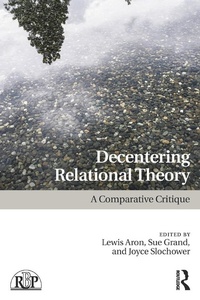
Decentering Relational Theory
A Comparative Critique
1st Edition
Published on 13. June 2018
234 pages
978-1-351-62552-4 (ISBN)
Description

Decentering Relational Theory: A Comparative Critique invites relational theorists to contemplate the influence, overlaps, and relationship between relational theory and other perspectives. Self-critique was the focus of De-Idealizing Relational Theory. Decentering Relational Theory pushes critique in a different direction by explicitly engaging the questions of theoretical and clinical overlap - and lack thereof - with writers from other psychoanalytic orientations. In part, this comparison involves critique, but in part, it does not. It addresses issues of influence, both bidirectional and unidimensional. Our authors took up this challenge in different ways.
Like our authors in De-Idealizing, writers who contributed to Decentering were asked to move beyond their own perspective without stereotyping alternate perspectives. Instead, they seek to expand our understanding of the convergences and divergences between different relational perspectives and those of other theories.
Whether to locate relational thought in a broader theoretical envelope, make links to other theories, address critiques leveled at us, or push relational thinking forward, our contributors thought outside the box. The kinds of comparisons they were asked to make were challenging. We are grateful to them for having taken up this challenge. Decentering Relational Theory: A Comparative Critique will appeal to psychoanalysts and psychoanalytic psychotherapists across the theoretical spectrum.
Like our authors in De-Idealizing, writers who contributed to Decentering were asked to move beyond their own perspective without stereotyping alternate perspectives. Instead, they seek to expand our understanding of the convergences and divergences between different relational perspectives and those of other theories.
Whether to locate relational thought in a broader theoretical envelope, make links to other theories, address critiques leveled at us, or push relational thinking forward, our contributors thought outside the box. The kinds of comparisons they were asked to make were challenging. We are grateful to them for having taken up this challenge. Decentering Relational Theory: A Comparative Critique will appeal to psychoanalysts and psychoanalytic psychotherapists across the theoretical spectrum.
Reviews / Votes
"In Decentering Relational Theory, eminent relationalists converse with other theories. The human condition is complex; healing human suffering often requires multiple perspectives in mutual dialogue. Engaging in this dialogue, these authors ask how the non-relational literature can inform further development of relational theory. These comparisons also illuminate the way Relational theory is linked to its historical roots in non-Relational theory.The essays are excellent in both style and in content. This book should be in the library of anyone interested in psychoanalytic theories and therapies - newcomers and seasoned clinicians alike."-Nancy McWilliams, Ph.D., ABPP, Visiting Full Professor, Rutgers Graduate School of Applied & Professional Psychology "In Decentering Relational Theory, eminent relationalists converse with other theories. The human condition is complex; healing human suffering often requires multiple perspectives in mutual dialogue. Engaging in this dialogue, these authors ask how the non-relational literature can inform further development of relational theory. These comparisons also illuminate the way Relational theory is linked to its historical roots in non-Relational theory.The essays are excellent in both style and in content. This book should be in the library of anyone interested in psychoanalytic theories and therapies - newcomers and seasoned clinicians alike."-Nancy McWilliams, Ph.D., ABPP, Visiting Full Professor, Rutgers Graduate School of Applied & Professional PsychologyMore details
Series
Edition
1. Auflage
Language
English
Place of publication
London
United Kingdom
Publishing group
Taylor & Francis Ltd
Target group
Professional and scholarly
College/higher education
Product notice
Reflowable
ISBN-13
978-1-351-62552-4 (9781351625524)
Copyright in bibliographic data and cover images is held by Nielsen Book Services Limited or by the publishers or by their respective licensors: all rights reserved.
Schweitzer Classification
Other editions
Additional editions
Book
06/2018
1st Edition
Routledge
€57.50
Shipment within 10-20 days
Book
06/2018
1st Edition
Routledge
€187.20
Shipment within 10-20 days
Persons
Lewis Aron, Ph.D., ABPP is the director of the New York University Postdoctoral Program in Psychotherapy and Psychoanalysis. He is the author and editor of numerous articles and books on psychotherapy and psychoanalysis and well known for his study and reading groups around the world. His most recent book, co-authored with Galit Atlas, is the Routledge title Dramatic Dialogue: Contemporary Clinical Practice.
Sue Grand, Ph.D., is faculty at the NYU Postdoctoral Program in Psychotherapy and Psychoanalysis. She is the author of The Reproduction of Evil: A Clinical and Cultural Perspective and The Hero in the Mirror, and has co-edited two books on the trans-generational transmission of trauma. She practices in NYC and in Teaneck, NJ.
Joyce Slochower, Ph.D., ABPP is Professor Emerita at Hunter College and Graduate Center, the City University of New York. She is on the faculty of the New York University Postdoctoral Program, the Steven Mitchell Center, the National Training Program of NIP, the Philadelphia Center for Relational Studies, and the Psychoanalytic Institute of Northern California in San Francisco. She is the author of the Routledge titles Holding and Psychoanalysis and Psychoanalytic Collisions. Second editions of both books were released in 2014. She is in private practice in New York City, where she sees individuals and couples, and runs supervision and study groups.
Sue Grand, Ph.D., is faculty at the NYU Postdoctoral Program in Psychotherapy and Psychoanalysis. She is the author of The Reproduction of Evil: A Clinical and Cultural Perspective and The Hero in the Mirror, and has co-edited two books on the trans-generational transmission of trauma. She practices in NYC and in Teaneck, NJ.
Joyce Slochower, Ph.D., ABPP is Professor Emerita at Hunter College and Graduate Center, the City University of New York. She is on the faculty of the New York University Postdoctoral Program, the Steven Mitchell Center, the National Training Program of NIP, the Philadelphia Center for Relational Studies, and the Psychoanalytic Institute of Northern California in San Francisco. She is the author of the Routledge titles Holding and Psychoanalysis and Psychoanalytic Collisions. Second editions of both books were released in 2014. She is in private practice in New York City, where she sees individuals and couples, and runs supervision and study groups.
Content
Introduction Lewis Aron, Sue Grand, and Joyce Slochower 1. Trauma as radical inquiry Sue Grand 2. Otherness within psychoanalysis: On recognizing the critics of relational psychoanalysis Donnel B. Stern 3. Reflections and directions: An interview of Jessica Benjamin by Sue Grand Jessica Benjamin and Sue Grand 4. Toward a more fully integrative and contextual relational paradigm Paul Wachtel 5. The pathologizing tilt: Undertones of the death instinct in relational trauma theory Sophia Richman 6. The injurious impact of failed witnessing: Reflections on Richman's "pathologizing tilt" Sam Gerson 7. Don't throw out the baby! External and internal, attachment and sexuality Galit Atlas 8. Multiplicity and integrity: Does an anti-developmental tilt still exist in relational psychoanalysis? Donna M. Orange 9. Reflections on relational psychoanalysis: A work in progress Anthony Bass & Adrienne Harris 10. Beyond Tolerance in Psychoanalytic Communities: Reflexive Skepticism & Critical Pluralism Lewis Aron
