

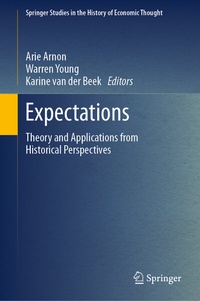
Expectations
Description

This book provides a unique historical perspective on expectations in economic theory, and applications of expectations models in economic history. Based on papers presented at the 2017 Thomas Guggenheim Conference, it brings together the work of economists, historians of economics, and economic historians on issues and events concerning expectations in economics and economic history. The contributions address: (i) the history of expectations models; (ii) growth, expectations and political economy; (iii) controversies regarding expectations methods and models; (iv) expectations in theory and reality; and (v) expectations in economic history.
The book opens with a lecture by Thomas Guggenheim Prize winner Duncan Foley on the evolution of expectations in modern economic thought. The remaining content is divided into two parts, the first of which focuses on the utilization of expectations in the "ancient" and "meso" periods of high theory, i.e., from Smithian to Keynesian approaches. The papers cover topics such as "modern" applications of expectations in both "Tobinesque-Phillips" and "Harrodian-Solowian" contexts, and the debate between Friedmanite and Keynesian approaches to expectation formation. In turn, the last part presents essays on the role of economic expectations in connection with historical events and contexts, ranging from the early 20th century to World War II, and on the application of expectations theory to hyperinflation and stabilization, taking Israel as a case study.More details
Other editions
Additional editions
Persons
Warren Young is a Professor Emeritus, Dept. of Economics, Bar-Ilan University, Israel. His academic work focuses on the history of modern economics, and energy economics. His publications include Interpreting Mr Keynes (1987); Harrod and his Trade Cycle Group (1989); Oxford Economics and Oxford Economists (1993, with F. Lee); Atomic Energy Costing (1998); Economics, Economists, and Expectations (2004, with R. Leeson and W. Darity); Real Business Cycles in Economics (2014), and a survey series on the history of growth theory for Macroeconomic Dynamics (with S. Spear). He has edited IS-LM and Modern Macroeconomics (Springer, 2000, with B. Zilberfarb), and two conference volumes (with A. Arnon) for Springer. He has been a Visiting Professor at Victoria University of Wellington, Deakin University, Carnegie-Mellon University, and ArizonaState University. He was a consultant to the Archives Project, Federal Reserve Bank of Minneapolis.
Arie Arnon
is a Professor Emeritus, Dept. of Economics, Ben-Gurion University, Israel. His academic work focuses on macroeconomics, monetary theory and policy, and history of economic thought. His publications include
Thomas Tooke: Pioneer of Monetary Theory
(1991), and
Monetary Theory and Policy from Hume and Smith to Wicksell: Money, Credit and the Economy
(2011). He has edited two conference volumes with W.Young:
The Open Economy Macromodel
(Springer, 2002); and
Perspectives on Keynesian Economics
(Springer, 2011; co-editor with W. Young and J. Weinblatt). He has been a Visiting Professor at Stanford, the University of California Berkeley, SOAS (London) and the University of Pennsylvania. He was a Senior Economist at the Research Department of the Bank of Israel and a consultant to the WorldBank.
Karine van der Beek
is a senior lecturer at the department of economics at Ben-Gurion University of the Negev and a research affiliate at the Centre of Economic Policy Research (CEPR). She specializes in European economic history and long-run economic growth with a specific interest in political institutions, human capital and technological change. Her publications include: The Effects of Political Fragmentation on Investments": A case Study of Watermill Construction in Medieval Ponthieu, France (2010); Political Fragmentation, Competition and Investment Decisions: The Medieval Grinding Industry in Ponthieu, France: 1150-1250 (2010); Market Forces Shaping Human Capital in Eighteenth Century London (2015); Skill Choice and Skill Complementarity in Eighteenth Century England (2016); and Flexible Supply of Apprenticeship in the British Industrial Revolution (2017). Karine's current research examines the persistent relationship between watermills, millwrights and industrialization in eighteenth century England.
