

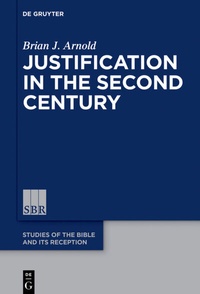
Justification in the Second Century
Description

This book seeks to answer the following question: how did the doctrine of justification fare one hundred years after Paul's death ( c . AD 165)? This book argues that Paul's view of justification by faith is present in the second century, a thesis that particularly challenges T. F. Torrance's long-held notion that the Apostolic Fathers abandoned this doctrine ( The Doctrine of Grace in the Apostolic Fathers , 1948). In the wake of Torrance's work there has been a general consensus that the early fathers advocated works righteousness in opposition to Paul's belief that an individual is justified before God by faith alone, but second-century writings do not support this claim. Each author examined-Clement of Rome, Ignatius of Antioch, Epistle to Diognetus , Odes of Solomon , and Justin Martyr-contends that faith is the only necessary prerequisite for justification, even if they do indicate the importance of virtuous living.
This is the first major study on the doctrine of justification in the second century, thus filling a large lacuna in scholarship. With the copious amounts of research being conducted on justification, it is alarming that no work has been done on how the first interpreters of Paul received one of his trademark doctrines. It is assumed, wrongly, that the fathers were either uninterested in the doctrine or that they misunderstood the Apostle. Neither of these is the case. This book is timely in that it enters the fray of the justification debate from a neglected vantage point.
More details
Other editions
Additional editions
Person
Brian J. Arnold , Phoenix Seminary, Phoenix, AZ, U.S.A.
Content
- Intro
- Acknowledgements
- Contents
- List of Abbreviations
- 1. Introduction
- 1.1 Paul and the Second Century
- 1.2 Torrance and the Doctrine of Grace
- 1.3 Justification in the Fathers
- 2. "But Through Faith": Clement of Rome
- 2.1 The Background
- Authorship
- Date
- 2.2 Summary of 1 Clement
- 2.3 Translation and Commentary
- anslation of 32.3-4
- 2.4 Objections and Responses
- 2.5 Conclusion
- 3. "Faith and Love": Ignatius of Antioch
- 3.1 Background
- Manuscripts
- Antioch
- 3.2 The Negative: What Justification is not
- Ignatius's Opponents
- "We Love the Prophets"
- "Parting of the Ways"?
- Jewish Practices
- Ignatius, Paul, and Judaism
- 3.3 The Positive: Justification in Ignatius
- Faith and Love
- The Gospel
- Justification
- Excursus: Prayer and Justification
- Ignatius and Paul?
- 3.4 Martyrdom
- 3.5 Conclusion
- 4 "O Sweet Exchange!": Epistle to Diognetus
- 4.1 Background
- Genre
- Authorship
- Date
- 4.2 The Text: Summary, Translation, Commentary
- Summary
- Translation
- Commentary
- 4.3 Theological Considerations: Atonement and Justification
- Atonement
- Justification
- 4.4 Conclusion
- 5. "My Chains Were Cut Off": Odes of Solomon
- 5.1 Background
- Manuscripts and Languages
- Authorship and Influences
- Dating and Provenance
- 5.2 The Text
- 5.3 Justification in the Odes
- Ode 17
- Ode 25
- Ode 29
- 5.4 Conclusion
- 6. "???a??p?a??a? ????? ": Dialogue with Trypho
- 6.1 Justin and Paul
- 6.2 Rhetorical Device or Genuine Interlocutor?
- 6.3 Structure of the Dialogue
- 6.4 Exegesis of Selected Passages
- Dialogue 8
- Dialogue 10
- Dialogue 23 and 92
- Dialogue 137
- 6.5 Conclusion
- 7 Conclusion
- Bibliography
- General Works
- Books
- Articles
- Dissertations
- 1 Clement
- Books
- Articles
- Theses
- Ignatius of Antioch
- Books
- Articles
- Epistle to Diognetus
- Books
- Articles
- Odes of Solomon
- Books
- Articles
- Dissertations
- Dialogue with Trypho
- Books
- Articles
- Dissertations
- Index of Authors
- Index of Scripture References
- Index of Ancient Sources
- Topical Index
