

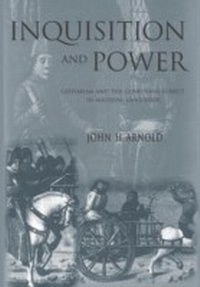
Inquisition and Power
Catharism and the Confessing Subject in Medieval Languedoc
1st Edition
Published on 20. July 2013
328 pages
978-0-8122-0116-1 (ISBN)
Description

What should historians do with the words of the dead? Inquisition and Power reformulates the historiography of heresy and the inquisition by focusing on depositions taken from the Cathars, a religious sect that opposed the Catholic church and took root in southern France during the twelfth century. Despite the fact that these depositions were spoken in the vernacular, but recorded in Latin in the third person and rewritten in the past tense, historians have often taken these accounts as verbatim transcriptions of personal testimony. This belief has prompted some historians, including E. Le Roy Ladurie, to go so far as to retranslate the testimonies into the first-person. These testimonies have been a long source of controversy for historians and scholars of the Middle Ages.
Arnold enters current theoretical debates about subjectivity and the nature of power to develop reading strategies that will permit a more nuanced reinterpretation of these documents of interrogation. Rather than seeking to recover the true voice of the Cathars from behind the inquisitor's framework, this book shows how the historian is better served by analyzing texts as sites of competing discourses that construct and position a variety of subjectivities. In this critically informed history, Arnold suggests that what we do with the voices of history in fact has as much to do with ourselves as with those we seek to 'rescue' from the silences of past.
Arnold enters current theoretical debates about subjectivity and the nature of power to develop reading strategies that will permit a more nuanced reinterpretation of these documents of interrogation. Rather than seeking to recover the true voice of the Cathars from behind the inquisitor's framework, this book shows how the historian is better served by analyzing texts as sites of competing discourses that construct and position a variety of subjectivities. In this critically informed history, Arnold suggests that what we do with the voices of history in fact has as much to do with ourselves as with those we seek to 'rescue' from the silences of past.
Reviews / Votes
"The lasting importance of Arnold's book is that . . . it will provoke scholars to rethink what they thought they knew about heresy, confession, and the inquisition in the Middle Ages." (Speculum) "Intelligent and demanding. . . . The persevering reader will be amply rewarded by many insights into the nature of the Inquisition, Catharism, and elitist construction of confession, conformity, and subjectivity." (Religious Studies Review) "Arnold has written an innovative, challenging, and stimulating book." (James Given, University of California, Irvine) "Arnold has contributed to raising important questions of methodology, enriching a recently rediscovered debate on the reliability of sources about the repression of heresy in the late Middle Ages." (Journal of Ecclesiastical History)More details
Series
Language
English
Place of publication
Pennsylvania
United States
Target group
College/higher education
File size
0,71 MB
ISBN-13
978-0-8122-0116-1 (9780812201161)
Copyright in bibliographic data and cover images is held by Nielsen Book Services Limited or by the publishers or by their respective licensors: all rights reserved.
Schweitzer Classification
Other editions
Additional editions
Book
08/2001
University of Pennsylvania Press
€79.00
Shipment within 10-20 days
Person
John H. Arnold is Lecturer in History at the University of East Anglia.
Content
- Cover
- Title
- Copyright
- Contents
- Note on Texts and Translations
- Introduction
- PART I
- 1 The Lump and the Leaven: The Move to Inquisition
- 2 To Correct the Guilty Life: Representation and Knowledge
- 3 The Construction of the Confessing Subject
- PART II
- 4 Questions of Belief: Catharism and Its Contexts
- 5 Sex, Lies, and Telling Stories: A Critical and Effective History
- Conclusion
- Abbreviations
- Notes
- Bibliography
- Index
- Acknowledgments
